Best File Manager App for iPhone: Files, AltTunes, Documents, and Real Transfer Fixes

Looking for the best file manager app for iPhone usually means one of 3 things.
You cannot find a download. You need to move files between your iPhone and a PC. Or you want a better way to handle PDFs, ZIP files, videos, cloud drives, or NAS folders without wrestling with Apple's idea of "simple."
The short answer:
No single iPhone file manager wins every job. iOS still limits full file-system access, and that is by design. The right app depends on what you are trying to move, where the file lives, and whether your real problem is file browsing or file transfer.
- Use Apple Files for basic downloads, iCloud Drive, local folders, external drives, and third-party cloud apps.
- Use Documents by Readdle, FileBrowser, Owlfiles, or FE File Explorer if you need stronger on-device file tools.
- Use a desktop iPhone manager when you need iPhone-to-PC transfer, local backups, photos, music, messages, or media libraries.
- Use AltTunes if you are on Windows and want to browse, back up, export, and move iPhone data without iTunes.
- Use WALTR PRO if you want to drag music, videos, PDFs, books, or other files from Mac or Windows to your iPhone without syncing.
Before we begin
Windows users should download AltTunes to browse an iPhone from a PC and export photos, music, messages, contacts, and files without iTunes. Connect the iPhone with a data-capable cable and approve the Trust prompt before opening the device library.
Best file manager app for iPhone by use case
Use case | Best fit | Why it works | Main limit |
|---|---|---|---|
Find downloads, browse iCloud Drive, open local files | Apple Files | Built into iPhone and iPad, supports On My iPhone, iCloud Drive, connected storage, and added cloud apps | Limited power tools and not a full file-system browser |
Manage PDFs, ZIP files, downloads, media, and cloud files on iPhone | Documents by Readdle | Strong all-in-one iOS file manager for documents, media, browser downloads, and cloud storage | Still works inside iOS app access rules |
Access NAS, SMB, FTP/SFTP, WebDAV, or network shares | FileBrowser, Owlfiles, or FE File Explorer | Built for network storage and power-user file access | More setup, more permissions, more ways to misconfigure private access |
Transfer files from iPhone to PC without iTunes | AltTunes | Windows desktop access to iPhone files, photos, messages, music, backups, contacts, and more | Windows-only |
Transfer files from PC or Mac to iPhone | WALTR PRO | Drag-and-drop transfer for music, videos, PDFs, books, subtitles, and other files into Apple-friendly apps | Best for sending files to iPhone, not browsing every app sandbox |
Manage photos across cloud drives | Apple Files plus cloud apps | Dropbox, Google Drive, OneDrive, Box, and similar apps can appear inside Files | Photos from your camera roll still live in Photos, not Files |
Replace iTunes for backup and local exports | AltTunes or iMazing-style tools | Desktop tools handle local exports, backups, messages, contacts, and device data better than Files | Paid desktop apps, usually more than basic users need |
If you only need to find a PDF you downloaded from Safari, start with Files. If you need to export 2,000 photos to a Windows laptop, Files is the wrong battlefield. Use a desktop tool and save yourself the clicking.
How to use the iPhone Files app
Apple Files is the default iPhone file manager. It handles the basics well once you know where Apple hides things. Apple also keeps a short support page on finding files, folders, and downloads on iPhone if you want the official version.
Use Files when you need to:
- Open files saved locally under On My iPhone or On My iPad.
- Browse iCloud Drive folders.
- Find Safari downloads.
- Open documents stored in apps that expose folders to Files.
- Browse third-party cloud apps you have added, such as Dropbox, Google Drive, OneDrive, or Box.
- Open files from a connected USB drive or SD card reader.
- Search, sort, tag, rename, move, duplicate, compress, or share files.
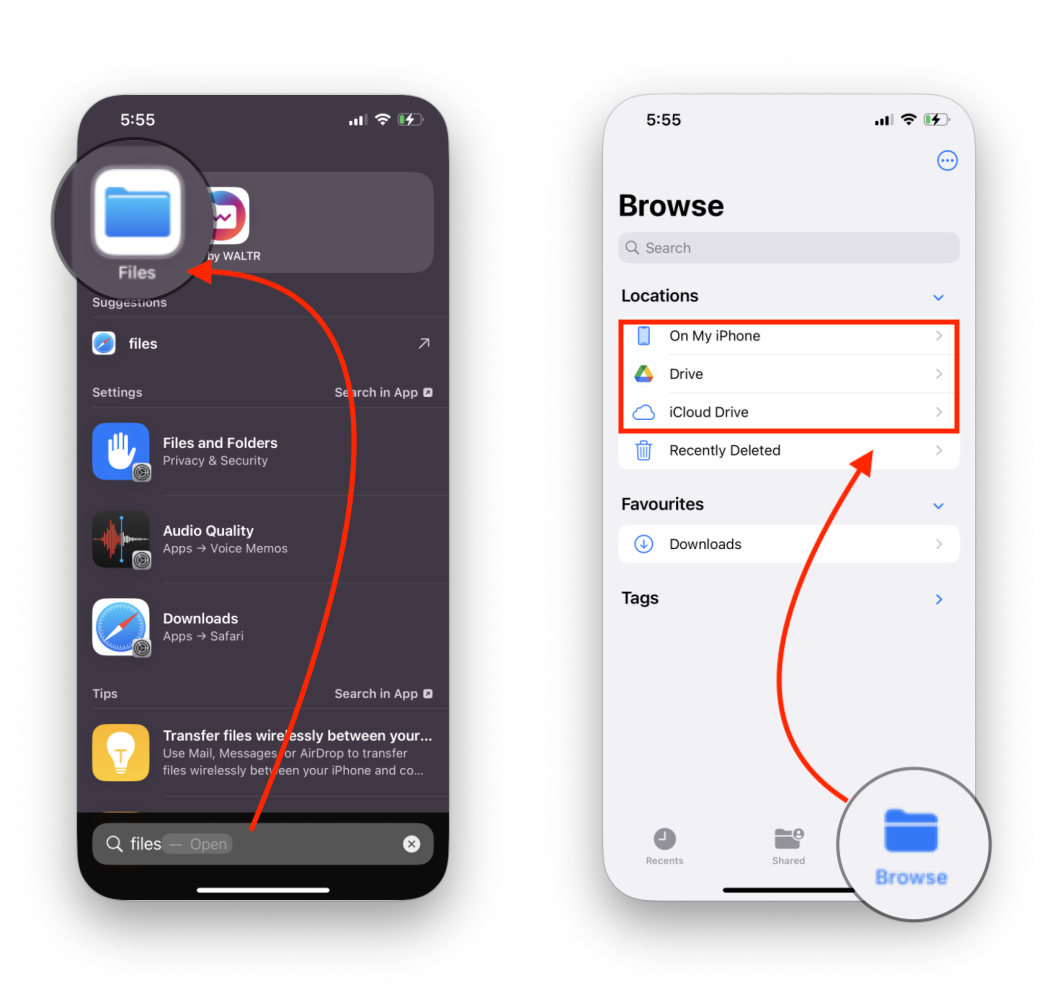
1. Open the Files app
- Find the Files app on your Home Screen, or swipe down and search for Files.
- Tap Browse at the bottom.
- Choose a location such as On My iPhone, iCloud Drive, Downloads, a cloud app, or a connected storage device.
2. Where are your files stored?
Files can show several storage locations:
- On My iPhone: files saved locally on your device.
- iCloud Drive: files synced across devices through your Apple Account.
- Downloads: the common Safari download location, often inside iCloud Drive.
- Third-party cloud apps: Dropbox, Google Drive, OneDrive, Box, and similar services after you add them to Files.
- Connected storage: USB drives and SD card readers that iOS recognizes.
3. Find downloaded files on iPhone
Most downloads end up in the Downloads folder. Try this first:
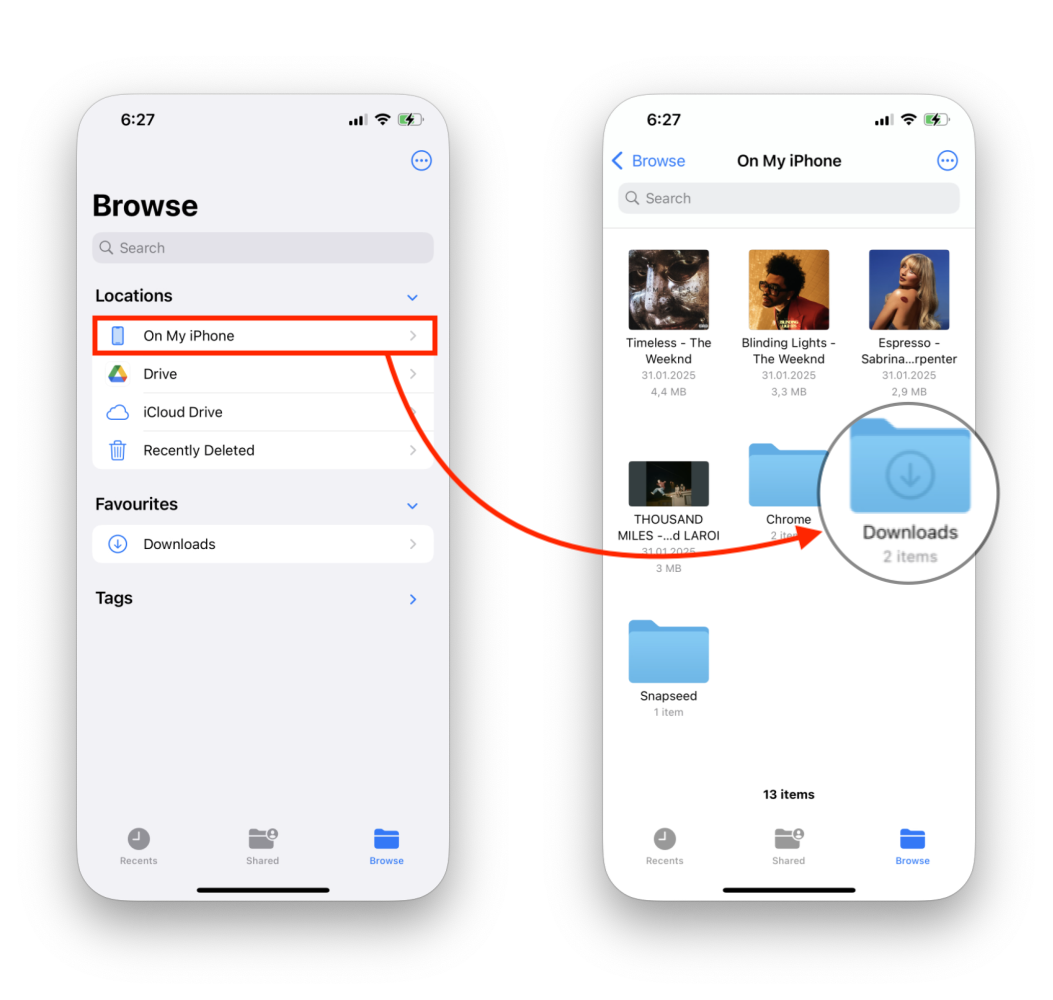
If the file is not there, check On My iPhone > Downloads. Some apps save locally instead of using iCloud Drive.
- Open Files.
- Tap Browse.
- Open iCloud Drive.
- Open Downloads.
- Use the search field if you know part of the file name.
4. File management tips inside Files
Files can handle more than opening PDFs. These basics cover most everyday jobs:
One important caveat: photos and videos from your camera roll live in the Photos app. If you cannot find a photo in Files, check Photos first. Apple treats the photo library as a separate world because of course it does.
- Press and hold a file to rename, move, duplicate, compress, delete, tag, or share it.
- Tap the 3-dot menu to create a new folder, change sorting, or select multiple files.
- Use tags for files you need often across different folders.
- Add cloud services through their apps, then enable them inside Files.
- Save private files locally if you do not want them synced to a third-party cloud account.
Why the Files app is not enough for every job
The iPhone Files app is good for basic file browsing. It is not a complete iPhone file manager, and it cannot expose the full iOS file system like Finder on Mac or File Explorer on Windows.
The main limits:
That does not make Files bad. It means Files is the baseline, not the whole answer.
If you want to manage files on iPhone, first name the job:
- You cannot freely browse every app's private storage.
- App folders only appear when that app exposes documents to Files.
- Bulk transfer to Windows can feel clumsy.
- Network storage support depends on your setup and app needs.
- PDF, ZIP, media, and download workflows are basic compared with specialist apps.
- Large photo and video exports are better handled from a computer.
- iCloud adds another layer of confusion if files are online-only or syncing slowly.
- Finding and opening a downloaded file? Use Files.
- Editing PDFs, unzipping archives, and managing downloads? Try Documents by Readdle or a similar iOS file manager.
- Connecting to SMB, NAS, FTP/SFTP, or WebDAV? Use FileBrowser, Owlfiles, or FE File Explorer.
- Exporting iPhone files, photos, music, messages, contacts, or backups to Windows? Use AltTunes.
- Sending videos, music, PDFs, books, or subtitles from a computer to iPhone? Use WALTR PRO.
Best iPhone file manager apps compared
Apple Files: best free option for basics
Apple Files is free, already installed, and safe for basic use. It is the first place to check for downloads, iCloud files, local folders, external storage, and supported third-party cloud apps.
Use it for everyday file browsing. Do not expect it to act like a full desktop file explorer.
Best for:
Skip it when:
- Safari downloads
- iCloud Drive
- Local files
- Added cloud drives
- Simple folders, tags, search, rename, move, compress, and share actions
- You need strong PDF tools.
- You need a browser download manager.
- You need NAS/SMB/FTP workflows.
- You need to export lots of iPhone data to a Windows PC.
Documents by Readdle: best on-device iPhone file manager for most power users
Documents by Readdle fits users who want more than Apple Files but still want to work on the iPhone itself. It is common in roundups because it combines document browsing, PDF tools, media playback, ZIP handling, downloads, cloud storage, and local organization.
Best for:
It is not a magic key to every iPhone app's private files. iOS still controls what each app can expose.
- PDFs
- ZIP files
- Media playback
- Browser downloads
- Cloud storage
- Local folders inside the app
FileBrowser, Owlfiles, and FE File Explorer: best for NAS, SMB, FTP, and network storage
If your files live on a NAS, office server, SMB share, SFTP folder, or WebDAV endpoint, use an app made for network storage. FileBrowser-style apps focus on this job.
Best for:
This is power-user territory. Use secure connections when possible, avoid public Wi-Fi for private files, and do not give random apps full cloud access because a listicle told you to.
- NAS folders
- SMB shares
- FTP/SFTP
- WebDAV
- Network file browsing
- Moving folders between remote and local storage
AltTunes: best iPhone file manager for Windows transfer and local exports
AltTunes is not an on-device iOS app. It is a Windows desktop iPhone manager for people who want local control from a PC.
That distinction matters. AltTunes is the better fit when your job is not "browse a PDF on my iPhone." It is for jobs like:
If you searched for "transfer files from iPhone to PC," this is the path to look at first. Apple's tools can do parts of the job, but Windows users often get the roughest version of Apple's ecosystem.
- Transfer files from iPhone to PC.
- Browse iPhone files and file system data from Windows.
- Export photos and videos to a PC or external drive.
- Export music, messages, contacts, call history, voice memos, books, notes, and other iPhone data.
- Back up an iPhone locally to a chosen storage location.
- Convert HEIC photos to JPEG during export.
- Keep iPhone data off iCloud when you prefer local storage.
How to transfer files from iPhone to Windows without iTunes
Windows users usually do not need another iPhone file manager app on the phone. They need a cleaner bridge between iPhone and PC.
With AltTunes, you manage iPhone data from Windows through a desktop app instead of poking around iCloud, File Sharing, Photos import, or iTunes.
1. Download and install AltTunes
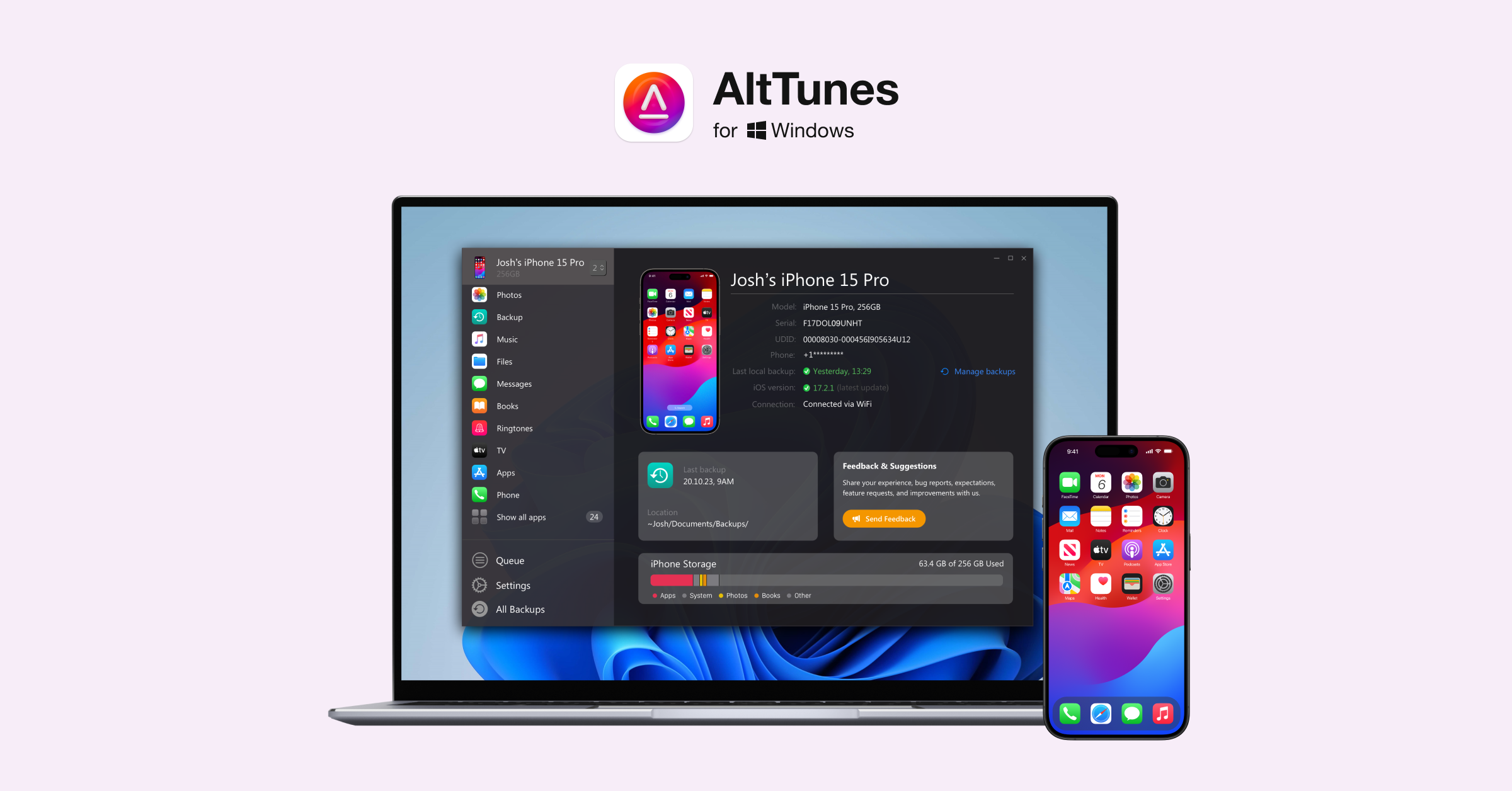
Install AltTunes for Windows. AltTunes works on Windows 10 and Windows 11 and is built for iPhone/iPad data management from a PC.
You can download AltTunes and try it during the free trial period.
2. Connect your iPhone to your PC
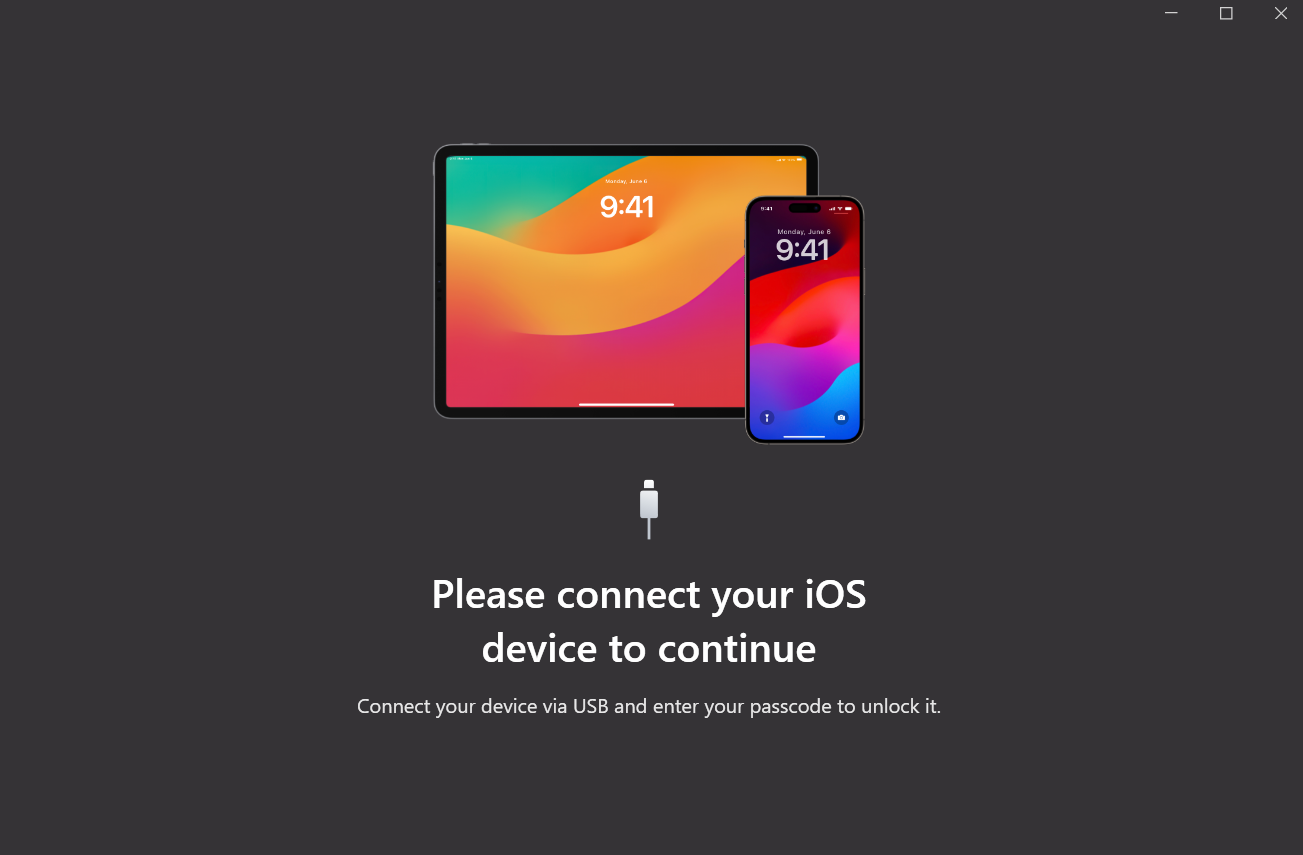
Connect your iPhone with a USB cable. On the first connection, unlock the iPhone and tap Trust This Computer when iOS asks.
Once the device is paired, AltTunes can show iPhone categories from the Windows app. Use cable for the first setup and for large transfers. Wi-Fi workflows can be convenient, but cable is still the sane choice for huge photo libraries, videos, and backups.
3. Choose the data you want to export or manage
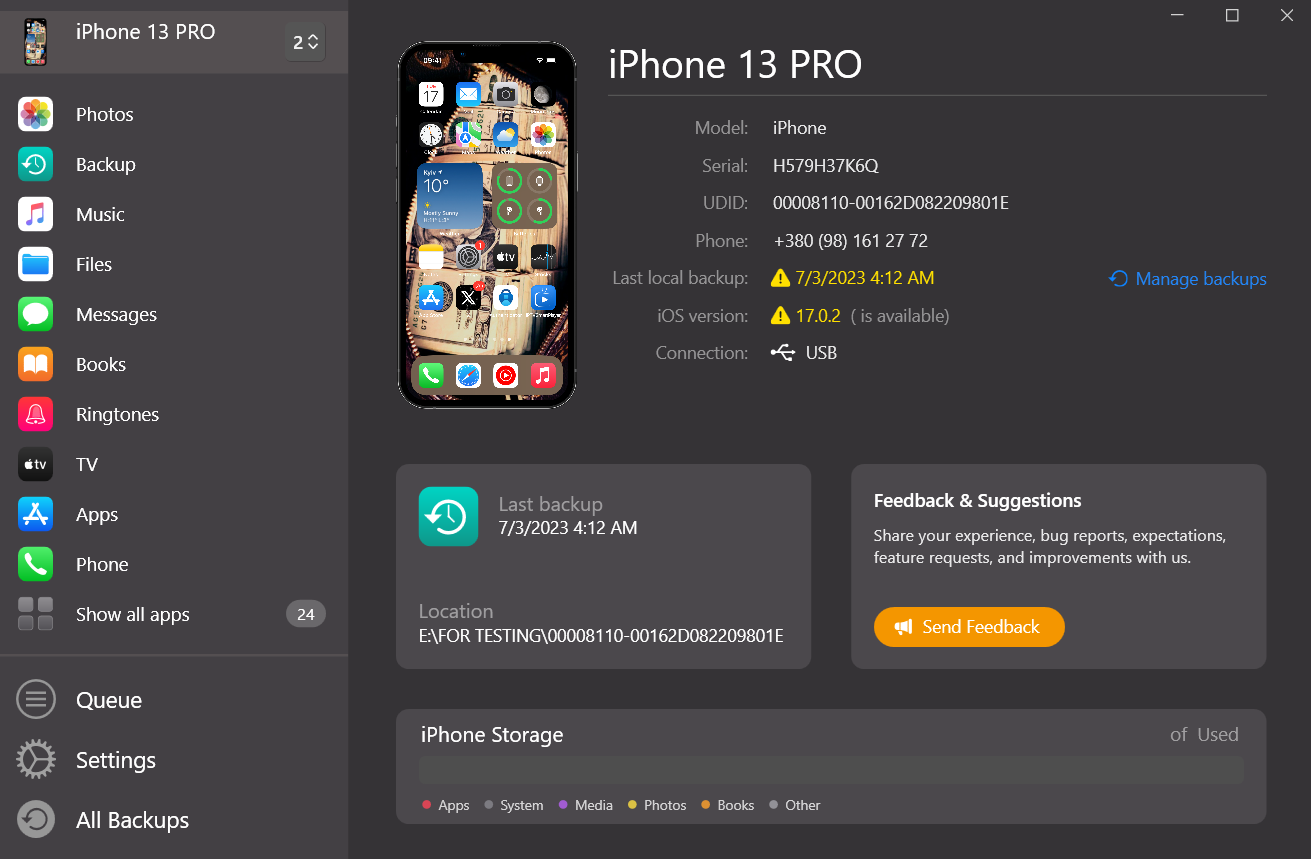
AltTunes can help with files, photos, music, messages, contacts, backups, notes, books, videos, voice memos, and more. Pick the category that matches the job.
A practical workflow looks like this:
Do not treat any transfer app as your only copy. If the file matters, keep a backup in at least one other place.
- Open the iPhone in AltTunes.
- Choose a category such as Files, Photos, Music, Videos, Messages, Contacts, or Backups.
- Select the files or records you want.
- Export them to a folder on your PC or external drive.
- Check the destination folder before deleting anything from your iPhone.
When to use WALTR PRO instead
Use WALTR PRO when the transfer direction goes the other way: from Mac or Windows to iPhone.
WALTR PRO is built for drag-and-drop transfers into iPhone and iPad. It can handle music, videos, books, PDFs, subtitles, and other files, including formats like MP3, FLAC, MKV, AVI, MP4, EPUB, PDF, SRT, ASS, and SSA.
The useful part is where files land. Music can go into Apple Music. Videos can go into Apple TV or compatible apps. Books and PDFs can go into Apple Books or supported apps. You skip iTunes sync and manual conversion in many common media workflows.
Use WALTR PRO for:
Use AltTunes for iPhone-to-PC export and local backup jobs. Use WALTR PRO for PC/Mac-to-iPhone transfer jobs. They solve different sides of the file-transfer headache.
- Adding FLAC, MP3, AAC, or WAV music to iPhone.
- Putting MKV, AVI, MP4, or MOV videos on iPhone.
- Sending EPUB or PDF files to iPhone.
- Adding subtitles with video files.
- Moving files from computer to iPhone without syncing a whole library.
How to choose the best file manager app for iPhone
Pick based on the file job, not the app ranking.
If you only need to find downloads
Use Apple Files. Check iCloud Drive > Downloads, then On My iPhone > Downloads. Search by file name if you remember it.
If your files are in Photos
Open Photos. Camera-roll photos and videos usually do not live in Files unless you manually saved or exported them there.
If you need PDF and ZIP tools
Use Documents by Readdle or another iOS file manager with stronger document tools. Files can preview and share many files, but specialist apps handle more workflows in one place.
If you need NAS or server access
Use FileBrowser, Owlfiles, or FE File Explorer. Look for SMB, SFTP, FTP, and WebDAV support. Use secure protocols and save credentials carefully.
If you need to move iPhone files to Windows
Use AltTunes. It is built for Windows users who want local exports, backups, photos, messages, music, files, contacts, and device data without iTunes.
If you need to send media from computer to iPhone
Use WALTR PRO. It is the better fit for dragging media and documents from Mac or Windows to iPhone and letting the app handle Apple-friendly destinations.
Privacy and safety notes before you install any file manager
File manager apps often ask for cloud access, local network access, file access, or photo-library permissions. That is normal for the category, but you should still be picky.
Use these rules:
For Windows users, local export tools like AltTunes can reduce cloud dependency because files land on your PC or external drive. That does not replace backup discipline. It makes the storage location clear.
- Avoid unknown apps that ask for broad cloud access before you understand why.
- Prefer apps with clear product pages, support docs, and recent updates.
- Use SFTP or HTTPS instead of plain FTP when moving sensitive files.
- Avoid public Wi-Fi for private file transfers.
- Keep local backups for files you cannot replace.
- Check exported files on your computer before deleting originals.
- Do not assume "private vault" or "secure folder" means encrypted backup. Read the app's details.
Final thoughts: the best file manager app for iPhone depends on the job
The best file manager app for iPhone is not one app.
Apple Files is the best starting point. Documents by Readdle is better for on-device document and media work. FileBrowser-style apps are better for NAS, SMB, FTP, and WebDAV. AltTunes is the better pick for Windows users who need iPhone-to-PC transfers and local backups. WALTR PRO is the better pick when you want to move files from a computer to iPhone without iTunes.
If your main problem is Windows transfer, start with AltTunes. If your main problem is sending media to iPhone, start with WALTR PRO. If your main problem is finding a Safari download, open Files and save yourself the install. For the broader device basics, Apple's iPhone User Guide is still the safest reference.
FAQ
Is there any file manager on my iPhone?
Yes. Every iPhone and iPad includes Apple's Files app. It lets you browse On My iPhone, iCloud Drive, connected storage, and third-party cloud services you add to Files.
What is the best file manager app for iPhone?
For basic use, Apple Files is the best free iPhone file manager. For stronger on-device file work, Documents by Readdle is a common pick. For NAS, SMB, FTP, or WebDAV, look at FileBrowser, Owlfiles, or FE File Explorer. For Windows transfer and local exports, use AltTunes. For sending files from Mac or PC to iPhone, use WALTR PRO.
Where are downloaded files on iPhone?
Most Safari downloads are in Files > Browse > iCloud Drive > Downloads. If they are not there, check Files > Browse > On My iPhone > Downloads, then search by file name.
Is the Files app enough for managing files on iPhone?
Files is enough for basic downloads, iCloud Drive, local folders, simple sharing, and added cloud apps. It is not enough for heavy PDF work, browser downloads, NAS workflows, large exports to Windows, or full device backups.
How do I access app files on my iPhone?
Open Files and check On My iPhone. Some apps create folders there for their documents. If an app does not appear, iOS may not let Files browse that app's private storage. Check the app's own export or sharing settings.
How do I transfer files from iPhone to PC without iTunes?
Use a desktop iPhone manager such as AltTunes if you want local Windows exports. Connect your iPhone, trust the PC, choose the file category, and export files to a folder on your computer or external drive.
Can I transfer files from PC to iPhone without iTunes?
Yes. WALTR PRO can transfer music, videos, PDFs, books, subtitles, and other files from Mac or Windows to iPhone without iTunes sync. AltTunes also supports Windows-side iPhone management and transfer workflows.
Can iPhone access NAS, SMB, FTP, or WebDAV folders?
Yes, but Apple Files may not be the best tool for every network setup. Use FileBrowser, Owlfiles, FE File Explorer, or a similar network-focused iPhone file manager if you need regular NAS, SMB, FTP/SFTP, or WebDAV access.
Are there free file manager apps for iPhone?
Yes. Apple Files is free and built in. Some third-party file managers offer free versions or free downloads with paid upgrades. Check the exact limits before moving important files into any app.
Can I manage PDFs on my iPhone?
Yes. Files can open and mark up PDFs for basic use. Documents by Readdle, Adobe Acrobat Reader, and similar apps offer stronger PDF reading, editing, annotation, and organization tools.

AltTunes
Seamlessly Browse, Manage & Export iOS Data
