How to Convert AIFF to MP3 or M4A in 2026

Need to convert AIFF to MP3? Use Apple Music on Mac or iTunes for Windows if you want a free local method. Use a trusted online converter if the file is small and not private. Use M4A instead of MP3 if your real goal is listening on iPhone, iPad, or Apple Music.
AIFF sounds great because it keeps uncompressed audio. That also means huge files. MP3 and M4A shrink those files so you can share them, store them, or play them on more devices without dragging around studio-size audio.
This guide gives you the practical routes: Mac, Windows, browser, batch conversion, and the WALTR PRO path for Apple-device playback.
Quick answer: best AIFF to MP3 method by situation
What you need | Best option | Why |
|---|---|---|
Free AIFF to MP3 on Mac | Apple Music app | Built into macOS, keeps the original AIFF copy |
AIFF to MP3 on Windows | iTunes for Windows or a desktop converter | iTunes handles library conversion; desktop tools handle batches better |
One quick non-private file | Online converter | Fast, no install, but uploads the file |
Many AIFF files | Desktop batch converter | Better for folders, albums, and large libraries |
iPhone or iPad listening | M4A/AAC + WALTR PRO | Better Apple fit, easier transfer to Apple Music |
Archive or editing | Keep AIFF | AIFF is the master-quality source |
The short version: make an MP3 copy for universal compatibility. Make an M4A copy for Apple devices. Keep the original if quality matters.
Before we begin
Download WALTR PRO on Mac or Windows to convert an AIFF file to an Apple-ready format and transfer it to an iPhone, iPad, or iPod. Keep the original AIFF until you confirm playback and audio quality.
AIFF vs MP3 vs M4A: which one should you choose?
AIFF, MP3, and M4A solve different problems. Pick the format based on where the audio needs to go.
Format | Type | File size | Best for | Tradeoff |
|---|---|---|---|---|
AIFF | Uncompressed audio | Large | Archiving, editing, original masters | Takes much more storage |
MP3 | Compressed audio | Small | Sharing, websites, old devices, car stereos | Loses some audio data |
M4A/AAC | Compressed audio | Small to medium | iPhone, iPad, Apple Music, everyday listening | Not as universal as MP3 |
AIFF is the file you keep when you care about the original recording. MP3 is the file you make when you need compatibility. M4A is often the better everyday Apple-device copy because AAC is efficient and plays nicely with Apple Music.
Important: Do not convert your only AIFF master and delete it. Make an MP3 or M4A copy, then keep the AIFF somewhere safe.
How to convert AIFF to MP3 on Mac with Apple Music
Apple's current Mac path runs through the Music app. It is not glamorous, but it works and it does not upload your audio anywhere.
Apple's official guide says the Music app can convert songs between compressed and uncompressed formats while keeping the original file unchanged. It also warns that converting from uncompressed AIFF to compressed MP3 can reduce sound quality. That is normal. MP3 gets smaller by removing audio data.
Use this route when you want a free local AIFF to MP3 converter on Mac.
If the converted file does not appear, check that the AIFF file is in your Music library first. You can also hold Option and use File > Convert to import and convert files from a folder or disk, based on your chosen import setting.
For the exact workflow and quality caveats, use Apple's support page on converting songs with the Apple Music app or iTunes for Windows.
- Open Apple Music.
- Go to Music > Settings > Files > Import Settings.
- Choose MP3 Encoder, then pick your quality setting.
- Add the AIFF file to your Music library if it is not there yet.
- Select the AIFF file.
- Choose File > Convert > Create MP3 Version.
- Check the new MP3 copy before deleting or moving anything.
When to convert AIFF to M4A instead of MP3
MP3 is not always the best answer. If you plan to listen on iPhone, iPad, Mac, or Apple Music, M4A is usually the cleaner choice.
M4A usually stores AAC audio. AAC can sound better than MP3 at similar file sizes, especially for normal listening. It also fits Apple Music, iPhone, and iPad better than MP3 because they handle M4A without fuss.
Choose M4A when:
Choose MP3 when:
That is the real decision. MP3 is the compatibility path. M4A is the Apple path.
- You want the file in Apple Music.
- You plan to transfer music to an iPhone or iPad.
- You care about quality but still need smaller files than AIFF.
- You do not need old-device compatibility.
- You need the file to play almost anywhere.
- You are sharing audio with someone on unknown devices.
- You are uploading to a website, CMS, or older system.
- You need a car stereo or older media player to recognize the file.
Convert AIFF to M4A and transfer it to iPhone with WALTR PRO
If your real goal is "I want this AIFF music on my iPhone," do not turn the job into a full iTunes project. WALTR PRO is built for this exact Apple-device transfer pain.
WALTR PRO works on Mac and Windows. It supports AIFF as a music input format, converts files into Apple-friendly versions when needed, and sends music directly to Apple Music on iPhone or iPad. No Finder sync. No iTunes library wrestling.
WALTR PRO is the better path for AIFF to M4A and Apple-device transfer. If you specifically need a standalone MP3 file, use Apple Music, iTunes for Windows, or a dedicated MP3 converter first.
Step 1: Download and install WALTR PRO
Download WALTR PRO for Mac or Windows from Softorino. The free trial is enough to test the workflow with your own AIFF file before you commit.
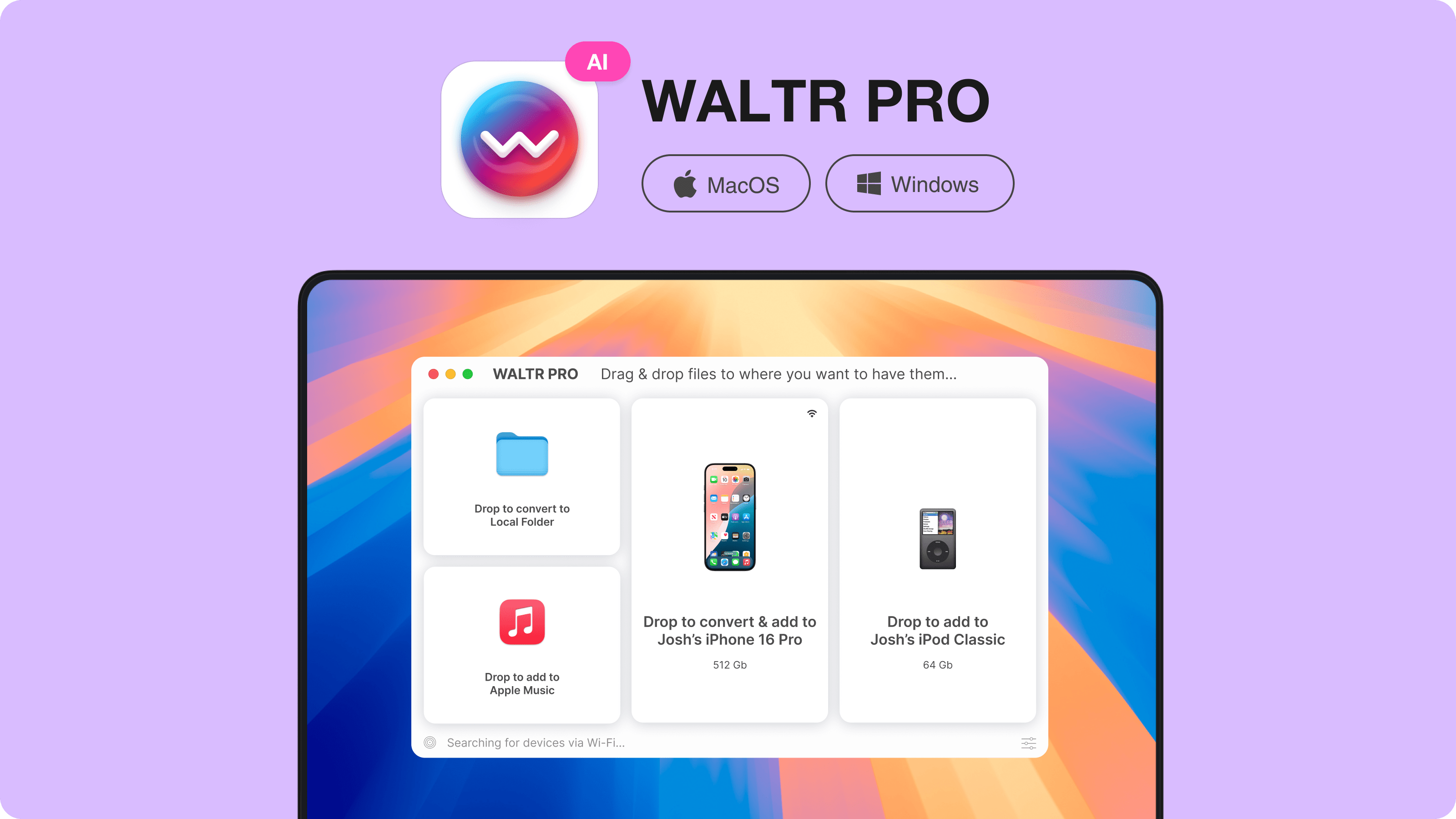
Step 2: Open WALTR PRO
Launch the app. You will see a drag-and-drop window where you can choose a destination: your iPhone, iPad, iPod, local folder, USB drive, or a compatible app.
Step 3: Drop your AIFF file
Drag the AIFF file into WALTR PRO. If you choose a local folder, WALTR PRO can prepare an Apple-friendly copy there. If you choose your iPhone or iPad, WALTR PRO handles the conversion and transfer in one flow.
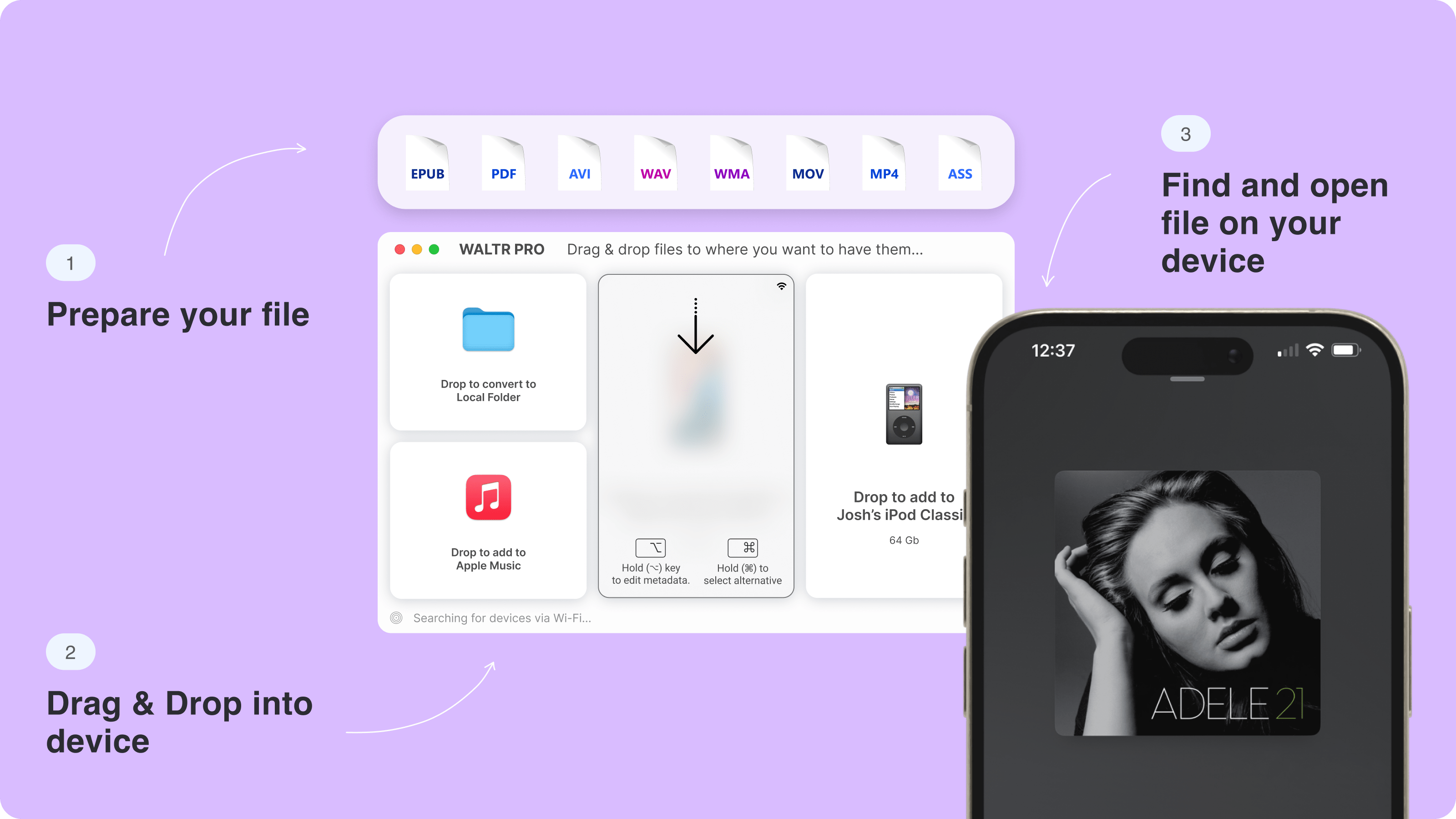
Step 4: Send it to Apple Music on iPhone or iPad
Connect your device and drop the file onto the device tile. WALTR PRO sends the converted music into the native Apple Music app so you can play it like normal music.
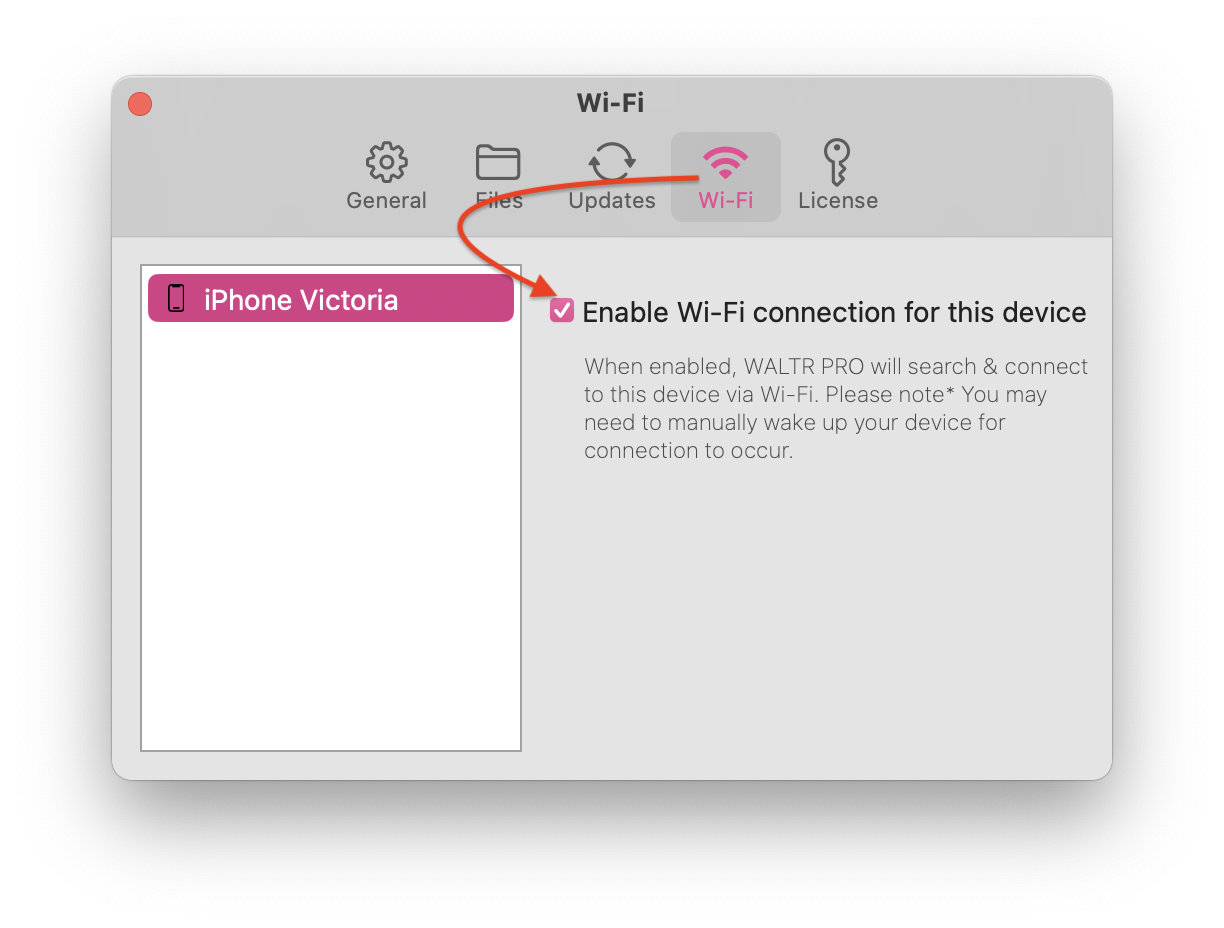
Bonus: choose a target app with Option
Hold the Alt/Option key while dropping files if you want to choose a different app on your device. Use this when you want the audio in a specific compatible music or file app instead of the default destination.
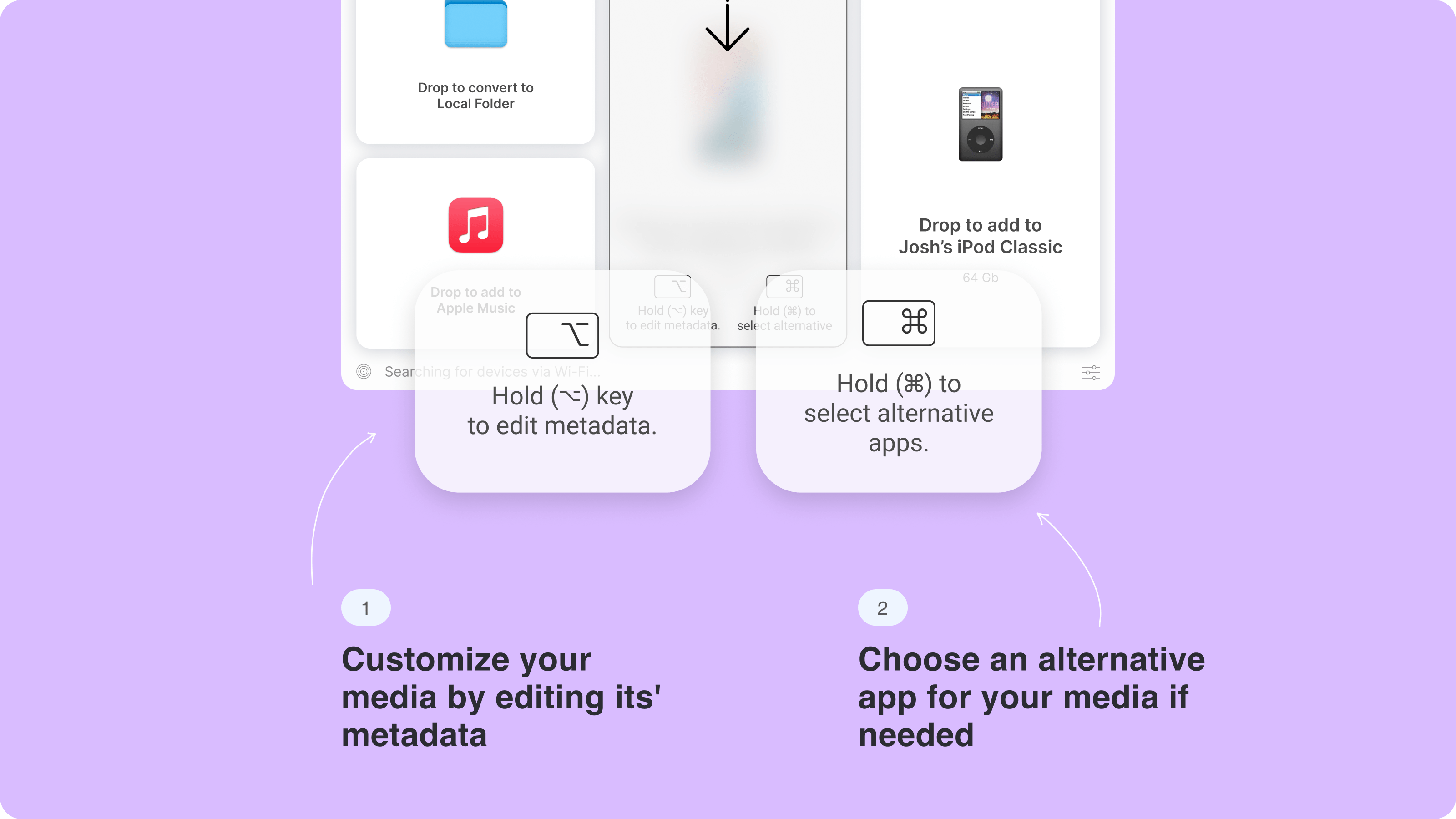
WALTR PRO makes sense when you care less about making an MP3 file and more about playing the music on your Apple device. That is where it beats the usual converter-plus-sync mess.
How to convert AIFF to MP3 on Windows
Windows gives you 3 realistic paths.
The first path is iTunes for Windows. Apple's support workflow is similar to the Mac version: open Preferences, choose Import Settings, select MP3 Encoder, then use File > Convert to create an MP3 copy. This works if the AIFF files are already in your iTunes library.
The second path is a desktop audio converter. This is better when you have folders of AIFF files, long recordings, or a full music library. Desktop tools usually give you clearer batch controls, output folders, bitrate settings, and metadata options.
The third path is an online converter. This is fine for one casual file. It is a bad idea for unreleased songs, client audio, private voice recordings, or anything you would not upload to a random website.
Windows Media Player is not the main answer for existing AIFF files. It can rip CDs in some workflows, but it is not the clean path for converting AIFF files already sitting on your PC.
For iTunes for Windows, use this path:
- Open iTunes.
- Go to Edit > Preferences > General > Import Settings.
- Choose MP3 Encoder.
- Add the AIFF files to your library.
- Select the files.
- Choose File > Convert > Create MP3 Version.
Are online audio converters safe?
Online converters are convenient. They are also the one method where your audio leaves your computer.
That may be fine for a random sound effect. It is not fine for private recordings, unreleased tracks, client work, paid samples, or anything sensitive. Converter sites also vary on file-size limits, deletion rules, bitrate control, ads, and account prompts.
Use this checklist before you upload audio to any browser converter:
The file is small and non-sensitive.
You do not need strict deletion guarantees.
You do not need private client, unreleased, or paid-sample material protected.
You are fine with browser upload limits, ads, and weaker bitrate controls.
Important: If privacy matters, local conversion wins. Use Apple Music, iTunes, a desktop converter, or WALTR PRO instead of uploading the file.
Best bitrate for AIFF to MP3
Bitrate controls the size and quality of the MP3 copy. Higher bitrate means larger files and better sound. Lower bitrate means smaller files and more quality loss.
Practical settings:
Output | Use this setting | Best for |
|---|---|---|
192 kbps MP3 | Good general setting | Podcasts, casual listening, smaller music files |
256 kbps MP3 | Better quality | Music sharing, personal library copies |
320 kbps MP3 | Highest common MP3 setting | When you want the best MP3 copy and file size is less important |
256 kbps AAC/M4A | Strong Apple-device setting | iPhone, iPad, Apple Music listening |
Important: Do not call any of these lossless. MP3 and AAC/M4A are compressed listening copies. AIFF is the source you keep for archive and editing.
Troubleshooting AIFF to MP3 conversion
The MP3 option is missing in Apple Music or iTunes
Open Import Settings again and choose MP3 Encoder. The Convert menu changes based on your import preference. If AAC Encoder is selected, Apple Music will create an AAC/M4A-style copy instead.
The converted file sounds worse
That can happen when you compress AIFF to MP3. Use a higher bitrate, such as 256 kbps or 320 kbps, and keep the AIFF original. Repeatedly converting between compressed formats can make quality worse.
The converted file is still too large
Lower the bitrate or use AAC/M4A for Apple-device listening. If the file is spoken audio, you can often use a lower bitrate than you would use for music.
The file will not transfer to iPhone
Apple Music and Finder syncing can be picky. If the goal is iPhone playback, use WALTR PRO to send the Apple-friendly copy directly to Apple Music without rebuilding your library sync setup.
Metadata or album art is missing
Some converters keep metadata better than others. If the album title, artist, or artwork matters, check the file before you transfer it to your phone.
Final recommendation
If you need a universal file, convert AIFF to MP3 with Apple Music, iTunes for Windows, or a trusted desktop converter. Use 256 kbps or 320 kbps for music when quality matters.
If you want the audio on iPhone or iPad, convert AIFF to M4A and transfer it with WALTR PRO. It avoids the iTunes/Finder sync headache and gets your music into Apple Music where you can play it.
Keep the AIFF original either way. That is your master file. MP3 and M4A are the portable copies.
Want the Apple-device route? Download the WALTR PRO free trial and drop in one AIFF file. You will know in a minute if it solves your problem.
For a quick no-install conversion, use Softorino's free AIFF to MP3 converter. The audio stays on your device while your browser processes it.
FAQ
How do I convert AIFF to MP3 on Mac for free?
Use the Apple Music app. Go to Music > Settings > Files > Import Settings, choose MP3 Encoder, select the AIFF file in your library, then choose File > Convert > Create MP3 Version. Apple Music keeps the original AIFF file.
Does converting AIFF to MP3 reduce quality?
Yes. AIFF is uncompressed. MP3 is compressed. You can reduce the audible loss by choosing a higher bitrate, such as 256 kbps or 320 kbps, but MP3 is still a lossy copy.
Is M4A better than MP3 for iPhone?
For iPhone and Apple Music, M4A/AAC is often the better everyday format. It gives strong quality at smaller file sizes and fits Apple devices well. Use MP3 when you need the widest compatibility outside Apple devices.
Can WALTR PRO convert AIFF files to MP3?
Use WALTR PRO for AIFF to M4A-style Apple-device transfer, not as the main generic MP3 encoder. WALTR PRO supports AIFF input and can move music into Apple Music on iPhone or iPad without iTunes syncing. If you need a standalone MP3 file, use Apple Music, iTunes for Windows, or a dedicated MP3 converter.
Are online audio converters safe?
They can be fine for non-sensitive files if you trust the site, but they require uploading your audio. Avoid online converters for private recordings, unreleased music, client files, or anything confidential.
What bitrate should I use for converted files?
Use 192 kbps for casual listening, 256 kbps for a better quality-size balance, and 320 kbps when you want the best common MP3 output. Keep the AIFF original if quality matters.
Can I batch convert AIFF files to MP3?
Yes. Use a desktop converter or Apple Music/iTunes folder conversion. Batch conversion is better than browser tools when you have albums, many folders, or large files.
Should I delete the AIFF files after converting?
Do not delete them unless storage matters more than quality. AIFF files are your uncompressed originals. MP3 and M4A files are portable copies for playback, sharing, or Apple-device transfer.

WALTR PRO
Convert & Push Any File into Any Apple Device
