How to Activate eSIM on iPhone: 5 Safe Methods (2026)

Need to know how to activate eSIM on iPhone without poking through every carrier screen? Start here: open Settings > Cellular or Settings > Mobile Service, tap Add eSIM, then choose the method your carrier supports.
Most iPhones can activate an eSIM through 1 of 5 paths: eSIM Quick Transfer, Carrier Activation, QR code, carrier app, or manual SM-DP+ details. The annoying part is that carriers name the same steps differently. Apple gives you the framework. Your carrier supplies the plan.
Before we begin
Windows users can download AltTunes to make a local iPhone backup before an eSIM transfer, carrier change, or device migration. AltTunes handles the separate backup step; eSIM activation still happens through the carrier and iPhone settings described below.
Before you activate eSIM on iPhone, check the basics. A failed setup usually comes from carrier support, an expired QR code, poor Wi-Fi, or trying to transfer a plan your carrier has not approved for Quick Transfer.
- An iPhone that supports eSIM. Apple says iPhone XS, iPhone XS Max, iPhone XR, and later support eSIM.
- A carrier or worldwide service provider that supports eSIM for your plan.
- A Wi-Fi connection, hotspot, or active cellular connection during setup.
- The carrier QR code, carrier app, transfer-ready old iPhone, or manual SM-DP+ details.
- Your Apple Account signed in on both iPhones if you plan to transfer an eSIM between devices.
- Bluetooth turned on when using nearby iPhone transfer.
Setup label you may see | What it means |
|---|---|
Cellular | Common U.S. Settings label for mobile plan controls |
Mobile Service | Common U.K. and international Settings label |
Mobile Data | Another regional label for cellular settings |
Add eSIM | The entry point for QR code, transfer, and carrier activation flows |
If your iPhone shows Cellular instead of Mobile Service, you are in the right place. Apple changes the wording by region. Follow the meaning, not the exact label.
Choose the Right eSIM Activation Method
The best eSIM activation method depends on what you are doing. Do not force the QR code path if your carrier already pushed the eSIM to your iPhone, and do not expect Quick Transfer if your carrier does not support it.
Your situation | Use this method |
|---|---|
New iPhone, same number, old iPhone nearby | eSIM Quick Transfer |
Carrier says your eSIM is ready automatically | Carrier Activation |
Carrier or travel provider sent a QR code | Use QR Code |
Carrier manages setup inside its iPhone app | Carrier app setup |
Carrier sent SM-DP+ address and activation code | Manual details |
Apple’s official Set up eSIM on iPhone guide lists the main paths: Carrier Activation, Quick Transfer, QR code, carrier app, and manual setup. This article puts those paths into plain English.
How to Activate eSIM on iPhone with a QR Code
QR code setup is the most common way to activate a new carrier plan or travel eSIM. It works when your carrier or eSIM provider gives you a QR code tied to your plan.
- Open Settings on your iPhone.
- Tap Cellular, Mobile Service, or Mobile Data.
- Tap Add eSIM.
- Tap Use QR Code.
- Scan the QR code from your carrier or eSIM provider.
- Follow the on-screen prompts to add the cellular plan.
- Label the line, then choose which line handles calls, messages, and mobile data.
- Wait for activation to finish. Some plans activate in minutes. Others need carrier approval first.
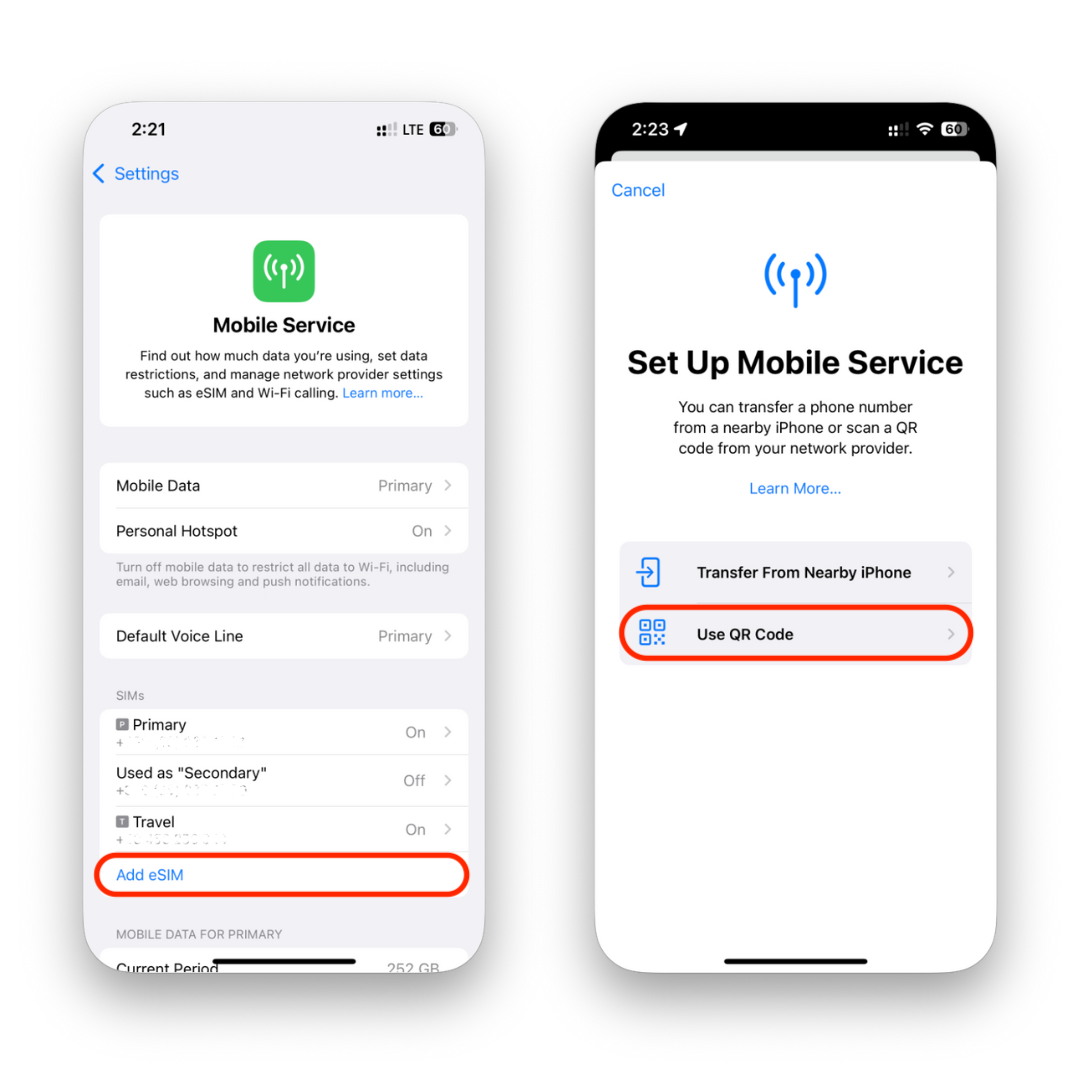
Do not share your eSIM QR code publicly. Treat it like a login code for your cellular plan.
How to Activate eSIM on iPhone with Carrier Activation
Carrier Activation means your carrier assigns the eSIM to your iPhone. You may see a notification during iPhone setup or a prompt later inside Settings.
- Turn on the iPhone and connect to Wi-Fi.
- Look for a message that says a cellular plan is ready to be installed.
- Tap the notification, or open Settings > Cellular/Mobile Service.
- Tap the carrier plan waiting to be activated.
- Follow the prompts and wait for service to appear.
If no prompt appears, sign in to your carrier account or open the carrier app. Some carriers only push the eSIM after you confirm the phone number, IMEI, or account owner details.
How to Activate eSIM from a Carrier App
Carrier app setup works when your provider handles plan purchase and installation inside its own app. Travel eSIM providers often use this flow too.
- Install the official carrier or eSIM provider app from the App Store.
- Sign in with the account tied to your plan.
- Find Activate eSIM, Install eSIM, Add Cellular Plan, or similar wording.
- Follow the app instructions. The app may open iOS Settings to finish the install.
- Return to Settings > Cellular/Mobile Service and confirm the new plan appears.
A travel eSIM may be data-only. That means it can give you mobile data abroad without moving your main phone number, voice calls, iMessage number, or SMS line.
How to Enter eSIM Details Manually
Manual setup is the fallback method. Use it only when your carrier gives you an SM-DP+ address, activation code, and any required confirmation code.
- Open Settings > Cellular/Mobile Service.
- Tap Add eSIM.
- Tap Use QR Code.
- Tap Enter Details Manually.
- Enter the SM-DP+ address and activation code exactly as your carrier provided them.
- Tap through the prompts and wait for activation.
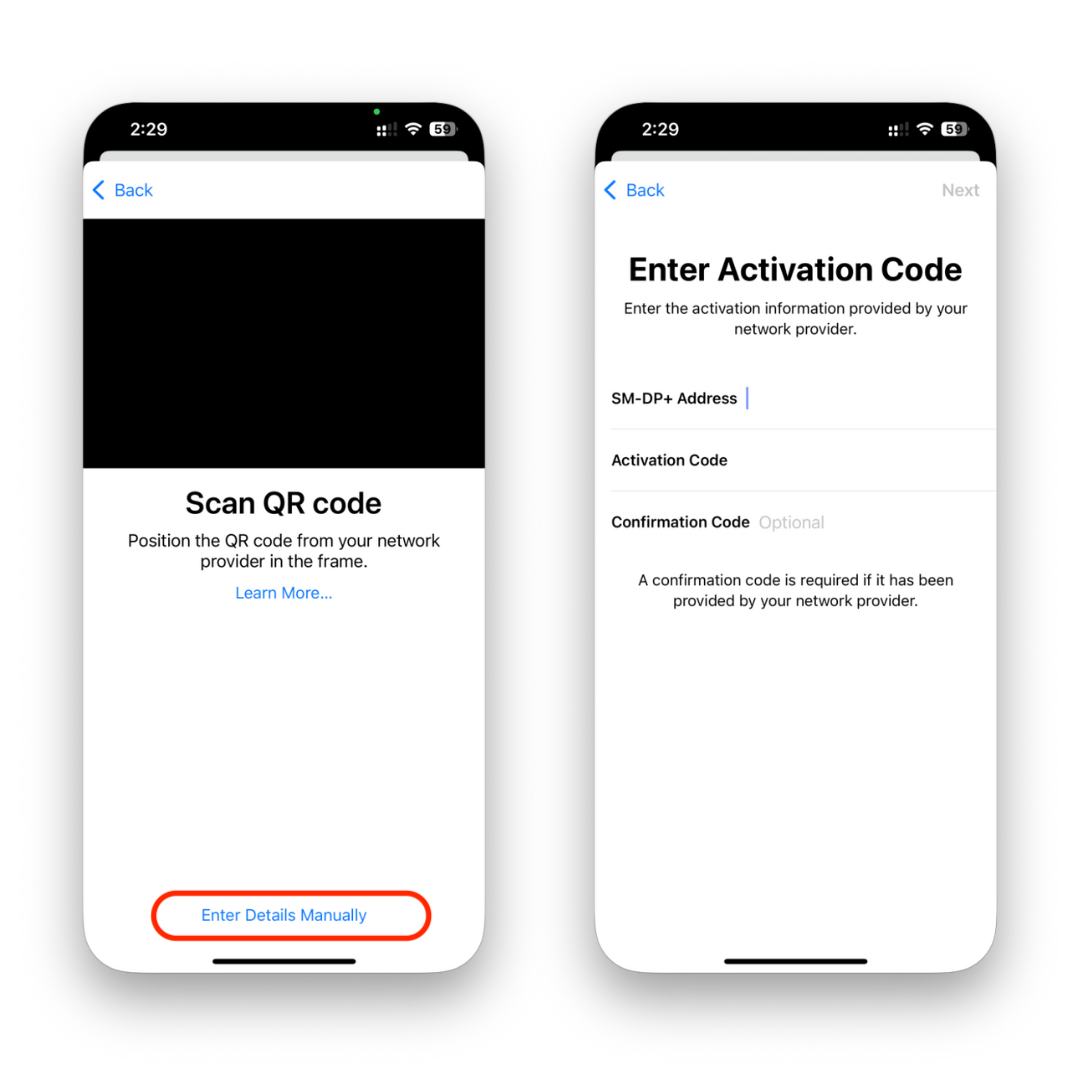
Important: If you do not have manual eSIM details, do not guess. Ask your carrier for a new QR code or account-based activation.
How to Transfer eSIM to a New iPhone
You can transfer eSIM to a new iPhone during setup or after the new iPhone is already running. Carrier support matters here. If your carrier blocks Quick Transfer, use a new QR code, the carrier app, or carrier support instead.
Transfer eSIM during new iPhone setup
- Place your old and new iPhones near each other.
- Make sure both iPhones are unlocked, connected to Wi-Fi, and have Bluetooth on.
- During new iPhone setup, choose the option to transfer your cellular plan or eSIM.
- Approve the transfer on the old iPhone.
- Wait for the new iPhone to activate the eSIM. The plan may stop working on the old iPhone after transfer.
Transfer eSIM after iPhone setup
- On the new iPhone, open Settings > Cellular/Mobile Service.
- Tap Add eSIM.
- If available, tap Transfer from Nearby iPhone.
- Unlock the old iPhone and approve the request.
- Follow the prompts until the new iPhone shows service.
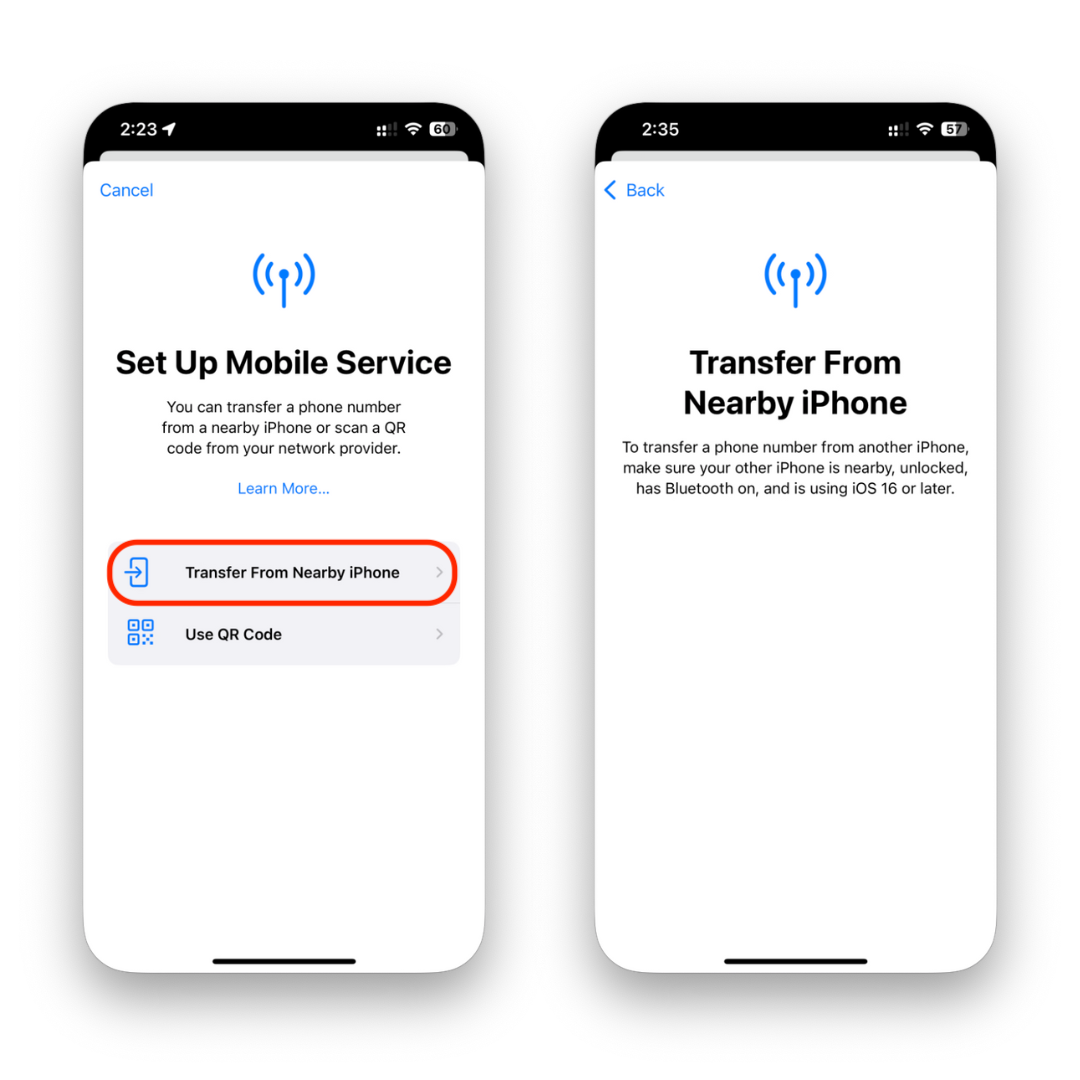
If the transfer option does not appear, your carrier may not support Quick Transfer for that plan. Contact the carrier or use its app. Apple’s eSIM setup page is the best external source for the supported iPhone-side methods.
How to Add eSIM as a Second Line
You can use eSIM as a second line for work, travel, or a separate data plan. Apple calls this Dual SIM. The setup is useful, but the labels matter because the wrong default line can send calls or iMessage from the wrong number.
- Activate the eSIM using QR code, carrier app, Carrier Activation, or Quick Transfer.
- When iOS asks for labels, choose clear names such as Personal, Work, or Travel.
- Choose the default line for calls and messages.
- Choose the line used for mobile data.
- Open Settings > Messages and Settings > FaceTime if you need to check which number iMessage and FaceTime use.
Apple’s Dual SIM guide explains how two phone numbers work for calls, messages, and mobile data. If you are setting up a second line before a trip, test it before you leave Wi-Fi behind. Airport troubleshooting is a bad hobby.
Why Your iPhone eSIM Is Not Activating
If your iPhone eSIM is not activating, slow down and isolate the failure. The message on screen usually tells you whether the problem is your iPhone, the carrier account, the QR code, or the transfer path.
Problem | Likely cause | What to do |
|---|---|---|
No Add eSIM option | Unsupported iPhone, old iOS, restricted carrier setup, or regional label confusion | Update iOS, check under Cellular/Mobile Service/Mobile Data, then confirm carrier support |
QR code will not scan | Expired QR code, already-used code, poor camera focus, or provider account issue | Raise brightness, scan again, then ask the carrier for a fresh QR code |
Activation stuck or pending | Carrier provisioning delay or weak connection | Stay on Wi-Fi, restart iPhone, wait a bit, then contact the carrier |
Transfer from Nearby iPhone missing | Carrier does not support Quick Transfer for that line | Use carrier app, QR code, or carrier support |
Travel eSIM has data but no calls | The travel plan is data-only | Use it for mobile data and keep your main line for calls/SMS if roaming is supported |
Old phone still has service | Transfer may not have completed or carrier has not deactivated old plan | Check both phones, then call the carrier before deleting anything |
Do not delete your old eSIM until the new one works unless your carrier tells you to. Removing a cellular plan does not cancel your service, but it can make setup harder if you still need that plan to receive confirmation texts.
What eSIM Can and Cannot Do
An eSIM replaces the physical SIM card for carrier access. It does not back up your iPhone, move your photos, save your iMessages, or transfer your apps. If you are setting up a new phone, handle the eSIM and the phone backup as separate jobs.
For the rest of the new-iPhone setup, use Softorino’s related iPhone guides: how to back up iPhone, how to enable iMessage on iPhone, and how to change password on iPhone. None of those guides activate a cellular plan, but they clean up the parts people usually mix into the same setup panic.
FAQ
Can I use eSIM and a physical SIM at the same time?
Yes, on supported iPhone models with a SIM tray. You can use Dual SIM with one physical SIM and one eSIM, or with multiple eSIMs on newer models. Your carrier and region still decide what plans work.
Can I have more than one eSIM on iPhone?
Yes. Many recent iPhones can store multiple eSIM profiles, but only a limited number can be active at the same time. Check Apple’s model-specific support if you plan to juggle several lines.
Does eSIM work internationally?
Yes, if your iPhone is unlocked and the carrier or travel eSIM provider supports your destination. Many travel eSIMs are data-only, so check voice and SMS support before relying on them.
Can I remove an eSIM from my iPhone?
Yes. Open Settings > Cellular/Mobile Service, tap the plan, then choose the option to delete or remove the eSIM. This removes the plan from the iPhone. It does not always cancel billing with your carrier.
Is eSIM activation free?
It depends on the carrier. Many carriers do not charge for eSIM activation, but fees and replacement policies vary. Check your carrier account before assuming it is free.
Why does my iPhone say eSIM activating?
Your iPhone is waiting for the carrier to provision the plan. Stay connected to Wi-Fi, restart the iPhone if it sits too long, and contact your carrier if the status does not change.
Final Check Before You Stop
You know how to activate eSIM on iPhone when the new plan appears under Settings > Cellular/Mobile Service, shows signal, and handles the line you assigned to it. Make a test call if the plan includes voice. Turn off Wi-Fi for a minute and test mobile data if the plan includes data.
If activation fails after the steps above, the fix is almost always with the carrier. eSIM is not something a third-party Mac or Windows utility can safely install for you. Use Apple’s Settings flow, keep your carrier details handy, and do not delete the old plan until the new one proves it works.

AltTunes
Seamlessly Browse, Manage & Export iOS Data
