How to Set Up Face ID on iPhone or iPad: 2026 Guide

Quick answer: how to set up Face ID
TL;DR: To set up Face ID on iPhone, open Settings > Face ID & Passcode > Set Up Face ID. Enter your passcode when prompted, tap Get Started, complete both face scans, then tap Done. The same setup path works on supported iPad Pro models.
Before we begin
Windows users who also want a local backup of their iPhone data can download AltTunes. This is optional data housekeeping, separate from Face ID setup. AltTunes does not configure Face ID, and backups do not include Face ID data. You do not need a backup to follow these steps.
Quick Takeaways
- Use a supported iPhone or iPad Pro with a TrueDepth camera.
- Keep your passcode: you still need it after a restart and in other security situations.
- For mask unlock, you need iPhone 12 or newer with iOS 15.4 or later. Mask mode does not work on iPad.
Face ID needs Apple's TrueDepth camera system. Check Apple's models that support Face ID if you are unsure about your device. An app or software update cannot add Face ID to a Touch ID-only model.
Before you start, check these details:
- Know your current passcode. If you have not set one, Face ID setup prompts you to create one.
- Clear the TrueDepth camera area. Remove any case or screen protector that covers it, and wipe away dirt.
- Keep your face visible. Hold the device upright, about 10 to 20 inches from your face, and look at the screen.
To check your iPhone model, open Settings > General > About and read Model Name. On iPad, confirm support before following the iPad Pro steps; not every iPad has Face ID.
A passcode prompt after restart is normal. Face ID does not replace your passcode. You also need it after repeated failed matches and for certain security checks.
This guide follows Apple's documentation. No new on-device testing took place. The preserved screenshots illustrate the setup and mask controls; their appearance may differ from your software version.
Apple documents the setup path, supported uses and device limits in Use Face ID on your iPhone or iPad Pro.
How to set up Face ID on iPhone or iPad Pro
Start in Settings > Face ID & Passcode. Hold your iPhone or supported iPad Pro in portrait orientation for enrollment. If moving your head is difficult, tap Accessibility Options on the setup screen rather than forcing the circular motion.
- Open Settings and tap Face ID & Passcode.
- Enter your passcode when prompted. Create a passcode if you do not already have one.
- Tap Set Up Face ID.
- Hold the device upright, place your face inside the frame and tap Get Started.
- Look at the screen and move your head slowly to complete the circle. Use Accessibility Options if needed.
- Tap Continue after the first scan.
- Complete the second scan, then tap Done.
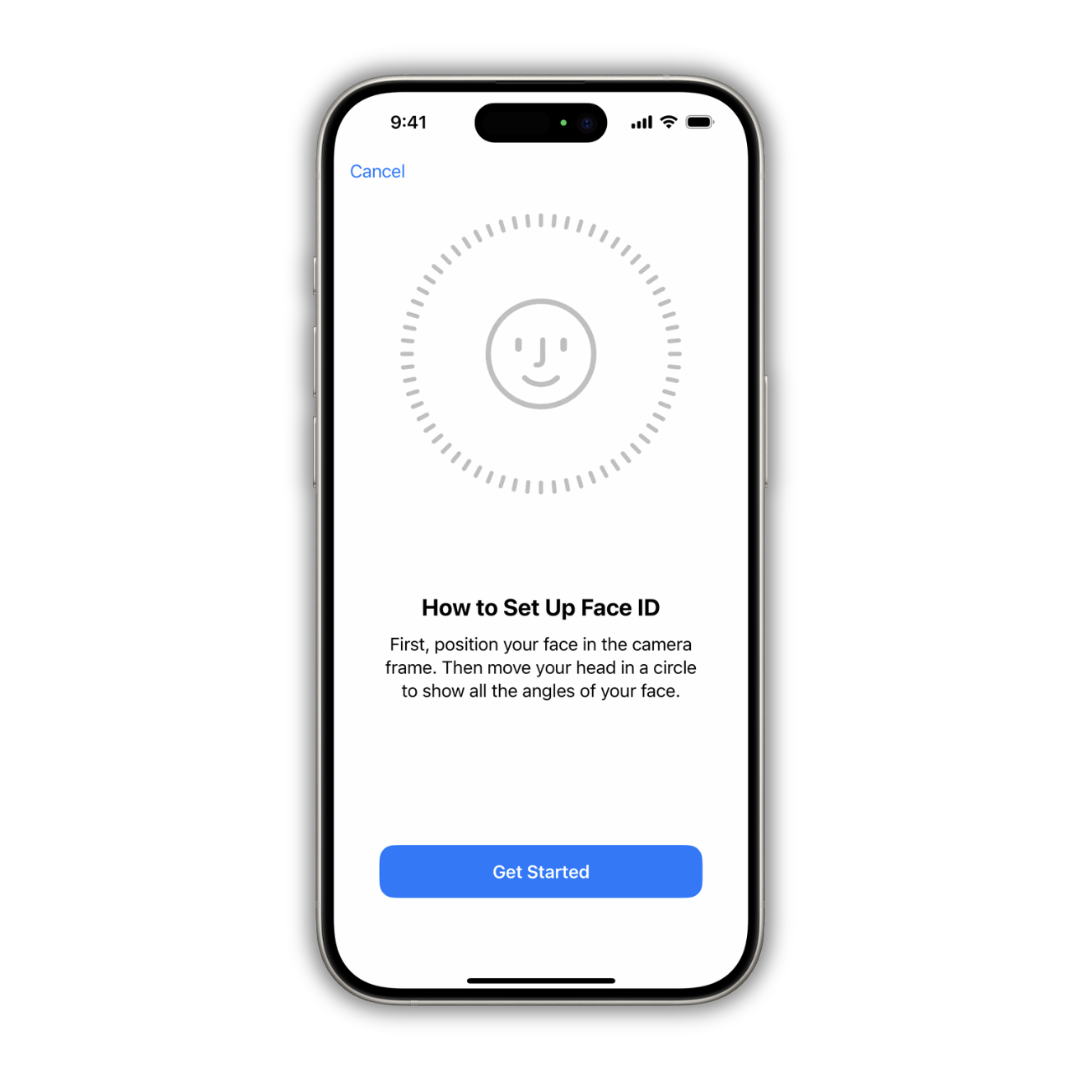
After setup, lock your iPhone and wake it again. Look at the screen. When the lock icon opens, swipe up from the bottom to reach the Home Screen.
Keep the camera clear during use. Face ID works in landscape on iPhone 13 and later with iOS 16 or later, except in mask mode. Other supported iPhones need portrait orientation. On supported iPad Pro models, Face ID works in any orientation; watch that your hand does not cover the camera.
How to use Face ID after setup
After you set up Face ID, iPhone can use it for more than unlocking. Open Settings > Face ID & Passcode and look under Use Face ID For.
You can turn Face ID on or off for supported uses:
- iPhone Unlock: unlock the device when you look at it.
- iTunes & App Store: approve purchases and downloads.
- Wallet & Apple Pay: authenticate payments.
- Password AutoFill: fill saved passwords after authentication.
- Other Apps: allow Face ID sign-in in apps that support it.
For Apple Pay on iPhone, double-click the side button and glance at the screen to authenticate. Then hold the top of the iPhone near the payment reader. App Store purchases also use the side-button confirmation when prompted.
If an app does not ask for Face ID, check that app's security settings too. App sign-in and locking an app are different controls. See our guide to lock apps on iPhone for the separate iOS app-locking feature.
How to set up Face ID with a mask
To use Face ID with a mask, you need iPhone 12 or newer and iOS 15.4 or later. Mask mode recognizes the area around your eyes. It works only in portrait orientation and is not available on iPad.
Turn on mask mode in Settings:
- Open Settings > Face ID & Passcode.
- Enter your passcode.
- Turn on Face ID with a Mask.
- Follow the scan prompts with your face uncovered.
- If you wear clear glasses, use Add Glasses and follow the prompts for those glasses.
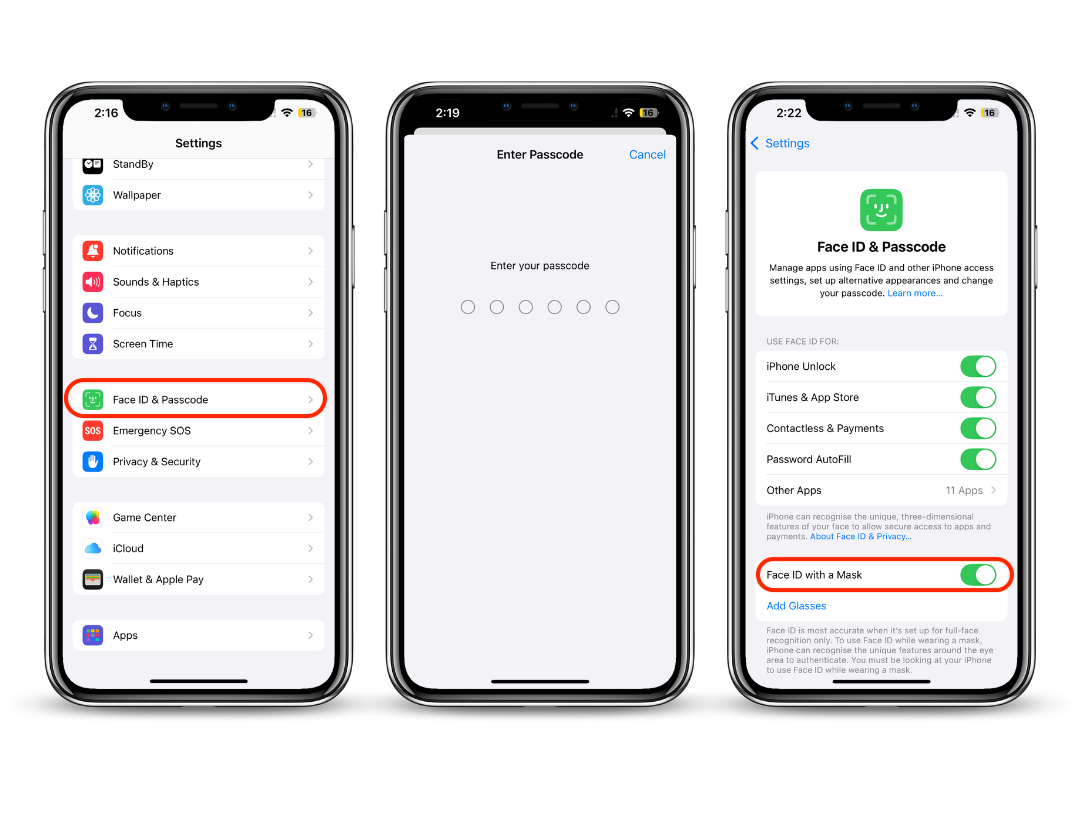
Look directly at the screen when using mask mode. Sunglasses are not supported with Face ID with a Mask. Apple explains the eye-area and glasses requirements in its Face ID with a mask guide.
How to add an alternate appearance or reset Face ID
Use Set Up an Alternate Appearance if your appearance is substantially different and Face ID struggles to recognize you. Face ID adapts to gradual changes, such as facial hair growth, so ordinary changes do not always need another scan.
To add an alternate appearance:
- Go to Settings > Face ID & Passcode.
- Enter your passcode.
- Tap Set Up an Alternate Appearance.
- Follow the scan prompts.
Alternate Appearance is not a guest account. Enrolling another person can let them unlock your device. Do not use it to share limited access to one app; consider locking the iPhone screen for kids when that is your goal.
To remove the saved face data and start again, open Settings > Face ID & Passcode > Reset Face ID. Then choose Set Up Face ID. Apple describes these controls in its iPhone Face ID settings guide.
Face ID not working? Try these fixes
Check the camera and settings before resetting Face ID. If you just restarted your iPhone, enter your passcode once. That expected security step does not mean Face ID is broken.
- Clean the TrueDepth camera area and remove anything covering it.
- Hold the device about 10 to 20 inches from your face.
- Look at the screen with your eyes open if Require Attention for Face ID is on.
- Uncover your face unless supported mask mode is enabled. Try removing sunglasses.
- Check Settings > Face ID & Passcode and enable the use that is failing, such as iPhone Unlock.
- Restart your device and enter the passcode. Check Settings > General > Software Update for updates.
- If recognition still fails, reset Face ID and set it up again.
If the camera does not work or you cannot complete enrollment, follow Apple's Face ID troubleshooting guide. Persistent TrueDepth camera or setup failures may need service. A backup app cannot repair that hardware.
Is Face ID safer than a passcode?
Face ID and your passcode work together. You use Face ID for everyday authentication, but the passcode remains a fallback. Apple requires it after a restart, five failed matches and other security conditions.
Choose a passcode other people cannot easily guess, and keep it private. Anyone who knows it may be able to unlock your iPhone without Face ID. Our guide explains how to change your iPhone passcode.
Keep Require Attention for Face ID on unless you need an accessibility adjustment. Apple explains attention checks, depth sensing and higher false-match risk for similar-looking twins and siblings in its Face ID security guide. Face ID data stays on your device; Apple does not back it up to iCloud or elsewhere.
Face ID benefits and limits
Use | Benefit | Limit to keep in mind |
|---|---|---|
Unlock your device. | You can unlock with a glance. | Keep the TrueDepth camera and your face clear. |
Approve supported purchases and app sign-ins. | You can authenticate without typing each time. | Each use needs the relevant setting or app support. |
Unlock in the dark. | Face ID uses infrared rather than visible light. | Camera obstructions can still prevent recognition. |
Unlock while wearing a mask. | A supported iPhone can recognize your eye area. | You need iPhone 12 or newer, iOS 15.4 or later, and portrait orientation. |
FAQ
How do I set up Face ID on my iPhone?
Open Settings > Face ID & Passcode, enter your passcode, and tap Set Up Face ID. Tap Get Started, complete both scans, then tap Done.
Why can't I set up Face ID on my iPhone?
Your iPhone may lack Face ID support, or something may cover the TrueDepth camera. Check the model and camera area first. If enrollment still fails after Apple's troubleshooting steps, seek service.
How do I activate Face ID again?
After restarting your iPhone or temporarily disabling Face ID, unlock with your passcode. To re-enable a specific use, open Settings > Face ID & Passcode and turn on that option.
Can I use Face ID with glasses?
Yes. Face ID works with most glasses. For mask mode on a supported iPhone, use Add Glasses for clear glasses. Face ID with a Mask does not support sunglasses.
Does Face ID work in the dark?
Yes. Face ID uses infrared, so it can work in the dark. It still needs a clear view of your face and an unobstructed TrueDepth camera.
Can I use Face ID with a mask?
Yes, on iPhone 12 or newer with iOS 15.4 or later. Turn on Face ID with a Mask under Settings > Face ID & Passcode, and hold the iPhone upright. Mask mode is not available on iPad.
Can someone else use Face ID on my iPhone?
Enrolling another person can let them unlock your iPhone, but it is not the only access risk. Someone who knows your passcode may unlock it. Apple also warns of higher false-match risk for similar-looking twins and siblings.
How do I turn off Face ID temporarily?
On iPhone, hold the side button and either volume button for about two seconds. When the sliders appear, release the buttons and press the side button to lock. The next unlock needs your passcode; do not keep holding into Emergency SOS.
Can Face ID be fooled by a photo?
Apple says Face ID checks depth information that a flat photo does not contain. That does not make Face ID a guarantee against every access risk. Keep your passcode private too.
Check your Face ID settings
Set up Face ID, check unlock, then enable the uses you need: payments, purchases, saved passwords and supported app logins. If Face ID keeps failing, follow Apple's troubleshooting guide rather than repeatedly resetting it.
For another everyday iPhone control, see how to turn off the iPhone flashlight. If you also need a local data backup on Windows, the optional AltTunes download above covers that separate job. It does not back up or restore Face ID enrollment.

AltTunes
Seamlessly Browse, Manage & Export iOS Data
