How to Convert AIFF to M4A in 2026

Need to convert AIFF to M4A because your audio files are too large for daily use? That is the right move for most Apple-device listening. AIFF keeps uncompressed audio, which is great for editing and archiving. M4A gives you a smaller Apple-friendly file that is easier to store, share, and move to iPhone.
This guide gives you the fast answer first. You will also see when to use an online AIFF to M4A converter, when Apple Music or iTunes is enough, and when WALTR PRO makes more sense because you also need the music on your iPhone or iPad without iTunes sync.
Quick answer: the fastest way to convert AIFF to M4A
The fastest AIFF to M4A conversion flow is simple:
That solves the format problem. It does not always solve the Apple-device problem.
If you have one small, non-private file, an online converter is fine. If the file is private, large, or part of a full music library, use a local method. If your real goal is to convert AIFF to M4A and put the song on an iPhone, use WALTR PRO for the transfer step, or let WALTR PRO handle supported Apple-device media workflows without iTunes.
- Open an AIFF to M4A converter.
- Add your .aiff or .aif file.
- Choose M4A as the output format.
- Pick AAC for smaller files, or Apple Lossless if you need lossless audio.
- Convert the file and save the new .m4a version.
Situation | Best method | Why it works | Watch out for |
|---|---|---|---|
One small file | Online AIFF to M4A converter | Fast and no install | You upload the audio to another server |
Private recording | Local desktop conversion | File stays on your computer | Takes a few minutes to set up |
File already in Music on Mac | Apple Music | Built into macOS | Import settings control the output |
File already in iTunes on Windows | iTunes | Built into the iTunes library flow | The Windows interface still feels like iTunes |
Final destination is iPhone or iPad | WALTR PRO | Sends music to Apple devices without sync | Best when transfer matters, not only conversion |
Before we begin
Download WALTR PRO on Mac or Windows to transfer the finished M4A file to an iPhone, iPad, or iPod without an iTunes sync. Keep the AIFF source until you confirm the converted audio quality.
AIFF vs M4A: what changes when you convert?
AIFF is an uncompressed audio format created by Apple. It keeps the audio data intact, so file sizes get big fast. That makes AIFF useful for studio work, editing, and archiving. It is less fun when you are trying to keep a music library on a phone with limited storage.
M4A is a container format. Most M4A files use AAC, which compresses audio and makes the file much smaller. M4A can also hold Apple Lossless audio, often called ALAC. That matters because "M4A" does not automatically mean one quality level.
Here is the practical version:
Converting AIFF to M4A with AAC can reduce quality because AAC is lossy. For normal listening on iPhone, AirPods, car speakers, or a Bluetooth speaker, most people will prefer the smaller file. For archiving, keep the original AIFF too.
- AIFF is best for original masters, editing, and no-compromise storage.
- M4A with AAC is best for everyday listening, iPhone storage, and smaller libraries.
- M4A with Apple Lossless is best when you want lossless audio in an Apple-friendly format.
Keep your original AIFF files if they are masters, client recordings, or anything you might edit later. Convert copies to M4A for daily listening and phone storage.
Method 1: Convert AIFF to M4A online
Online converters dominate this search because they solve the first job fast. Upload the AIFF file, choose M4A, convert, download. No app install. No setup.
Use an online AIFF to M4A converter when:
The usual flow looks like this:
Do not upload private voice notes, client audio, unreleased music, or paid files you do not want sitting on another server. Many online tools publish file-size limits and deletion policies, but local conversion is still the cleaner choice for sensitive audio.
Online tools also stop at the download. If you want that M4A file inside the Music app on your iPhone, you still need a transfer method.
- The file is small.
- The audio is not private.
- You only need 1 or 2 conversions.
- You do not care about advanced metadata.
- You want the quickest possible result.
- Open a reputable online audio converter.
- Upload your AIFF file.
- Select M4A as the output.
- Choose AAC if the converter asks for a codec.
- Start the conversion.
- Download the M4A file.
Method 2: Convert and transfer AIFF/M4A files to iPhone with WALTR PRO
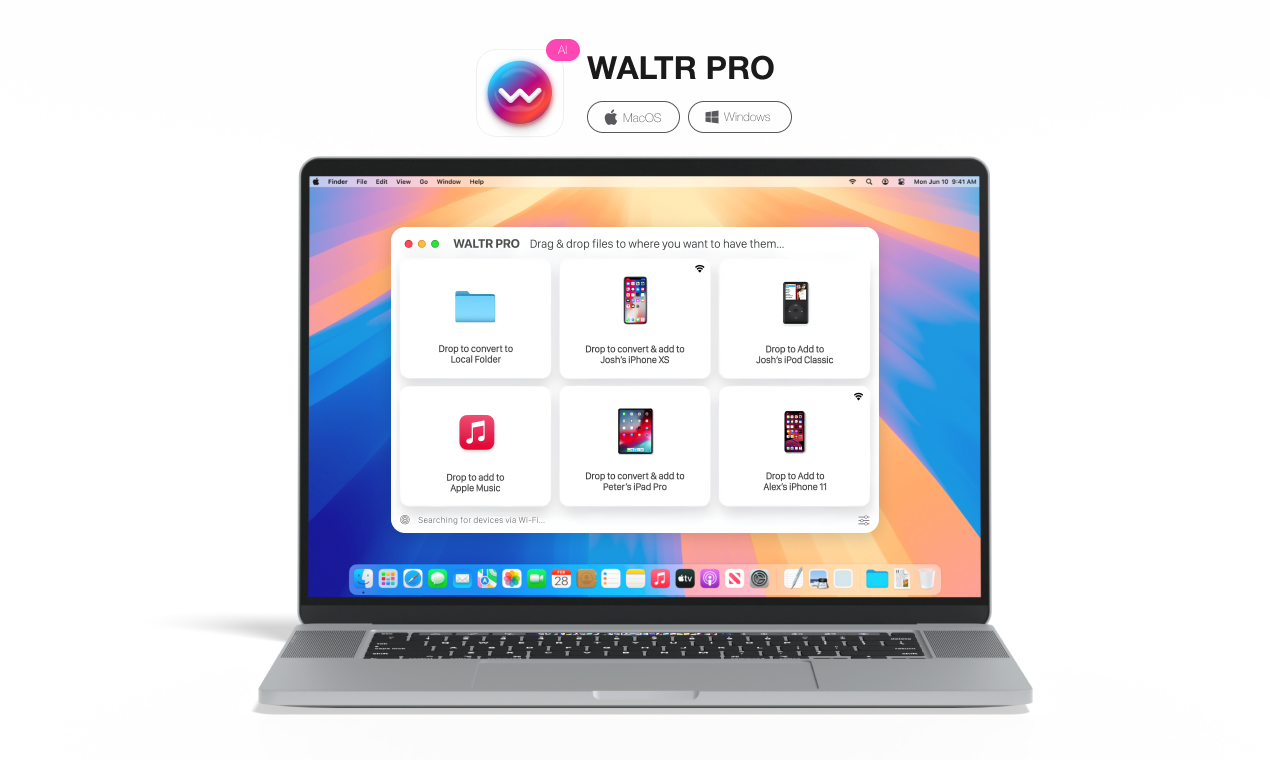
WALTR PRO is the Softorino option for the part most converter pages ignore: getting the file onto your iPhone or iPad in a way that feels normal.
Generic converters give you a file. WALTR PRO helps when you want that audio to land on your Apple device without opening iTunes, syncing a whole library, or hunting for the right destination folder.
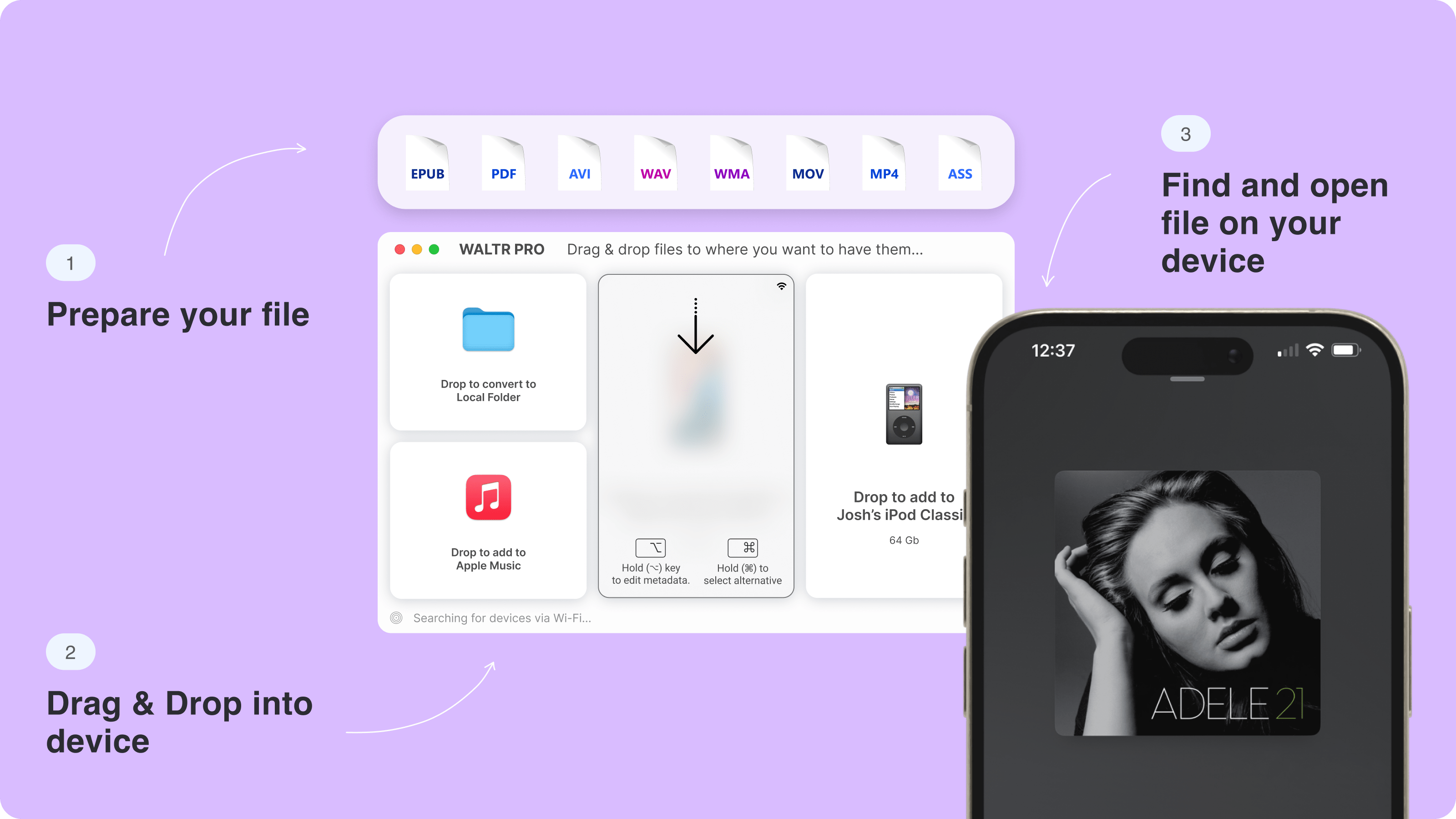
WALTR PRO runs on Mac and Windows. You drag in supported media, connect your iPhone or iPad by cable or Wi-Fi, and send the file to the device. Music lands where you expect it: inside the native Music app when the format and metadata are suitable. If you want the broader workflow, Softorino also has a guide on how to add music to iPhone without iTunes.
Step 1: Install WALTR PRO
Download WALTR PRO on your Mac or Windows PC. Install it, open it, and sign in or start the trial.
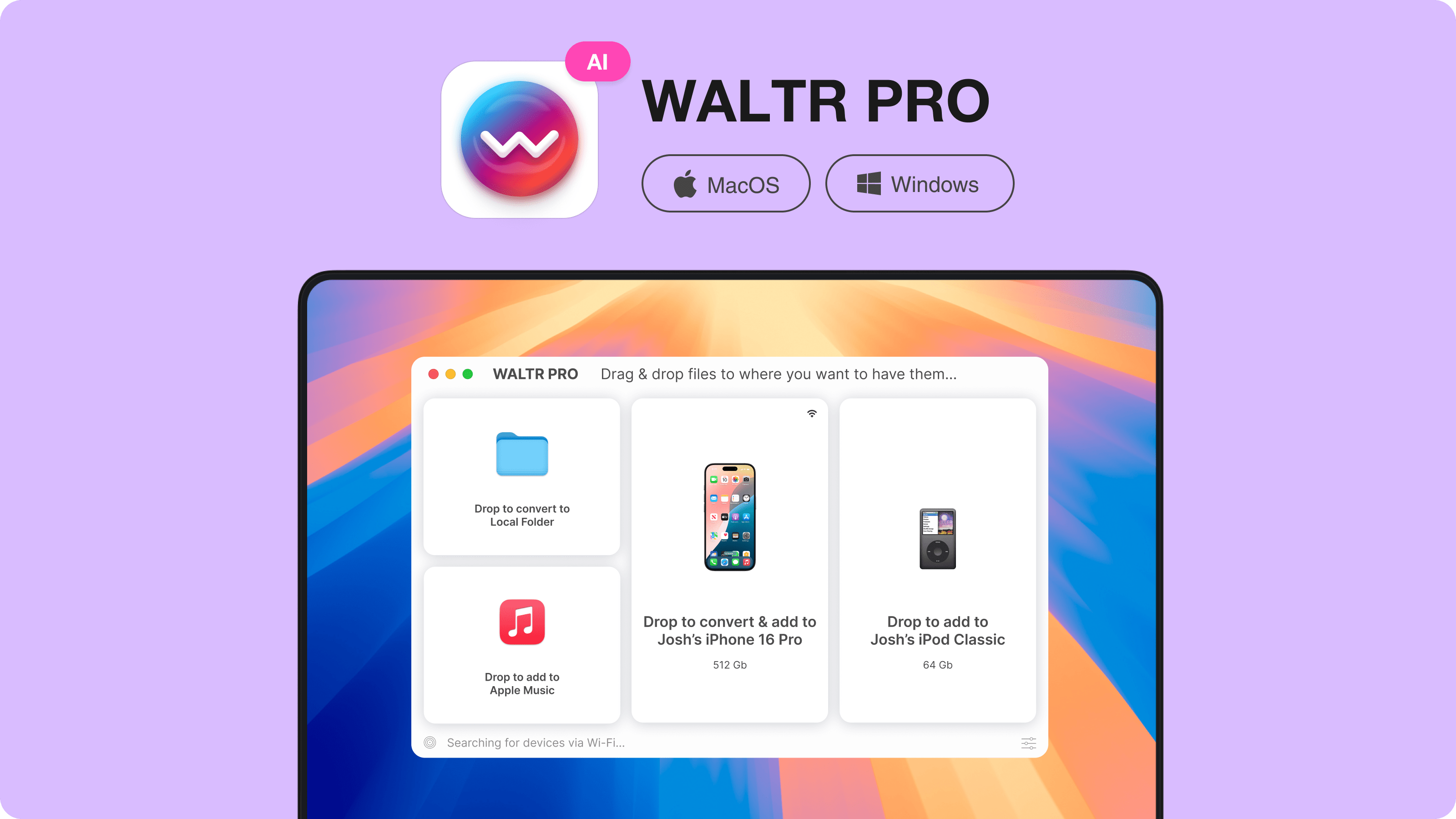
WALTR PRO is useful if you want a local desktop workflow instead of uploading audio to a browser converter. It also helps if the end goal is not a folder of M4A files, but a playable music library on your iPhone.
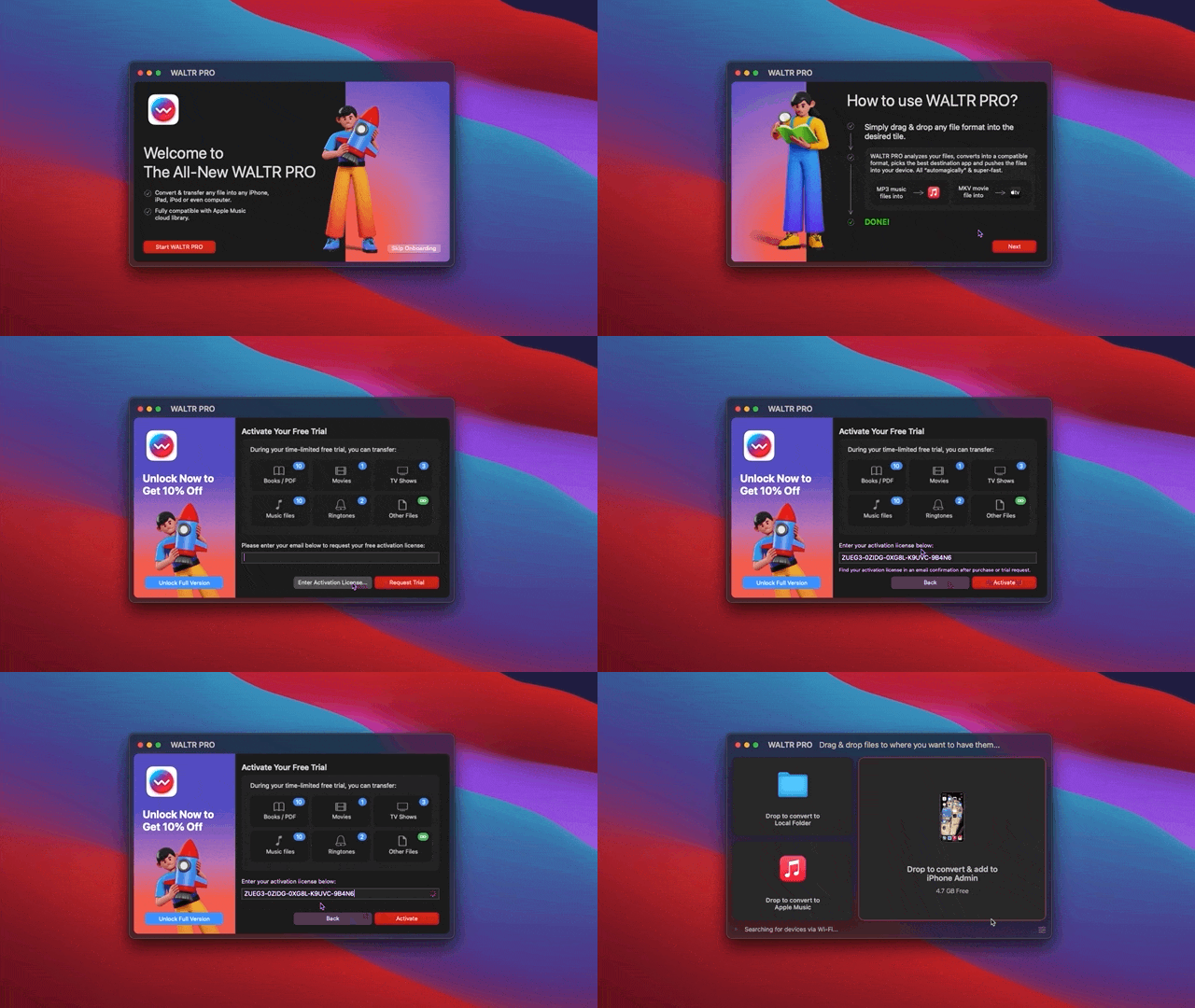
Step 2: Connect your iPhone or iPad
Connect your Apple device with a USB cable first. If you prefer wireless transfers, enable Wi-Fi connectivity inside WALTR PRO after the first cable setup.
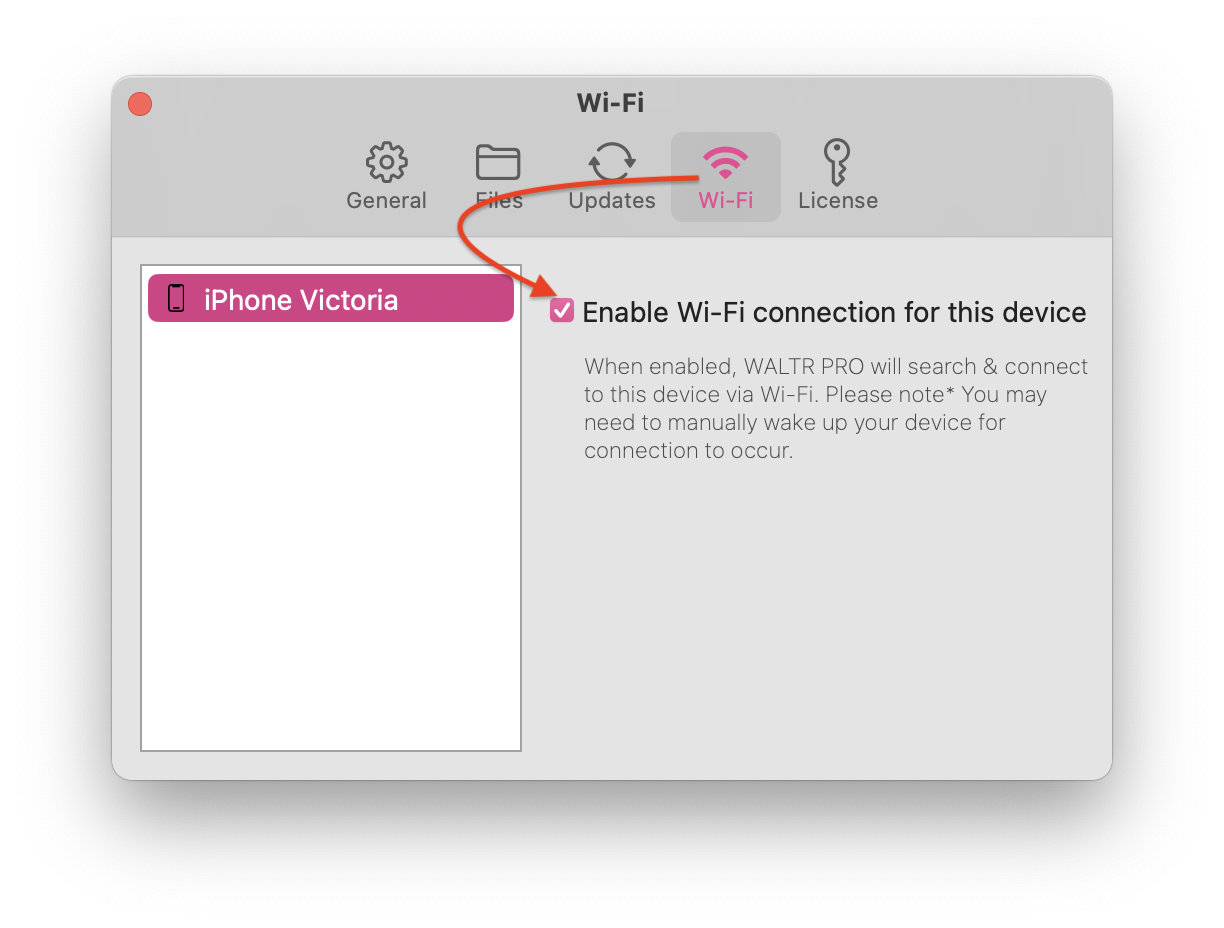
After that, your computer and iPhone can work over the same Wi-Fi network. No full iTunes sync. No replacing your existing library because you clicked the wrong thing.
Step 3: Add your AIFF or M4A files
Drag your audio into WALTR PRO or use the file picker. WALTR PRO detects supported media and prepares it for Apple-device playback.
Before you send files, check the metadata. Track title, artist, album, and artwork matter if you want the file to look clean in the Music app.
Use WALTR PRO when you care about:
- Moving converted M4A files to iPhone without iTunes.
- Keeping music inside the native Apple Music app.
- Sending files over USB or Wi-Fi.
- Avoiding browser uploads for private audio.
- Managing metadata before transfer.
Method 3: Convert AIFF to M4A with Apple Music on Mac
Apple Music can convert audio files on Mac after you set the import format. Apple documents this in its guide to convert music file formats in Music on Mac. The useful part: Music keeps your original file and creates a converted copy.
Use this method when the AIFF file is already in your Music library or you do not mind adding it there first.
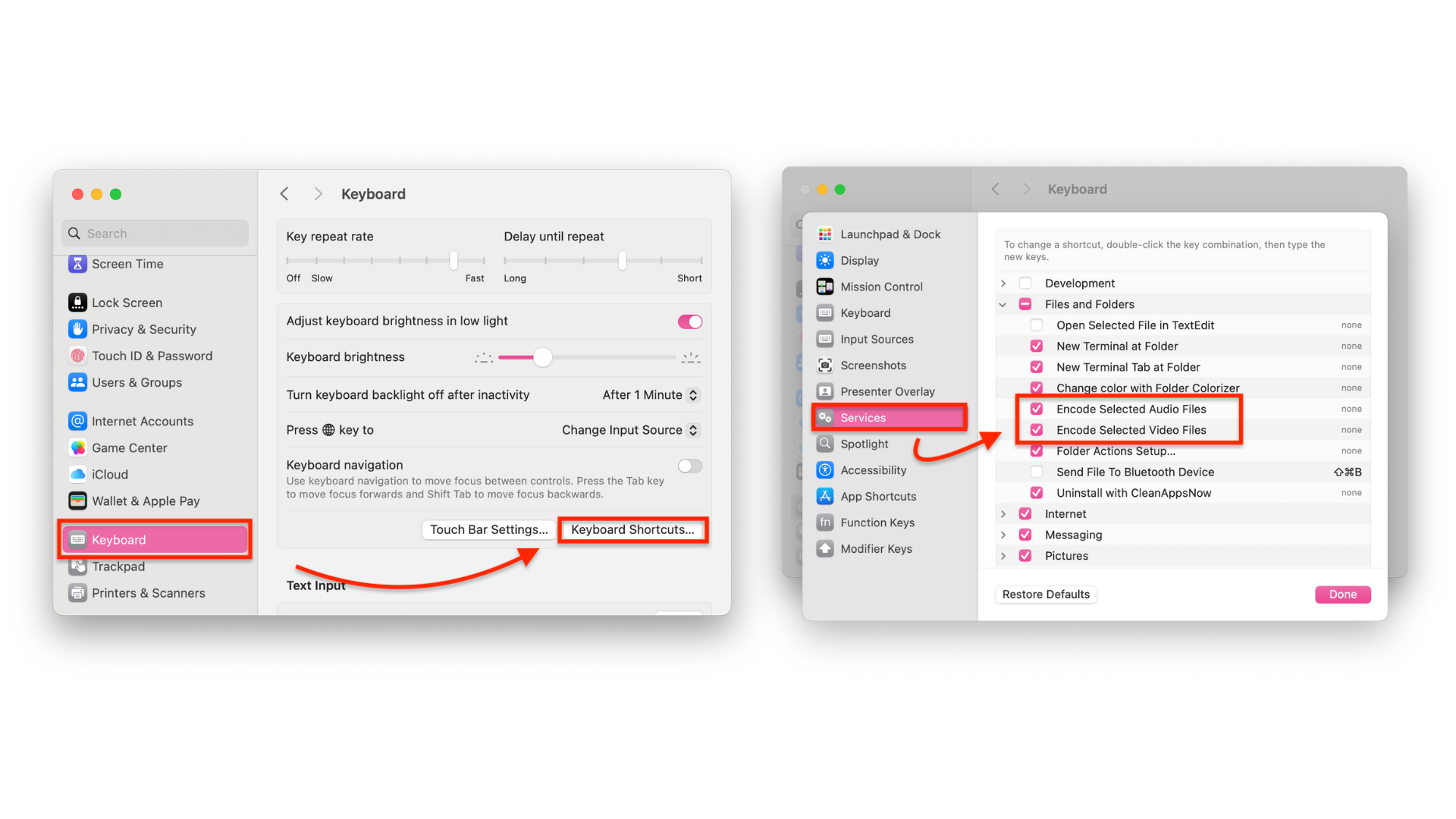
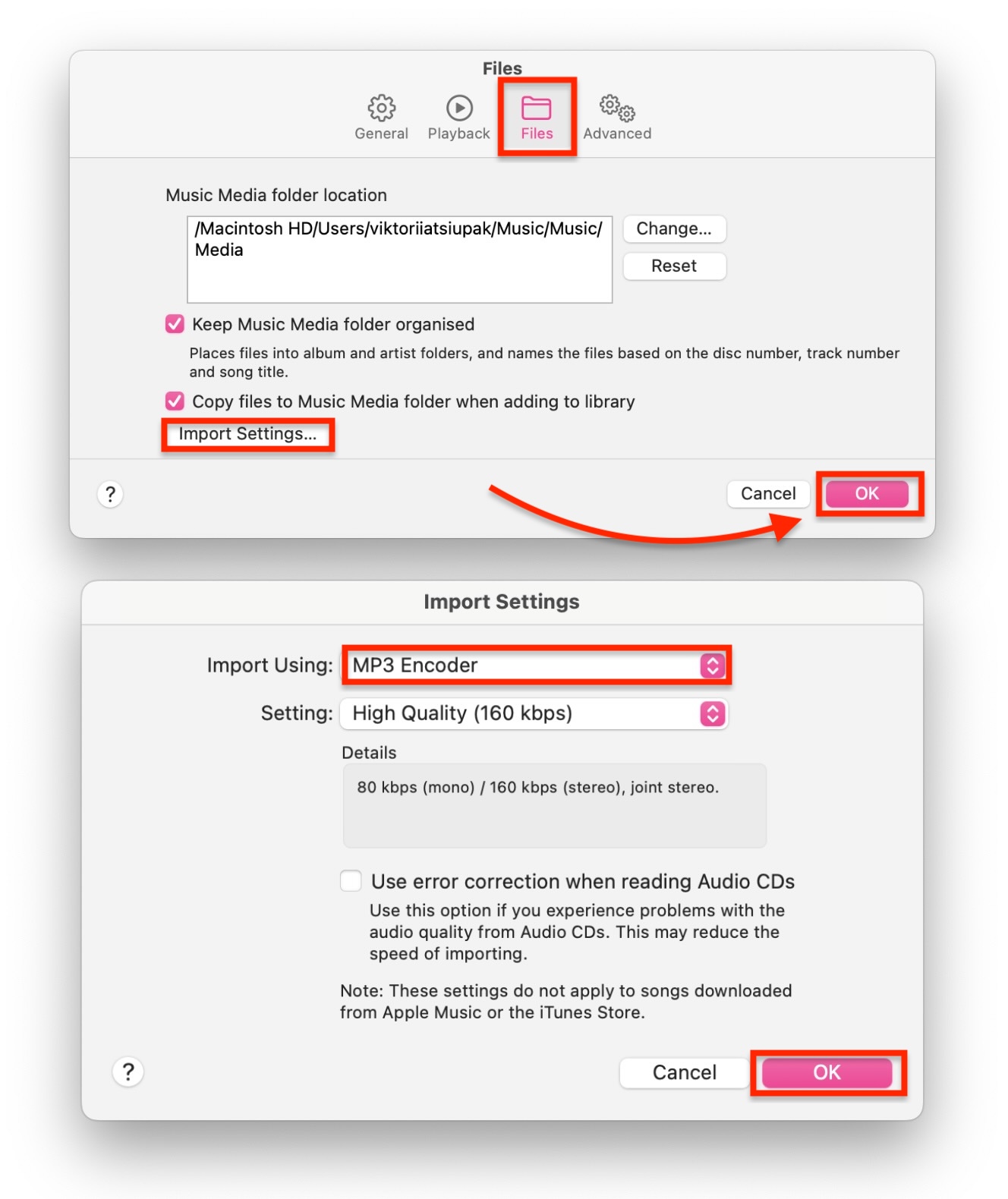
Step 1: Set M4A import settings
- Open the Music app on your Mac.
- Go to Music > Settings.
- Open the Files tab.
- Click Import Settings.
- Choose AAC Encoder for a smaller M4A file.
- Click OK.
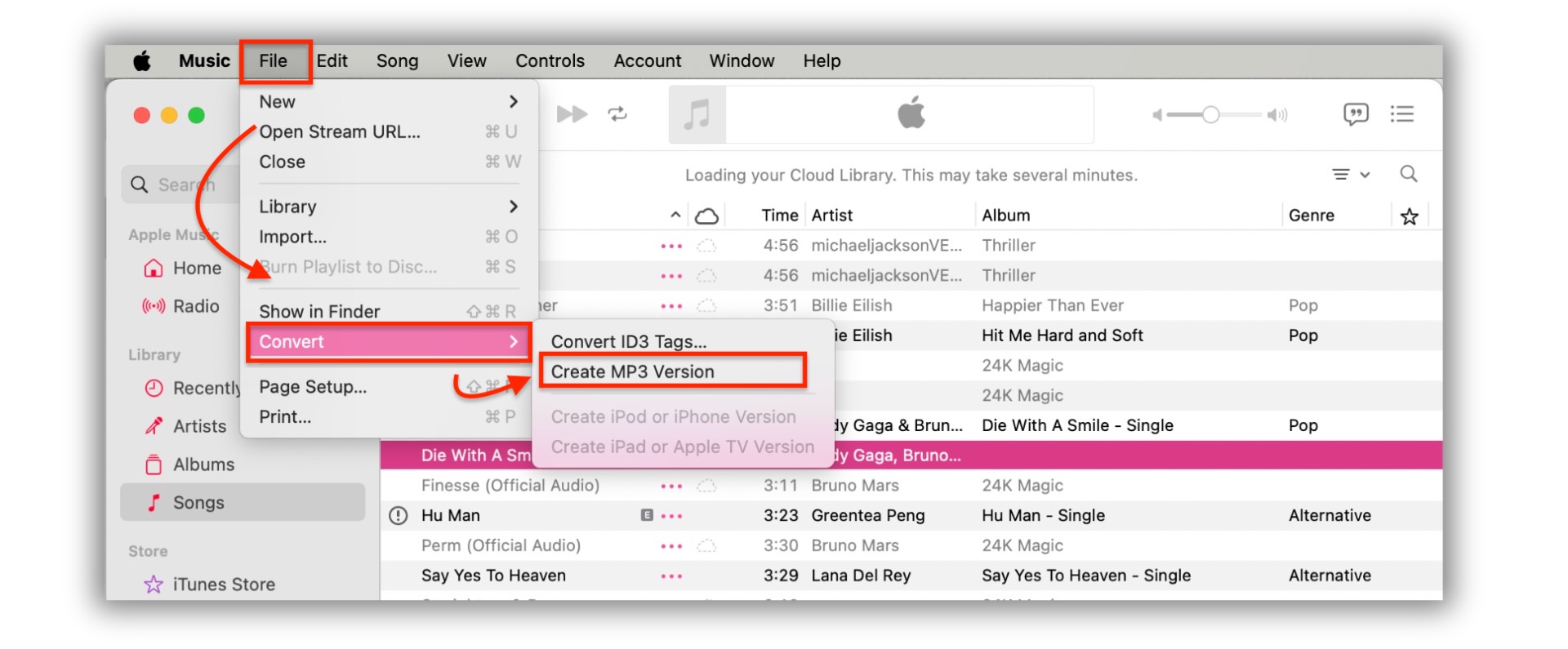
Step 2: Create the M4A copy
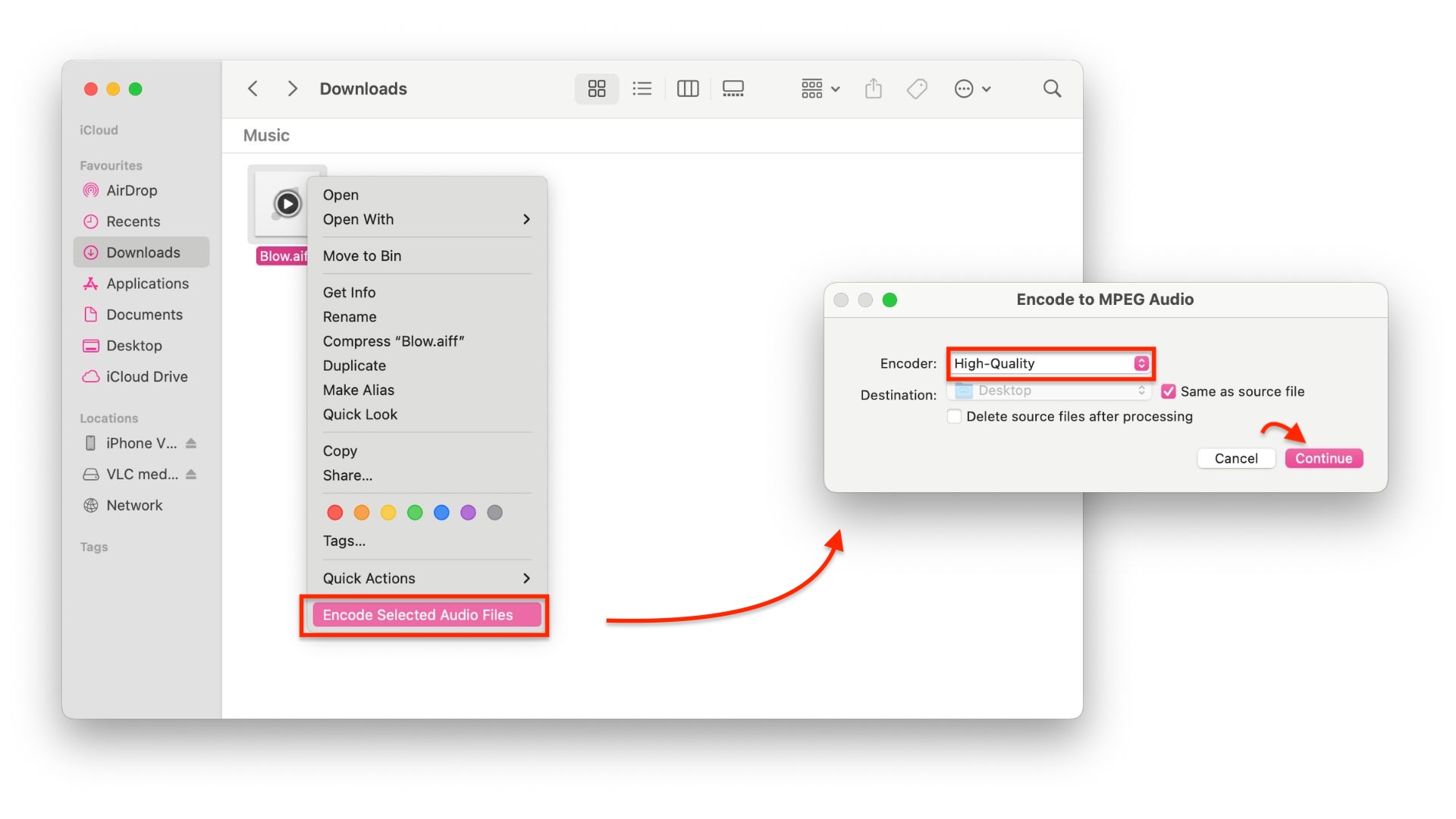
- Select the AIFF song in your Music library.
- Open File > Convert.
- Choose Create AAC Version.
- Wait for Music to create the M4A copy.
- Check the new file before deleting or moving anything.
Apple Music is fine for occasional conversions. It is not great if you have a folder full of files outside your library or you want a cleaner transfer path to iPhone.
What about VLC?
VLC can convert AIFF to M4A, but it is better as a backup method than the first recommendation. VLC is great for playing strange files. Its conversion flow is less friendly.
Use VLC if you already have it installed and only need a one-off conversion.
- Open VLC.
- Go to Media > Convert/Save on Windows, or File > Convert/Stream on Mac.
- Add your AIFF file.
- Choose an audio output profile that creates M4A or AAC output.
- Pick a destination file.
- Start the conversion.
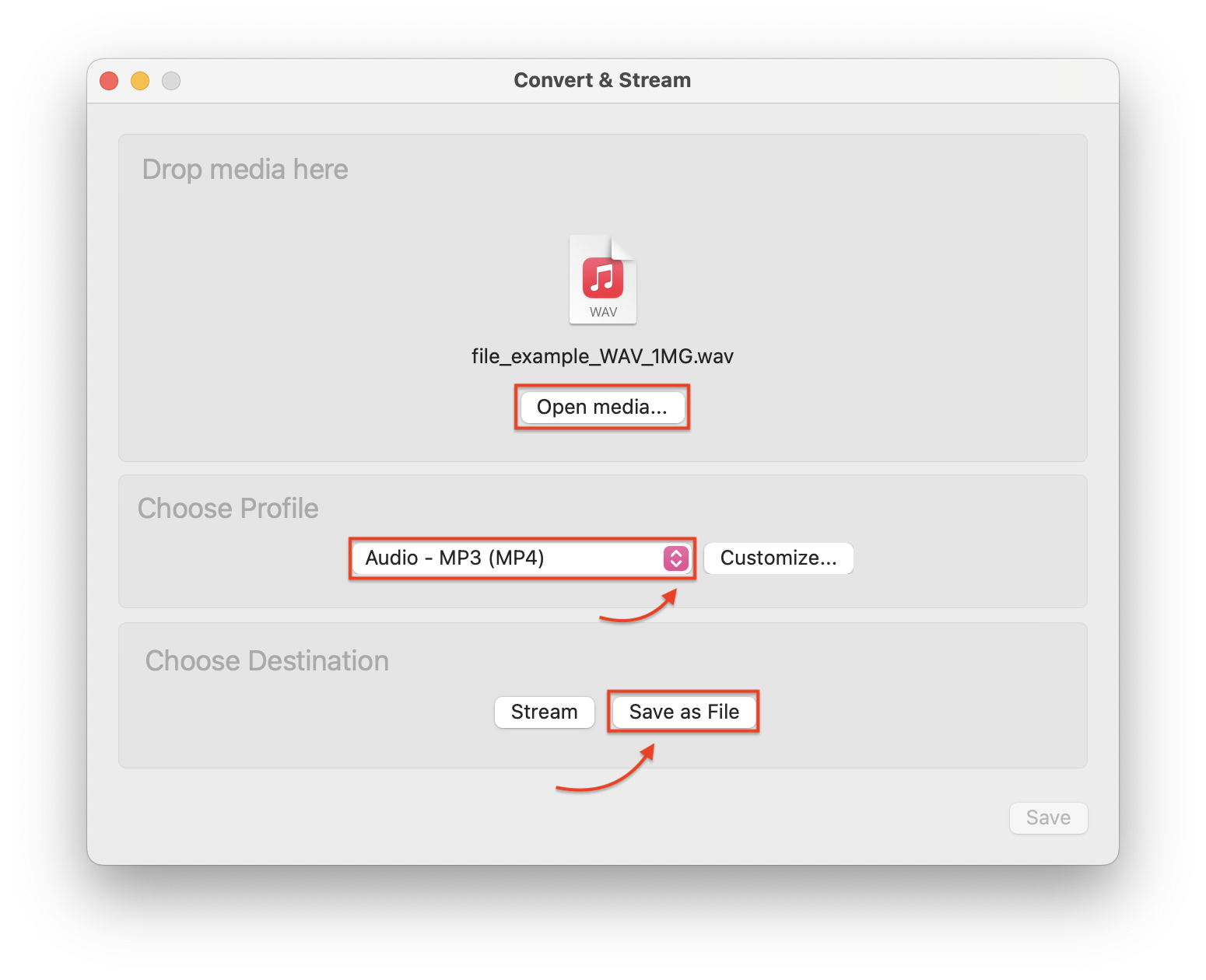
The downside is control. VLC profiles can be confusing, metadata handling is limited, and the converted file still needs a separate transfer step if you want it on iPhone.
Method 4: Convert AIFF to M4A with iTunes on Windows
iTunes on Windows can also convert audio after you set the import encoder. Apple lists AAC, AIFF, Apple Lossless, MP3, WAV, and HE-AAC options in its iTunes import settings guide.
Use this method if you already manage music in iTunes. If you left iTunes because it made simple tasks feel like a tax form, skip to WALTR PRO.
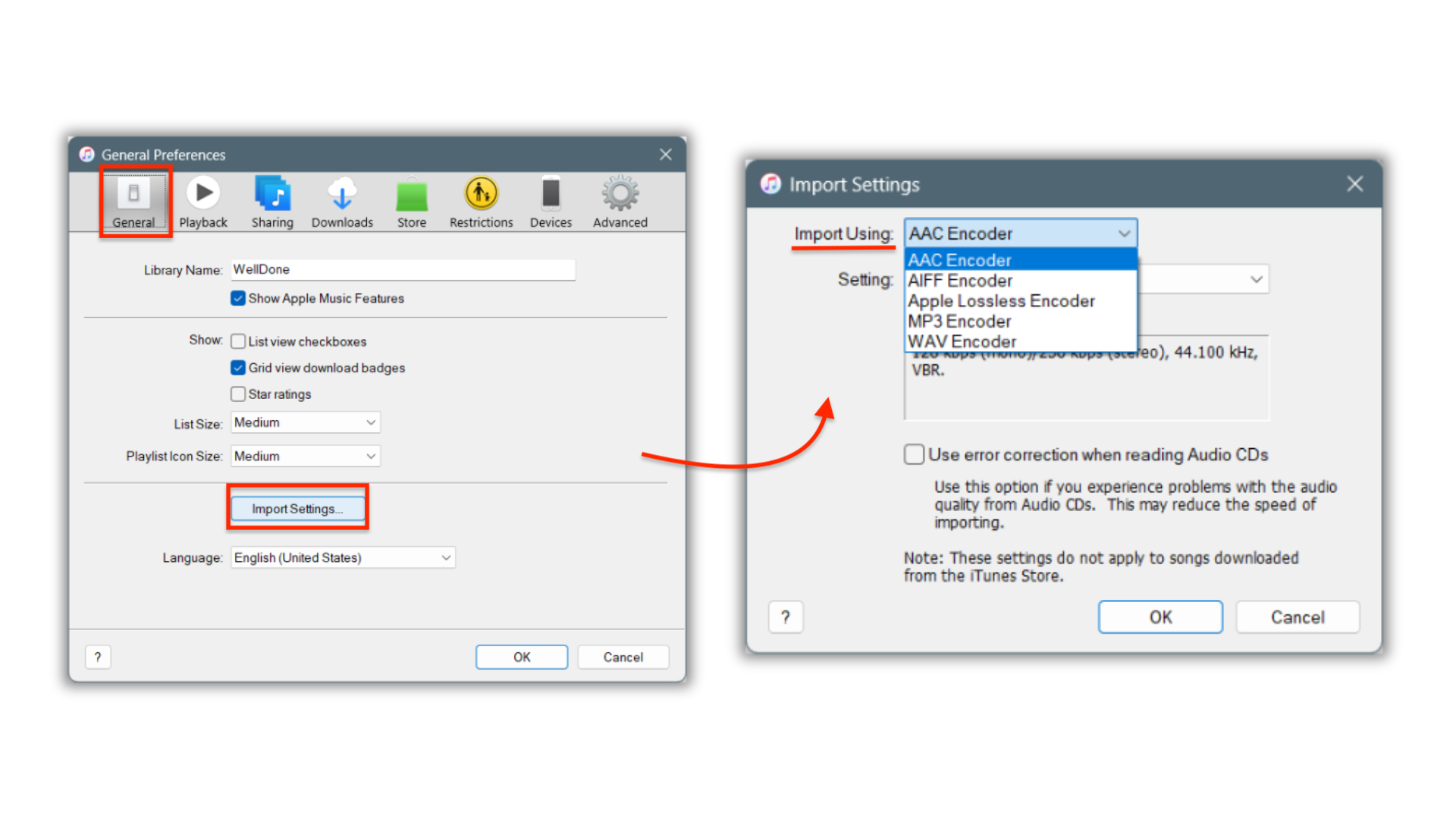
Step 1: Choose the AAC encoder
- Open iTunes on your Windows PC.
- Go to Edit > Preferences.
- Open the General tab.
- Click Import Settings.
- Choose AAC Encoder.
- Click OK.
Step 2: Convert the file
- Add your AIFF file to your iTunes library.
- Select the file.
- Open File > Convert.
- Choose Create AAC Version.
- Find the new M4A copy in your library.
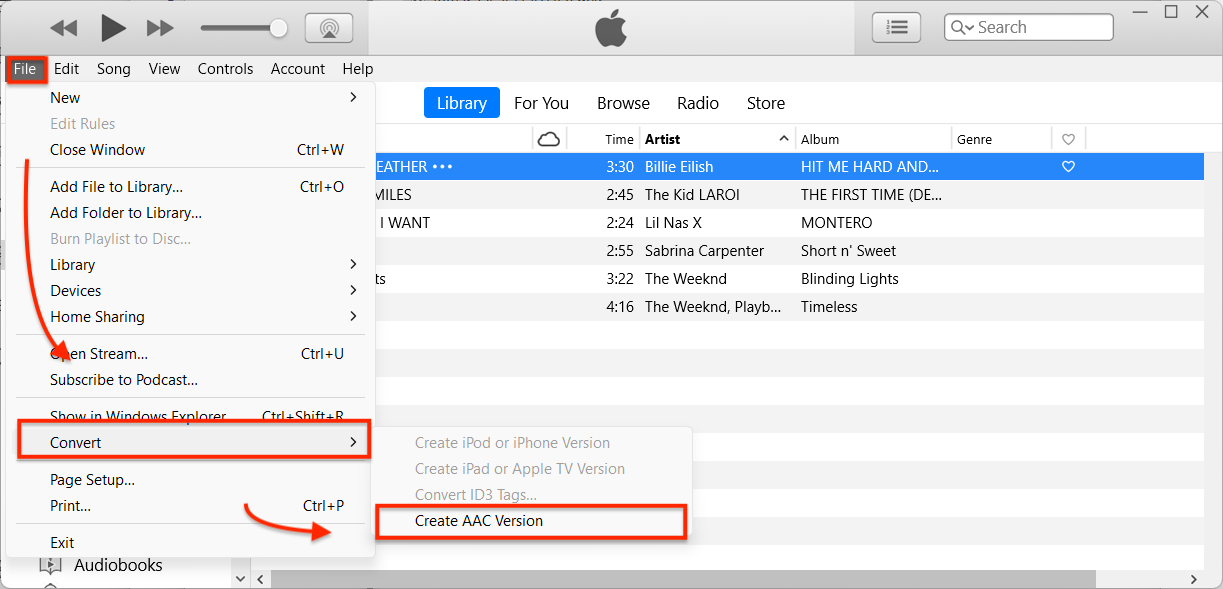
iTunes works, but it is still iTunes. The conversion sits inside a library workflow, and moving the result to an iPhone can pull you back into sync settings.
Which AIFF to M4A method should you choose?
Choose the method based on the real job, not only the file extension.
Goal | Pick this | Why |
|---|---|---|
Convert one small file now | Online converter | Fastest path from AIFF to M4A |
Convert private audio | Apple Music, iTunes, or another local desktop converter | Keeps the file on your computer |
Convert files already in your Mac library | Apple Music | Built in and preserves the original file |
Convert files already in iTunes on Windows | iTunes | Works if you already use iTunes |
Put the result on iPhone or iPad | WALTR PRO | Transfers music to Apple devices without iTunes sync |
Archive original recordings | Keep AIFF, make M4A copies | AIFF keeps the source quality intact |
If you only need a downloadable M4A file, use the fastest safe converter. If you want the file on your iPhone, use WALTR PRO to transfer converted M4A files to iPhone without iTunes. If you are comparing Apple-friendly audio formats, the FLAC to M4A guide covers the same AAC vs lossless tradeoff from another angle.
Common mistakes when converting AIFF to M4A
Deleting the AIFF original too early
Keep the AIFF file if it is an original recording, production master, or hard-to-replace source. M4A is excellent for listening, but AAC compression is not the same as keeping the original uncompressed audio.
Choosing the wrong codec
If you want small files, choose AAC. If you need lossless audio in an Apple-friendly container, choose Apple Lossless. Both can use the M4A extension, so check the settings before converting a full library.
Uploading sensitive files to online tools
Online converters are convenient. They are not the right place for client recordings, unreleased music, paid content, or private voice memos. Use a local app for those files.
Forgetting the transfer step
A converted M4A file on your desktop does not help much if your goal is listening on iPhone. Plan the full path: convert the file, check metadata, then transfer it to your Apple device.
Bottom line
Converting AIFF to M4A makes sense when you want smaller Apple-friendly audio files. Use AAC M4A for daily listening and phone storage. Keep AIFF for original masters. Use Apple Lossless only when you need lossless audio and can accept larger files.
For one quick file, an online converter works. For files already in your library, Apple Music or iTunes can do the job. For the full Apple-device workflow, use WALTR PRO. It handles the part that usually becomes annoying: getting your music onto iPhone or iPad without iTunes sync.
FAQ
Is AIFF better quality than M4A?
AIFF usually keeps higher source quality because it is uncompressed. M4A depends on the codec. AAC M4A is lossy and smaller. Apple Lossless M4A keeps lossless audio but creates larger files than AAC.
Does converting AIFF to M4A reduce quality?
Converting AIFF to M4A with AAC can reduce quality because AAC removes some audio data to shrink the file. For normal listening, the smaller file is usually worth it. For archiving or editing, keep the AIFF original.
Is M4A the same as AAC?
No. M4A is a container file format. AAC is a codec that often lives inside an M4A file. M4A can also contain Apple Lossless audio.
Can Apple Music convert AIFF to M4A on Mac?
Yes. Apple Music on Mac can create a converted copy after you set the import encoder in Music > Settings > Files > Import Settings. Choose AAC Encoder if you want a smaller M4A file.
Can iTunes convert AIFF to M4A on Windows?
Yes. iTunes for Windows can convert AIFF files after you choose AAC Encoder in Import Settings. It works best when the file is already part of your iTunes library.
What is the safest AIFF to M4A converter for private files?
The safest option is a local converter because the audio stays on your computer. Use Apple Music, iTunes, or a desktop app instead of uploading private recordings to an online converter.
How do I transfer converted M4A files to iPhone without iTunes?
Use WALTR PRO. Connect your iPhone or iPad, drag in the M4A file, and send it to the device. The point is simple: move music to iPhone without iTunes sync menus.

WALTR PRO
Convert & Push Any File into Any Apple Device
