How to Convert MPEG to MP4 for iPhone and Apple Devices

You have an old MPEG or MPG video. Your iPhone does not care. It refuses to play, or it plays in the wrong app, or iTunes turns a 2-minute job into a small punishment. The fix is to convert MPEG to MP4, or to an Apple-friendly M4V file, and then send it to the right Apple app.
This guide shows the practical route. You will see what MPEG, MPG, MP4, and M4V mean, when an online converter is fine, and how WALTR PRO converts and transfers the video to iPhone, iPad, or Apple TV without iTunes syncing.
Fast answer: use MP4 or M4V for Apple devices. Do not rename .mpg to .mp4. Convert the file, then transfer it with a tool that understands Apple apps.
Quick answer
- For one small public clip: an online MPG to MP4 converter can work.
- For private, large, or family videos: use a local Mac or Windows app instead of uploading the file to a random website.
- For iPhone or iPad: WALTR PRO can convert the video and send it straight to Apple TV or another supported app.
Before we begin
Download WALTR PRO on Mac or Windows to prepare an MPEG or MPG video for Apple playback and transfer it directly to an iPhone or iPad. Test one short file before processing a large batch.
MPEG to MP4 vs MPG to MP4: what you are converting
People search for MPEG to MP4 and MPG to MP4 because the file names are messy. MPEG is the video standards family. MPG is a common file extension for older MPEG video files, usually MPEG-1 or MPEG-2. In normal user language, MPG and MPEG often point to the same problem: an older video file that does not behave nicely on newer devices.
MP4 is a newer container format. A container is the wrapper. The codec is the way the video and audio are compressed inside it. That distinction matters because Apple devices care about both. A file named .mp4 can still fail if the video codec, profile, resolution, or audio track is not supported.
Format | Extension | Apple Compatibility | Best For |
|---|---|---|---|
MPEG | .mpg/.mpeg | ❌ Limited | 🎥 Older systems, DVD video |
MP4 | .mp4 | ✅ Good | 🌐 General use, web streaming |
M4V | .m4v/.mp4 | 🌟 Excellent | 🍎 Apple devices, iTunes |
MPG and MPEG
- Usually older MPEG-1 or MPEG-2 video.
- Often found in DVD rips, camcorder exports, archived clips, and old Windows video folders.
- May work on desktop players, but iPhone and iPad support is limited.
- Needs real conversion when the destination is Apple TV, iPhone, or iPad.
MP4
- A modern container format used across phones, computers, browsers, and TVs.
- Often carries H.264 or H.265/HEVC video with AAC audio.
- Usually creates smaller files than old MPEG workflows at similar visible quality.
- Best everyday target when you need a video to work on more devices.
M4V
- Apple’s MP4-family container used by Apple apps and older iTunes workflows.
- Can be the better output when the destination is iPhone, iPad, or Apple TV.
- Seeing .m4v from WALTR PRO is expected Apple-friendly behavior, not a broken conversion.
- For most viewers, MP4 and M4V solve the same playback job when the codecs are compatible.
Why Apple devices prefer MP4, M4V, or MOV
Apple technical specs commonly list video playback support for .m4v, .mp4, and .mov files, with codec and audio limits attached. That last part matters. The extension alone is not a magic passport.
This is why changing family-video.mpg to family-video.mp4 does not convert anything. You only changed the label. The video and audio inside the file stayed the same, so your iPhone may still reject it.
Rename changes the filename. Conversion changes the video. If the file still contains old MPEG video, iPhone playback may still fail.
Format note
The safest Apple-device target is an MP4 or M4V container with iPhone-friendly video and audio. You do not need to memorize codec profiles. You need a workflow that picks the right output and then gets the file onto the device without iTunes drama.
Standalone converter for various formats
Cover and metadata editor
Ability to transfer files to third-party apps on iPhone or iPad
How to convert MPEG to MP4 with WALTR PRO
WALTR PRO is the clean option when your real goal is not only conversion. The real job is: make the MPEG video work on iPhone, iPad, or Apple TV, then put it there. WALTR PRO handles both parts on Mac and Windows.
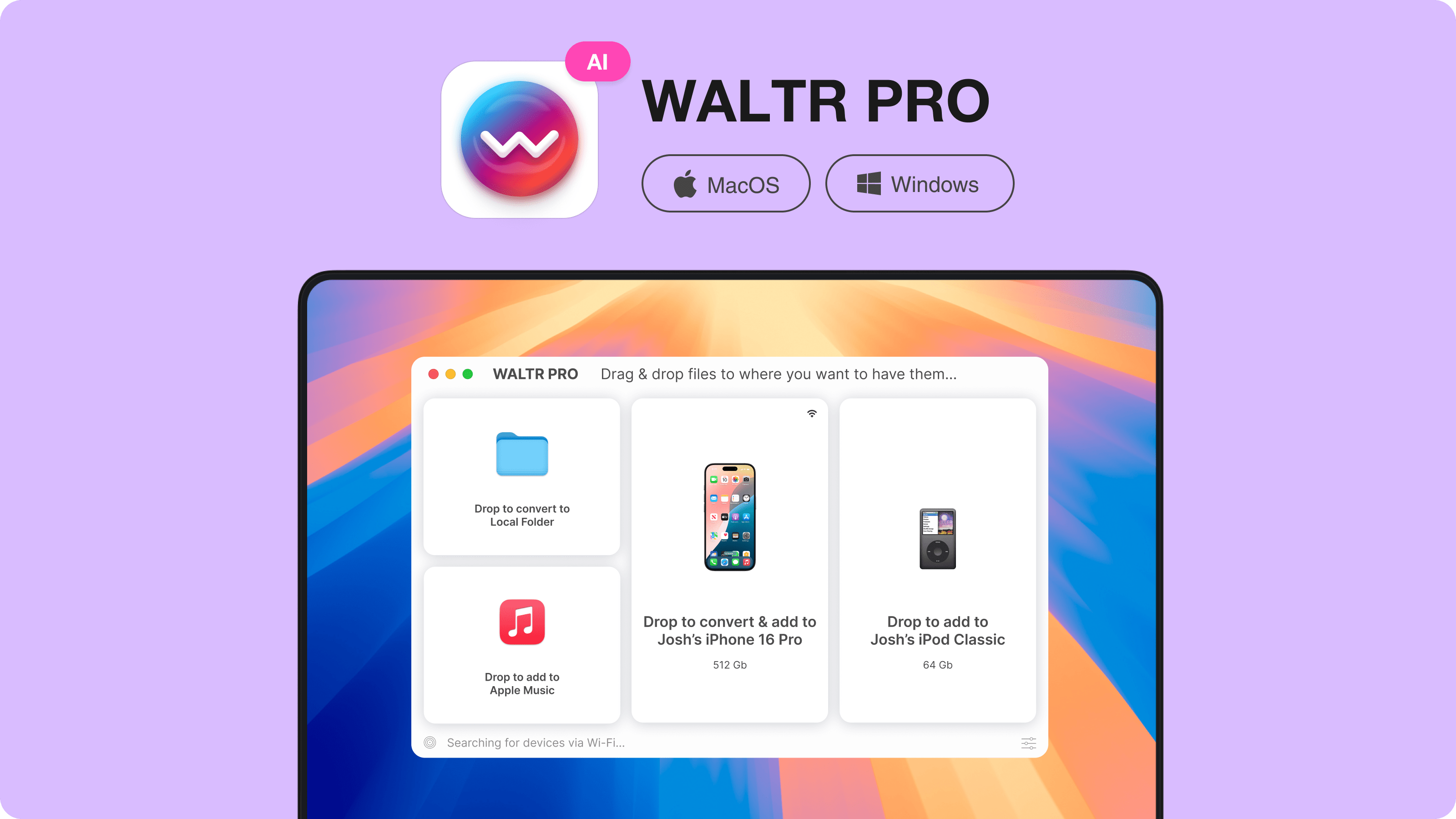
It supports many common media formats, including MPG, MKV, AVI, MP4, FLAC, MP3, PDFs, ringtones, and subtitles. It sends files to native Apple apps where they belong, such as Apple TV, Apple Music, or Apple Books, without making you sync a library through iTunes.
What WALTR PRO handles before the transfer
That product video is the point: drag a file in, pick the destination, and let the app deal with the Apple-format mess. No separate converter, no Finder hunt, no iTunes sync screen.
Step 1. Download and install WALTR PRO
Download WALTR PRO for Mac or Windows from Softorino. Install the app, open it, and start the free trial. Use the official product page so you avoid fake download buttons and repackaged installers.
If you only need a converted file on your computer, you can stop at a local output. If you want the video on iPhone or iPad, keep going. That is where WALTR PRO saves the most time.
Step 2. Connect your iPhone or iPad
Connect your device with a cable the first time and tap Trust on the iPhone or iPad. After setup, WALTR PRO can also work over Wi-Fi. Cable is still the boring reliable choice for huge old video files.
- Choose the destination app. For video, use the Apple TV-style destination when available.
- Keep the file local. Your private video stays on your computer and device instead of going through an upload-first converter site.
- Skip iTunes sync. You do not need to rebuild an Apple media library to move one video.
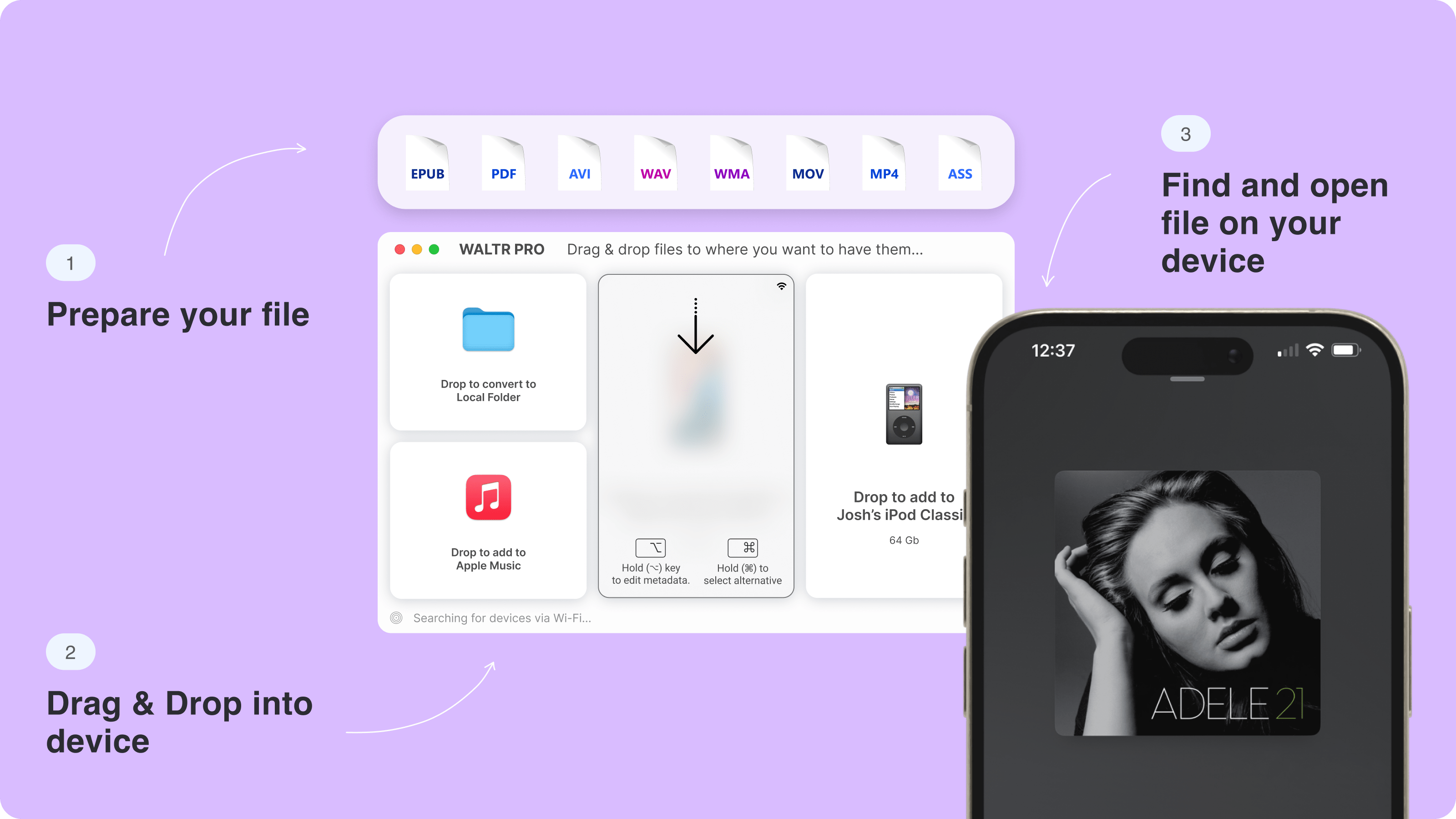
Step 3. Drop the MPEG or MPG file into WALTR PRO
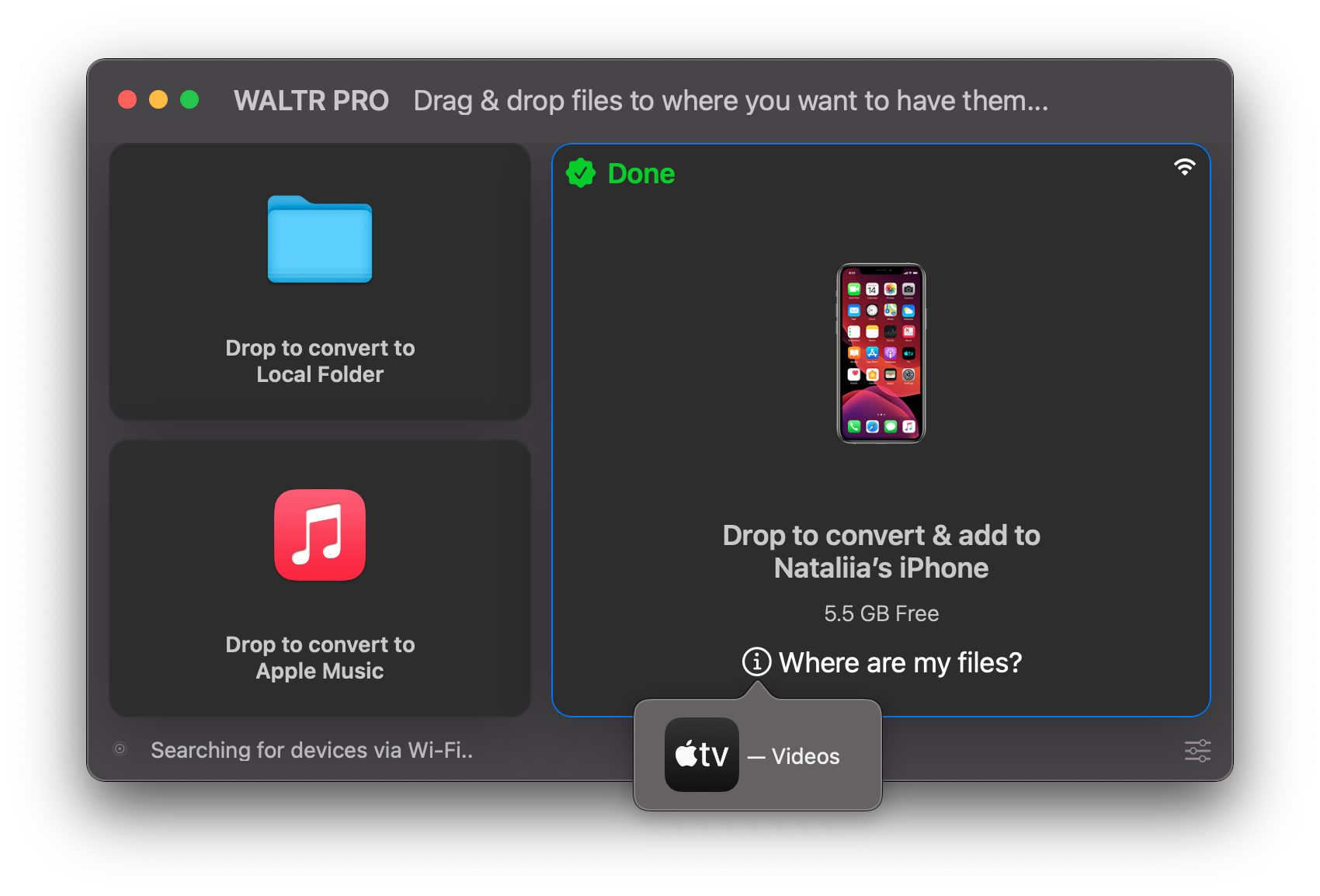
Find the MPEG or MPG file on your Mac or Windows PC. Drag it into WALTR PRO. The app prepares the Apple-friendly output and transfers it to the destination you picked.
- Open WALTR PRO.
- Drag the MPEG or MPG file into the transfer window.
- Choose the iPhone, iPad, or local destination.
- Wait for the conversion and transfer to finish.
- Open the video in the destination app on your Apple device.
When the transfer finishes, check the app you selected. If WALTR PRO used M4V instead of MP4, do not panic. For Apple playback, that can be the right call.
What else you can convert and transfer
This article focuses on MPEG to MP4, but the same Apple-device workflow helps with other annoying formats. If you have an old media folder, you probably have more than one format Apple does not love.
- Send AVI, MKV, and MPG videos to iPhone or iPad without iTunes.
- Move MP3, FLAC, and AAC files into Apple Music-style destinations.
- Transfer PDFs, subtitles, ringtones, and other supported files to the right Apple apps.
- Use related guides for adding movies to Apple TV library, converting TS to MP4, or transferring video from PC to iPhone.
When an online MPG to MP4 converter is fine
Integrates better with iOS and macOS
Supports rich metadata (cover art, episode info, etc.)
Allows for DRM (like iTunes purchases)
Online converters are not automatically evil. If you have a tiny public clip, no privacy concerns, and no need to transfer the file to an Apple device, a browser converter can be enough. Upload, convert, download, done.
The problems start with real files. Old family videos are private. Camcorder clips can be huge. Upload limits waste time. Some converter sites surround the real button with ads that look like download buttons. You know the exact circus.
Here is the practical split:
- Online MPG to MP4 converter: good for small public files and one-off jobs, but weak on upload privacy, file-size limits, ads, and iPhone transfer.
- Desktop video converter: good for local conversion with more control, but you still need a separate transfer step for iPhone.
- WALTR PRO: best when you want to convert and transfer videos to iPhone, iPad, or Apple TV in one flow.
- iTunes or Finder sync: useful only if you already live in Apple’s sync workflow and do not mind the extra friction.
If the final destination is your iPhone, use a workflow built for that destination. Convert and transfer files to iPhone with WALTR PRO instead of stitching together a random converter and Apple’s sync tools.
How to keep video quality when converting MPEG to MP4
Conversion can reduce quality if the settings are bad. That does not mean every conversion ruins the video. It means you should avoid needless re-encoding, low bitrate presets, and mystery “compress my file” buttons when you care about the result.
- Start with the best source file. You cannot restore detail that the old MPEG file no longer has.
- Do not upscale for no reason. A 480p camcorder clip does not become real 1080p because a converter lets you pick 1080p.
- Use Apple-friendly codecs. H.264 or H.265/HEVC video with AAC audio is usually safer than an obscure codec inside an MP4 wrapper.
- Avoid repeated conversions. Convert once for the destination you need, then keep that output.
Quality rule: conversion should solve compatibility, not pretend an old file has more detail than it has.
Quality note
For Apple-device playback, the practical target is simple: an MP4 or M4V file that Apple apps can read. WALTR PRO is useful because it removes the manual guessing and sends the file where you want it afterward.
Troubleshooting: converted MP4 still will not play on iPhone
Sometimes a file says MP4 and still refuses to play. Annoying, but not mysterious. Usually the file uses a codec, audio track, resolution, or corruption pattern your Apple device does not like.
- Check whether you renamed instead of converted. If you only changed .mpg to .mp4, convert the file properly.
- Check the codec. MP4 is a container. The video inside still needs an Apple-friendly codec.
- Try M4V output. If the destination is Apple TV or iPhone, M4V may behave better in Apple apps.
- Use cable for large videos. Wi-Fi transfer can fail or slow down with big files.
- Test a short clip first. If the source file is damaged, a small test conversion tells you before you wait on the whole thing.
If the file matters, do not keep throwing it into random web tools. Use a local workflow, keep the original MPEG file, and convert from that source once you know which output plays.
Why WALTR PRO may convert to M4V, not MP4
If WALTR PRO gives you an .m4v file, it is not broken. M4V is Apple’s MP4-family format. Apple apps have used it for years, especially for video libraries and metadata. For the person watching the video, the point is the same: the file opens where it should.
That is why the best answer is not always “MP4 at all costs.” The best answer is the file format your Apple device will play cleanly. If that means Apple-friendly M4V, take the win.
Final take: convert for the destination, not the extension
If you only need a quick web conversion for a harmless small clip, an online MPG to MP4 converter can do the job. If you want an old MPEG video on iPhone, iPad, or Apple TV, use a workflow that handles the Apple part too.
WALTR PRO converts and transfers in one pass. You drag in the MPEG or MPG file, choose the destination, and skip iTunes. That is the whole appeal.
Download WALTR PRO and try the MPEG to MP4 workflow. If you use several Softorino apps, you can also get all Softorino apps for $3/month.
For a quick browser-based conversion, use Softorino's free MPG to MP4 converter. Your video stays on the device while the browser processes it.
FAQ
Is MPG the same as MPEG?
Not exactly, but users often mean the same thing. MPEG is the video standards family. MPG is a common extension for older MPEG video files. If you are searching MPG to MP4, you are usually trying to convert an older MPEG-style video into a modern MP4 file.
Can iPhone play MPG files?
iPhone does not reliably play old MPG or MPEG-1/MPEG-2 files as normal Apple video files. Convert MPEG to MP4, M4V, or MOV with Apple-friendly codecs before you transfer the video.
Should I convert MPEG to MP4 or M4V for iPhone?
MP4 is the most universal choice. M4V is often better inside Apple video workflows. If WALTR PRO outputs M4V for an Apple device, treat that as an Apple-friendly output, not a failed MP4 conversion.
Can I convert MPEG to MP4 without losing quality?
You can avoid unnecessary quality loss by using a good source file, sane bitrate settings, and one clean conversion. Do not expect conversion to improve the original video. It solves compatibility; it does not invent detail.
Is an online MPG to MP4 converter safe?
It can be fine for a small public clip. Avoid online converters for private videos, large files, sensitive recordings, or anything you do not want uploaded to a site you do not control.
Can WALTR PRO transfer the converted video to iPhone without iTunes?
Yes. WALTR PRO can convert and transfer supported video files to iPhone or iPad over cable or Wi-Fi after setup. It sends files to Apple apps without iTunes syncing.

WALTR PRO
Convert & Push Any File into Any Apple Device
