How to Convert RM to MP4 on Mac or Windows in 2026


Need to convert RM to MP4? Use an online converter for a small, non-private file. Use VLC if you want a free local option. Use FFmpeg if you have a batch of old RealMedia files and do not mind the command line. If your real goal is watching an old RM or RMVB video on iPhone or iPad, use WALTR PRO and skip the iTunes mess.
That is the useful answer.
RM is an old RealMedia format from the RealPlayer era. You still find it in old downloads, archived lectures, backups, fan videos, and folders nobody has opened since Windows XP felt current. MP4 is the safer target now because it plays almost everywhere.
This guide shows the best conversion method for each situation, how RM and RMVB differ, what to do when VLC or FFmpeg fails, and where WALTR PRO fits without pretending one tool solves every job.
Quick answer: best RM to MP4 method by situation
Start here if you want the shortest path.
Your situation | Best method | Why it works | Watch out for |
|---|---|---|---|
One small RM file, nothing private | Online converter | Fast browser workflow, no install | Upload privacy, file-size limits, ads, account prompts |
Private video, client file, family archive | VLC | Free, local, no upload | Basic conversion controls, older codecs can still fail |
Many RM or RMVB files | FFmpeg | Batch-friendly and scriptable | Command line, build-specific codec support |
You want the video on iPhone or iPad | WALTR PRO | Transfers supported legacy video formats to Apple devices without iTunes | Not the best fit if you only need a guaranteed standalone .mp4 export |
File will not open anywhere | VLC or RealPlayer first | Confirms whether the source file is readable | Damaged files may not convert cleanly |
The best converter depends on the job. A browser tool is fine for a harmless clip. It is the wrong choice for private videos, large files, or a folder of 80 old .rmvb files.
Before we begin
Download WALTR PRO on Mac or Windows when the goal is to make an RM or RMVB video playable on an iPhone or iPad without managing a separate iTunes sync. Test one file first because old RealMedia codecs vary.
What are RM and RMVB files?
RM stands for RealMedia. RealNetworks created it for streaming audio and video over slower internet connections. That made sense at the time. Modern phones, TVs, browsers, and editing apps moved on.
An RM file usually contains RealVideo and/or RealAudio data inside a RealMedia container. The problem is not that the file is “bad.” The problem is that many current devices do not know what to do with it.
RMVB means RealMedia Variable Bitrate. It is a related format that changes bitrate as the video plays. Simple scenes can use fewer bits. Busy scenes can use more. That helped keep old videos smaller while keeping watchable quality.
RMVB also causes more conversion pain. Some tools support RM but choke on RMVB. Some convert the video but lose audio. Some produce a file much larger than the original because their bitrate settings are too high. If your file is specifically RMVB, Softorino also has a separate RMVB to MP4 guide for that format.
RM vs RMVB vs MP4
Format | What it is | Best use now | Common issue |
|---|---|---|---|
RM | RealMedia container | Opening old RealPlayer-era videos | Weak support on modern devices |
RMVB | Variable-bitrate RealMedia video | Old web videos and archived clips | Conversion failures and audio issues |
MP4 | Modern video container | Playback, sharing, editing, device support | Bad settings can create huge files |
MP4 is not magic. It is a container. The video and audio inside still matter. For modern playback, the safe target is usually MP4 with H.264 video and AAC audio.
Method 1: Convert RM to MP4 online
Online converters dominate this search because they solve the obvious problem fast. Open a page, upload the .rm file, choose MP4, download the result.
This is the easiest method for one small file.
When an online converter makes sense
Use an online RM to MP4 converter when:
Tools like CloudConvert, FreeConvert, Zamzar, Convertio, and similar sites target this exact job. Some support RMVB to MP4 too. Some give bitrate, resolution, or codec settings. Some limit free file size or push you toward an account.
- The file is small.
- The video is not private.
- You only need one quick MP4 copy.
- You do not want to install software.
- Your internet connection is stable.
How to convert RM to MP4 online
- Open a reputable online converter.
- Upload your .rm or .rmvb file.
- Choose MP4 as the output format.
- Pick H.264 video and AAC audio if the tool gives you codec options.
- Start the conversion.
- Download the MP4.
- Play the MP4 before deleting the original file.
Keep the original RM file until you know the MP4 works. Old files can be weird. Sometimes the first conversion opens but has no audio. Sometimes the video plays with the wrong aspect ratio. Check before you clean up.
Online converter privacy warning
Important: Uploading a video means sending it to someone else’s server. That may be fine for a public clip. It is not fine for private family videos, client work, legal footage, medical files, unreleased content, or anything you would not email to a stranger.
Online converters also add practical friction:
For private files, use a local tool instead.
- Upload time.
- Download time.
- Free file-size caps.
- Batch limits.
- Account prompts.
- Ads or upsells.
- Unclear file retention.
Method 2: Convert RM to MP4 with VLC
VLC is the best free local option for many people. VideoLAN’s official feature list says VLC supports Real containers, Real Video, Real Audio, and many other formats. It also says VLC has no spyware, ads, or user tracking.
That makes VLC a good first stop when you want a local conversion without uploading the file.
How to convert RM to MP4 in VLC on Windows
- Install VLC from VideoLAN.
- Open VLC.
- Choose Media > Convert / Save.
- Click Add and select your .rm or .rmvb file.
- Click Convert / Save.
- Choose an MP4 profile, preferably H.264 video with AAC audio.
- Pick a destination file ending in .mp4.
- Start the conversion.
- Open the MP4 and check video, audio, and length.
How to convert RM to MP4 in VLC on Mac
VLC is good for one-off conversion. It is not beautiful. Some settings feel like they escaped from a codec forum in 2008. Still, it is free, local, and trusted.
- Open VLC.
- Choose File > Convert / Stream.
- Drag your RM or RMVB file into the window.
- Choose an MP4 profile.
- Save the destination file with .mp4 at the end.
- Start the conversion.
- Play the finished file before deleting the source.
When VLC is not enough
VLC may fail if the RM file uses an odd codec, damaged index, missing audio stream, or DRM. It can also create an MP4 that plays on your computer but still fails on iPhone because the codec settings are wrong.
If VLC fails, try this order:
- Open the original file in VLC first. If VLC cannot play it, conversion may fail too.
- Try a different MP4 profile.
- Lower the resolution if the output file becomes huge.
- Use FFmpeg for more control.
- Keep the original file untouched.
Method 3: Convert RM to MP4 with FFmpeg
FFmpeg is the power-user answer. It is not friendly, but it is useful when you have many files, need repeatable settings, or want to see exactly what went wrong.
FFmpeg support depends on the build installed on your computer. The official FFmpeg docs recommend checking local support with ffmpeg -formats and ffmpeg -codecs. In plain English: your FFmpeg may handle one RM file perfectly and fail on another if the codec support is missing.
Basic FFmpeg command
Use this as a starting point:
ffmpeg -i input.rm -c:v libx264 -c:a aac output.mp4
For RMVB:
ffmpeg -i input.rmvb -c:v libx264 -c:a aac output.mp4
If the output file becomes huge, set a reasonable video bitrate:
ffmpeg -i input.rm -c:v libx264 -b:v 1800k -c:a aac -b:a 128k output.mp4
If you want better compression and do not mind waiting longer, use CRF:
ffmpeg -i input.rm -c:v libx264 -crf 23 -c:a aac -b:a 128k output.mp4
Lower CRF usually means better quality and a larger file. Higher CRF means smaller file and lower quality. Try CRF 23 first.
Batch convert RealMedia files
If you have a folder of RM files, FFmpeg can batch them with a shell loop. Test on copies first. Old video archives deserve paranoia.
On Mac or Linux:
for f in *.rm; do ffmpeg -i "$f" -c:v libx264 -crf 23 -c:a aac "${f%.rm}.mp4"; done
For RMVB files:
for f in *.rmvb; do ffmpeg -i "$f" -c:v libx264 -crf 23 -c:a aac "${f%.rmvb}.mp4"; done
On Windows, use PowerShell or convert files one at a time unless you are comfortable scripting.
Method 4: Use WALTR PRO when the goal is iPhone or iPad playback
Sometimes you do not need a neat local MP4 file. You need the old video on your iPhone, iPad, or iPod without touching iTunes.
That is where WALTR PRO makes sense.
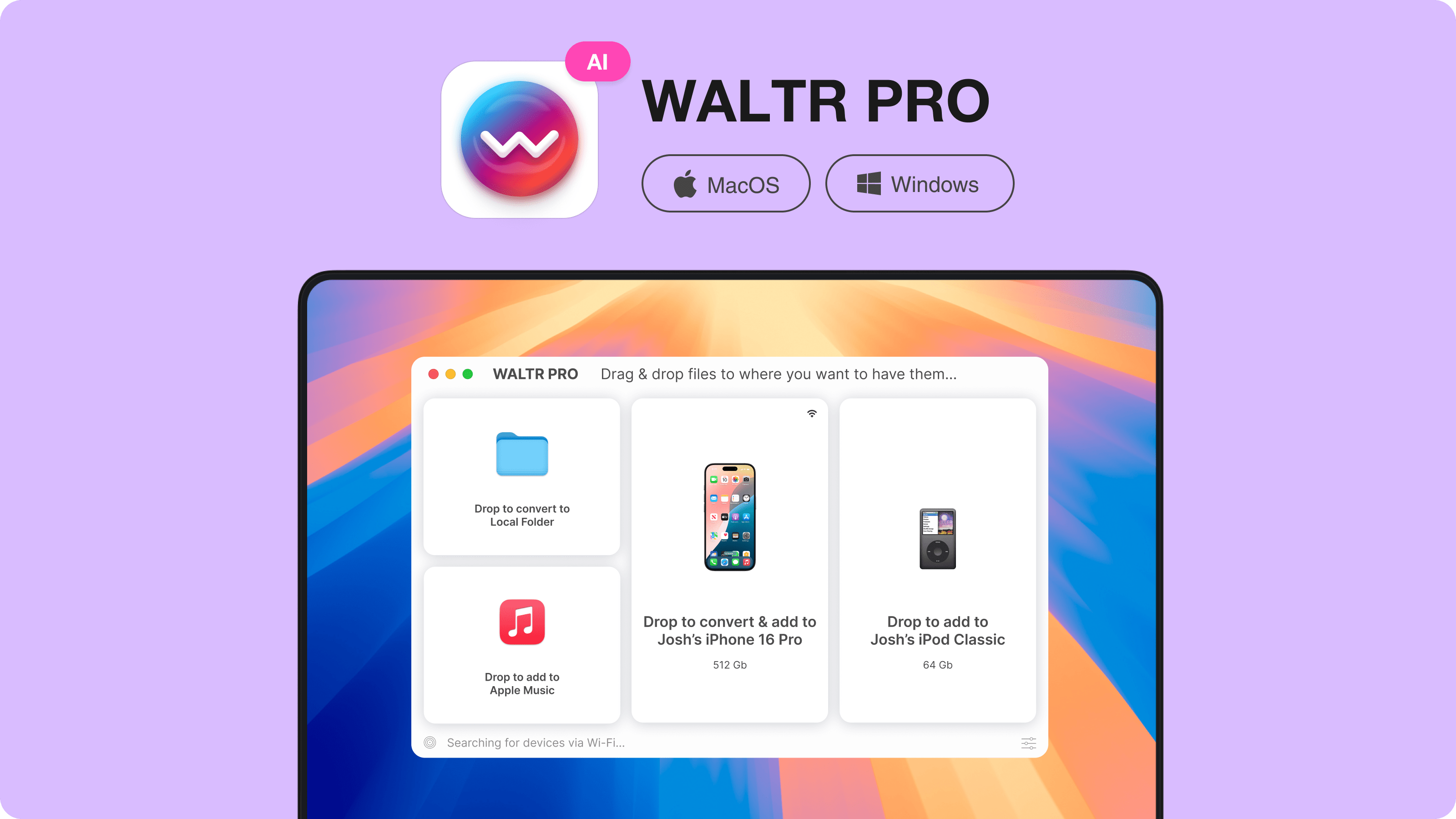
WALTR PRO works on Mac and Windows. Softorino’s current product page lists RM and RMVB among supported video formats, along with MP4, MKV, AVI, MOV, WEBM, VOB, WMV, FLV, TS, and more. The product is built for dragging files from your computer to Apple devices and placing them where they can be used.
Use WALTR PRO when:
If you need a guaranteed standalone .mp4 export for editing, archiving, or uploading elsewhere, use a dedicated converter workflow instead. That honesty matters. WALTR PRO is the easy Apple-device route, not the only RM converter on earth. For related old-format cleanup, the TS to MP4 guide covers another common video rescue job.
- You want to watch an old RM or RMVB video on iPhone or iPad.
- You do not want iTunes sync.
- You do not want to upload the file to an online converter.
- You want a simple drag-and-drop workflow.
- You care more about playback on Apple devices than managing codec settings.
How to use WALTR PRO for RM/RMVB videos
Step 1: Download and install WALTR PRO
Download WALTR PRO for Mac or Windows. Install it, then connect your iPhone or iPad with a cable or use Wi-Fi transfer if your setup supports it.
WALTR PRO is useful when the end goal is Apple-device playback. It helps you avoid the usual loop of converting, importing, syncing, failing, and pretending iTunes is normal software.
Step 2: Open WALTR PRO and choose the destination
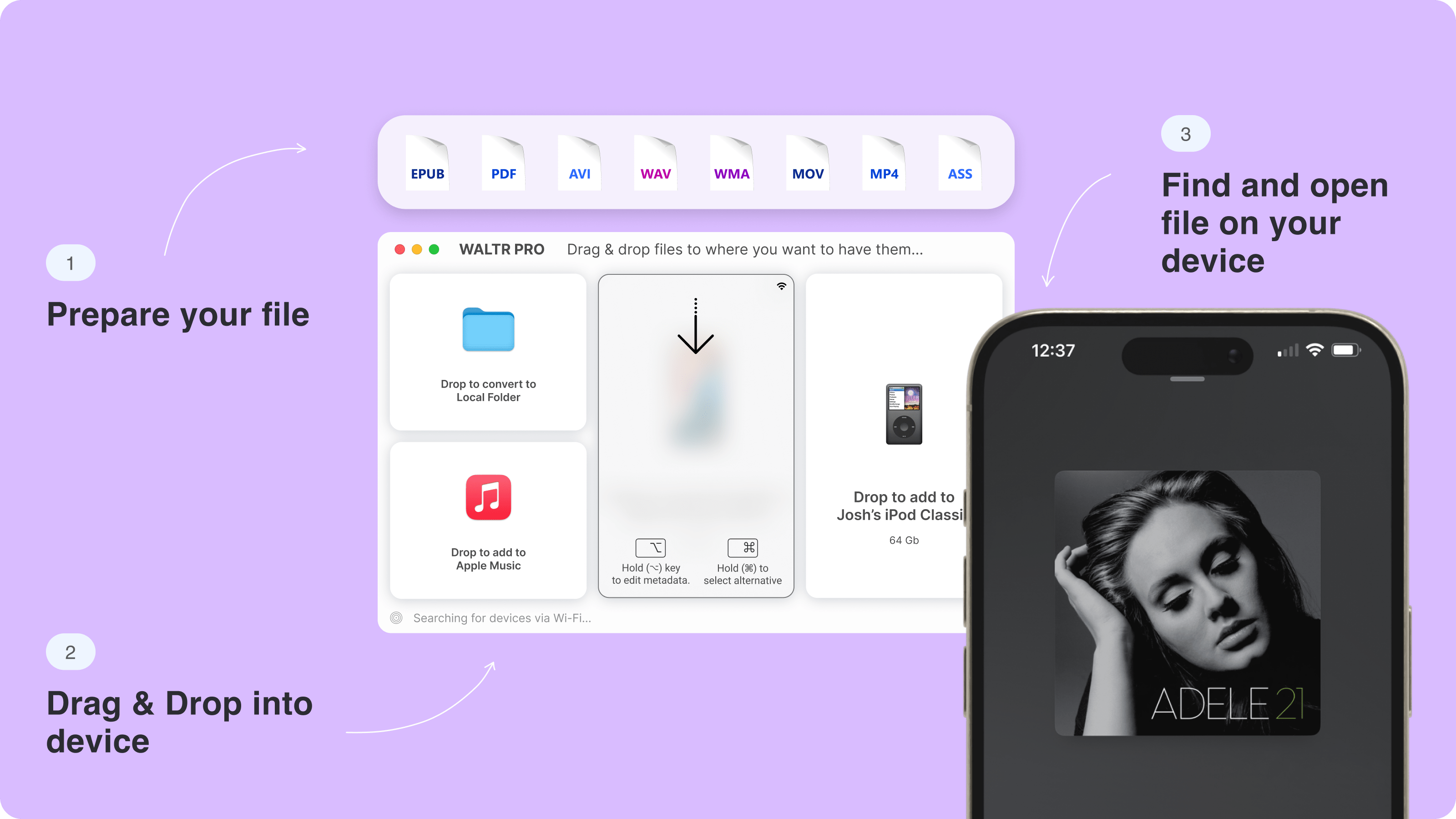
Open WALTR PRO. Choose your iPhone, iPad, local folder, or another supported destination.
The exact destination depends on what you want next. If you want the video on an Apple device, pick that device. If you are testing local conversion behavior, use a local folder and check the finished file before relying on it.
Step 3: Drag and drop your RM video file
Drag your .rm or .rmvb file into WALTR PRO. Let the app process the file. After it finishes, open the video on the destination device or folder and check playback.
Do not delete the original RM file until you confirm the result works. Old RealMedia files are too unpredictable for blind trust.
RM to MP4 settings that usually work
If your converter gives you settings, choose simple, compatible options.
Setting | Safe choice | Why |
|---|---|---|
Container | MP4 | Widest modern support |
Video codec | H.264 | Works on most phones, computers, TVs, and browsers |
Audio codec | AAC | Safe default for MP4 files |
Resolution | Same as source | Avoids blurry upscales and huge files |
Frame rate | Same as source | Avoids motion weirdness |
Bitrate | Close to source or moderate CRF | Prevents huge output files |
Do not upscale a tiny RM file to 4K. You will get a larger file, not a better video. Old source quality stays old.
Why did my converted MP4 get much larger?
This happens often with old RM and RMVB files. RealMedia was built to squeeze video hard for slow internet. If your converter uses a high H.264 bitrate, the MP4 can become much larger than the source.
A larger MP4 does not mean better quality. It may only mean the converter used too much bitrate for an already-compressed video.
To avoid bloated output:
If the RM source looks soft, the MP4 will look soft too. Conversion improves compatibility, not history.
Keep the original resolution.
Do not upscale.
Use H.264 instead of odd codecs.
Use AAC audio at 128 kbps or 160 kbps for normal video.
In FFmpeg, try CRF 23 before manual high bitrates.
Compare a 1-minute sample before converting the whole archive.
Troubleshooting RM and RMVB conversion problems
The RM file will not open
Try VLC first. If VLC cannot play the file, the source may be damaged, DRM-protected, incomplete, or encoded with a rare codec. Try RealPlayer if you have access to it, then export or re-save from there if possible.
The MP4 has video but no audio
The audio stream may use RealAudio or another codec your converter did not handle. Try VLC or FFmpeg. In FFmpeg, check the terminal output for audio stream errors before trying new settings.
The MP4 plays on Mac or Windows but not iPhone
The file may be MP4 by container but still use unsupported video or audio settings. Convert again with H.264 video and AAC audio. Or use WALTR PRO if your goal is Apple-device playback without manual settings. For the broader compatibility picture, see Softorino’s iPhone video format guide.
RMVB to MP4 conversion fails
RMVB files can be trickier than standard RM files because variable bitrate encoding and old codecs vary by file. Try VLC first. If that fails, use FFmpeg and test a short sample. If both fail, the file may be damaged.
The online converter says the file is too large
Use a local converter. Do not split private videos just to fit a free upload limit. VLC, FFmpeg, or a desktop converter is cleaner.
Should you delete the original RM file?
No. Not right away.
Keep the original until you have checked the MP4 on the device or app you care about. Test the first minute, the middle, the ending, and the audio. Old video files can fail halfway through.
If the video matters, keep both:
Storage is cheaper than trying to recover a broken conversion later.
- Original RM/RMVB for archive.
- MP4 for daily playback and sharing.
FAQ
What is an RM file?
An RM file is a RealMedia file. RealNetworks created it for streaming audio and video, especially when internet connections were slower. Many modern devices and apps do not support RM well, so people convert it to modern formats for easier playback.
What is an RMVB file?
RMVB means RealMedia Variable Bitrate. It is a RealMedia video format that changes bitrate depending on the scene. RMVB can be harder to convert than RM because codec support varies across tools.
Can VLC play RM files?
Yes, VLC can play many RM and RMVB files. VideoLAN’s official feature list includes Real containers, Real Video, and Real Audio. If VLC cannot play your file, the file may be damaged, protected, or encoded in a rare way.
Can VLC convert RM to MP4?
Yes, VLC can convert many RM files to MP4. Use Media > Convert / Save on Windows or File > Convert / Stream on Mac. Choose an MP4 profile, then test the output before deleting the source.
Is an online RM to MP4 converter safe?
It depends on the file. Online converters are fine for small, non-private videos. Do not upload private family videos, client files, legal footage, unreleased work, or anything sensitive. Use a local converter for those.
Can iPhone or iPad play RM files directly?
Apple’s native apps do not treat RM or RMVB as normal iPhone video formats. You usually need to convert the file, use a compatible third-party player, or use a tool like WALTR PRO to transfer the video for Apple-device playback without iTunes.
Can WALTR PRO convert RM to MP4?
WALTR PRO supports RM and RMVB video formats and can process them for Apple-device playback or supported destinations. If you need a guaranteed standalone .mp4 export for editing or uploading, use a dedicated converter workflow such as VLC, FFmpeg, or a trusted desktop converter.
Why is my converted MP4 larger than the RM file?
Your converter probably used a higher bitrate than the old RM source needs. Keep the original resolution, use H.264 video and AAC audio, and avoid high bitrate presets. In FFmpeg, CRF 23 is a reasonable first test.
Bottom line
If you need a fast conversion for a small public clip, an online converter is fine. If the file is private, use VLC. If you have a batch or need control, use FFmpeg. If the real job is getting an old RM or RMVB video onto your iPhone or iPad, use WALTR PRO and skip iTunes.
Old RealMedia files are annoying. The fix is picking the right method, not pretending every file needs the same converter.

WALTR PRO
Convert & Push Any File into Any Apple Device
