iPhone Video Format: How to Convert Videos for iPhone

The safest iPhone video format is MP4 or MOV with H.264 video and AAC audio. That combo plays almost everywhere: iPhone, iPad, Mac, Windows, smart TVs, editing apps, and most sharing sites.
But iPhone video format gets confusing fast because Apple mixes 2 different things: the file container and the codec inside it. A file can end in .MOV and still use the same H.264 codec as an MP4. A file can also end in .MP4 and still fail if the video or audio track inside it is wrong.
This guide keeps it simple. You’ll see which iPhone video formats work, which recording setting to use, and how to convert MKV, AVI, WebM, FLV, or other files so they play on iPhone without the iTunes mess.
Before we begin
Download WALTR PRO on Mac or Windows to transfer MKV, AVI, or MP4 video files to an iPhone without manually converting them first. Choose the source file, connect the iPhone, and let the transfer place the video in a native playback app.
Best video format for iPhone
Use this rule when you just want the file to work:
Goal | Best iPhone video format | Why it works |
|---|---|---|
Maximum compatibility | MP4 or MOV with H.264 video and AAC audio | Works on iPhone and almost every non-Apple device |
Smaller files on newer Apple devices | MOV or MP4 with HEVC/H.265 | Saves space while keeping quality high |
Editing high-quality footage | ProRes MOV | Great for post-production, terrible for storage |
Old or simple files | M4V, MOV, or MP4 | Usually fine if the codec is supported |
If you need the shortest answer: choose MP4 + H.264 + AAC.
That is the best video format for iPhone when compatibility matters more than file size. HEVC/H.265 is also an iPhone video format, but it can cause trouble when you send the file to older Windows apps, older TVs, browser tools, or editing software that does not support HEVC well.
iPhone video format: container vs codec
The file extension is only half the story.
- MP4, MOV, M4V, AVI, MKV, and WebM are containers. They are like boxes.
- H.264, HEVC/H.265, ProRes, MPEG-4, VP9, and AV1 are video codecs. They describe how the video is compressed.
- AAC, MP3, PCM, and Dolby audio are audio codecs.
Your iPhone checks the box and what is inside the box. That is why a file named video.mp4 can still fail. It may use an unsupported codec, a weird audio track, a bitrate the app does not like, or a file structure iPhone refuses to read.
This also explains why changing .MOV to .MP4 is not real conversion. Sometimes it works because the codec inside was already compatible. Sometimes it does nothing because the actual video stream still needs conversion.
iPhone supported video formats
For normal playback, iPhone is happiest with Apple-friendly files:
Format | Works on iPhone? | Best use | Watch out for |
|---|---|---|---|
MP4 | Yes | Most compatible video format for iPhone | Still needs H.264, HEVC, or another supported codec |
MOV | Yes | iPhone camera video and Apple workflows | Some non-Apple apps prefer MP4 |
M4V | Yes | Apple-style video files | Less common outside Apple apps |
AVI | Limited | Older clips | Many AVI files use codecs iPhone will not play |
MKV | Not natively in Apple’s normal apps | Movies and downloaded files | Convert or use a third-party player |
WebM | Not reliably in Apple’s normal apps | Web video | Convert for safer iPhone playback |
FLV | No practical native support | Old web video | Convert before transfer |
AV1 video | Depends on device/app support | Modern web video | Convert if the file fails on your iPhone |
The format name alone does not guarantee playback. MP4 is the safest target because most converter apps, editors, TVs, phones, and browsers know what to do with it.
If you want to transfer video files to iPhone without iTunes, WALTR PRO is the simple route. It handles the transfer side and can prepare video files like MKV, AVI, and MP4 for iPhone playback without making you sync a library.
What video format does iPhone use for recording?
By default, modern iPhones record video as MOV files. Inside that MOV file, the video codec depends on your Camera settings.
- Most Compatible records H.264 video. Use this when you want fewer problems with Windows, older apps, older devices, editors, and upload sites.
- High Efficiency records HEVC/H.265 video. Use this when you want smaller files and mainly stay inside Apple devices and modern apps.
- ProRes records much larger files on supported Pro iPhone models. Use it only when you plan to edit the footage seriously.
Apple’s own support guide explains how to change video recording settings on iPhone under Settings > Camera > Formats. Apple also documents ProRes on iPhone separately because ProRes has storage and device limits.
So when someone asks “is iPhone video MP4 or MOV?” the practical answer is: iPhone camera video is usually MOV, but the codec inside may be H.264, HEVC, or ProRes.
How to change iPhone video format settings
Want a more compatible iPhone video format for recording? Change the Camera format before you record.
- Open Settings on your iPhone.
- Tap Camera.
- Tap Formats.
- Choose Most Compatible for H.264 video.
- Choose High Efficiency for HEVC/H.265 video and smaller files.
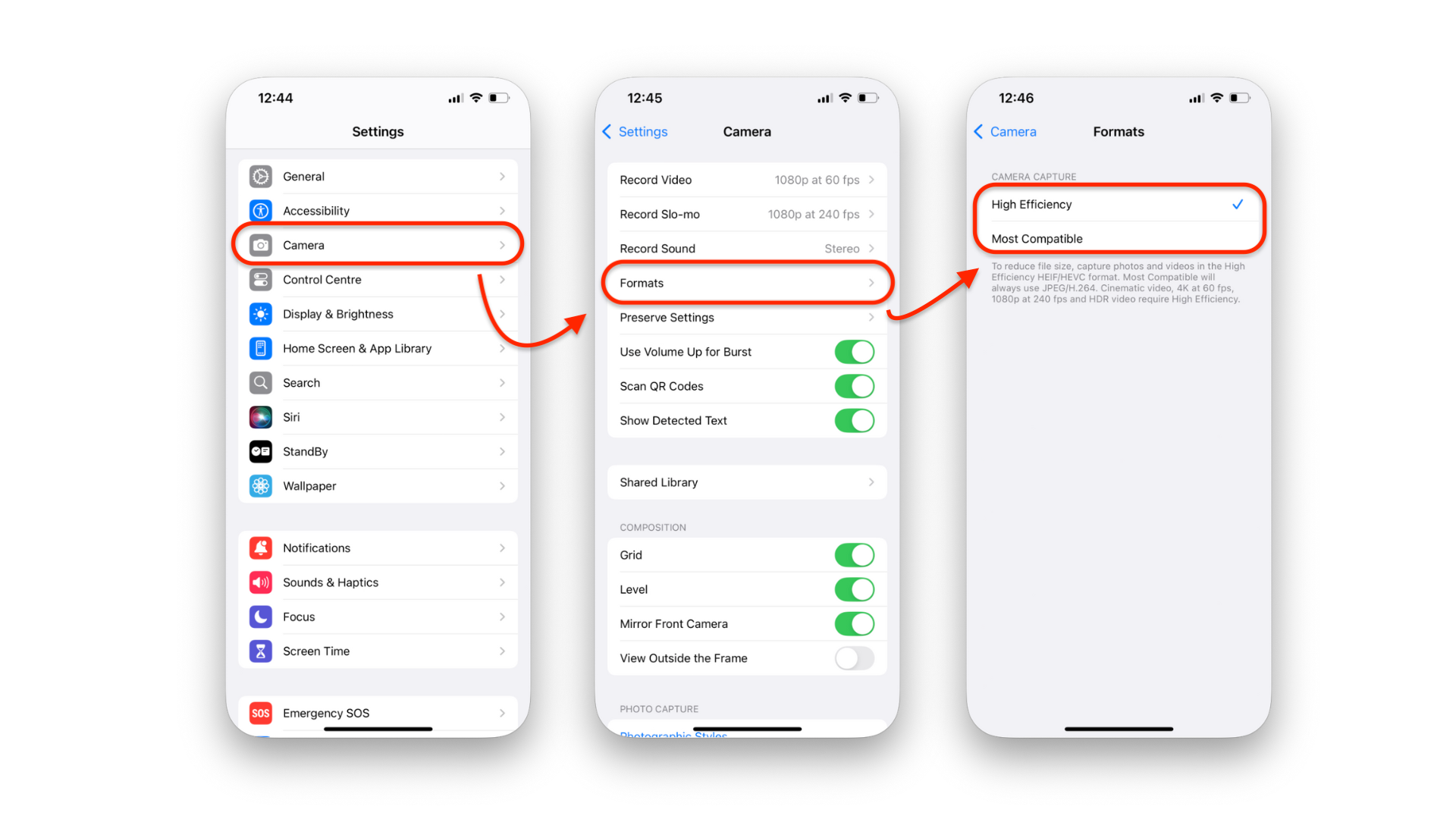
Most Compatible is the safer pick if you often move videos to a Windows PC, send files to people with older devices, or upload footage to apps that complain about HEVC.
High Efficiency is better if your iPhone storage fills up fast and you mostly view or edit videos on newer Apple devices.
To change resolution and frame rate, go to Settings > Camera > Record Video. This changes quality settings like 4K, 1080p, 60 fps, or 30 fps. It does not replace the Formats setting.
How to convert video to iPhone format
If your file is MKV, AVI, WebM, FLV, AV1, or another format your iPhone rejects, you have 4 practical options.
- Use WALTR PRO when you want conversion and transfer in one step.
- Use HandBrake when you want manual control over MP4/H.264 settings.
- Use an online converter for small, non-private files.
- Use a third-party player if you only need to watch the file and do not care where it lands.
The right choice depends on the job. If you just need a clean MP4 file on your computer, HandBrake is fine. If you need the video on your iPhone, in the right Apple app, without iTunes sync drama, WALTR PRO is the better fit.
Use WALTR PRO to convert and transfer videos to iPhone
WALTR PRO is built for the annoying part Apple still makes harder than it should be: getting a video file onto your iPhone. It works on Mac and Windows, supports common video formats like MKV, AVI, and MP4, and transfers files to iPhone or iPad without iTunes.
Here is the basic flow.
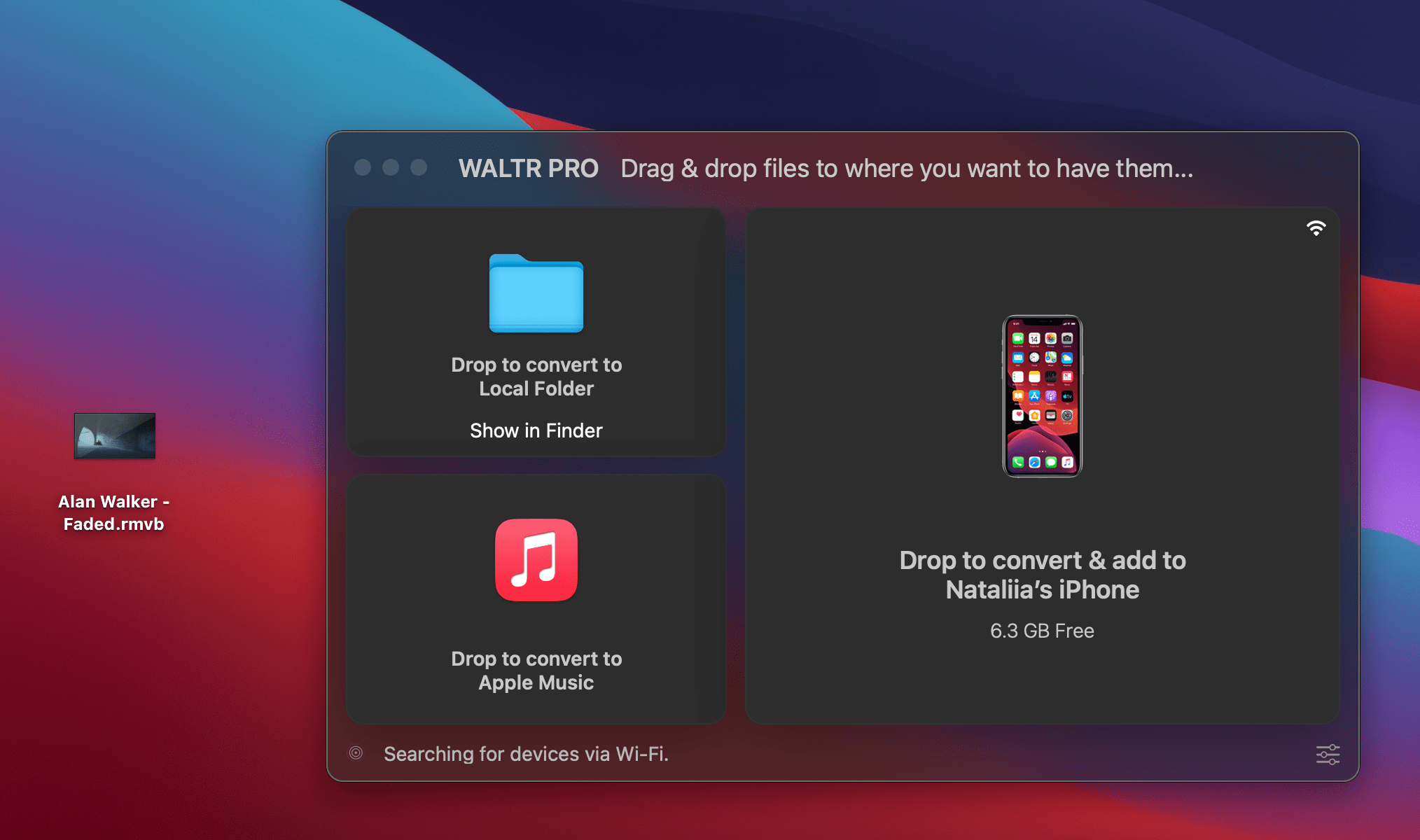
Step 1: Launch WALTR PRO and connect your iPhone
Open WALTR PRO on your Mac or Windows PC. Connect your iPhone with a cable first. After setup, you can use Wi-Fi transfer too.
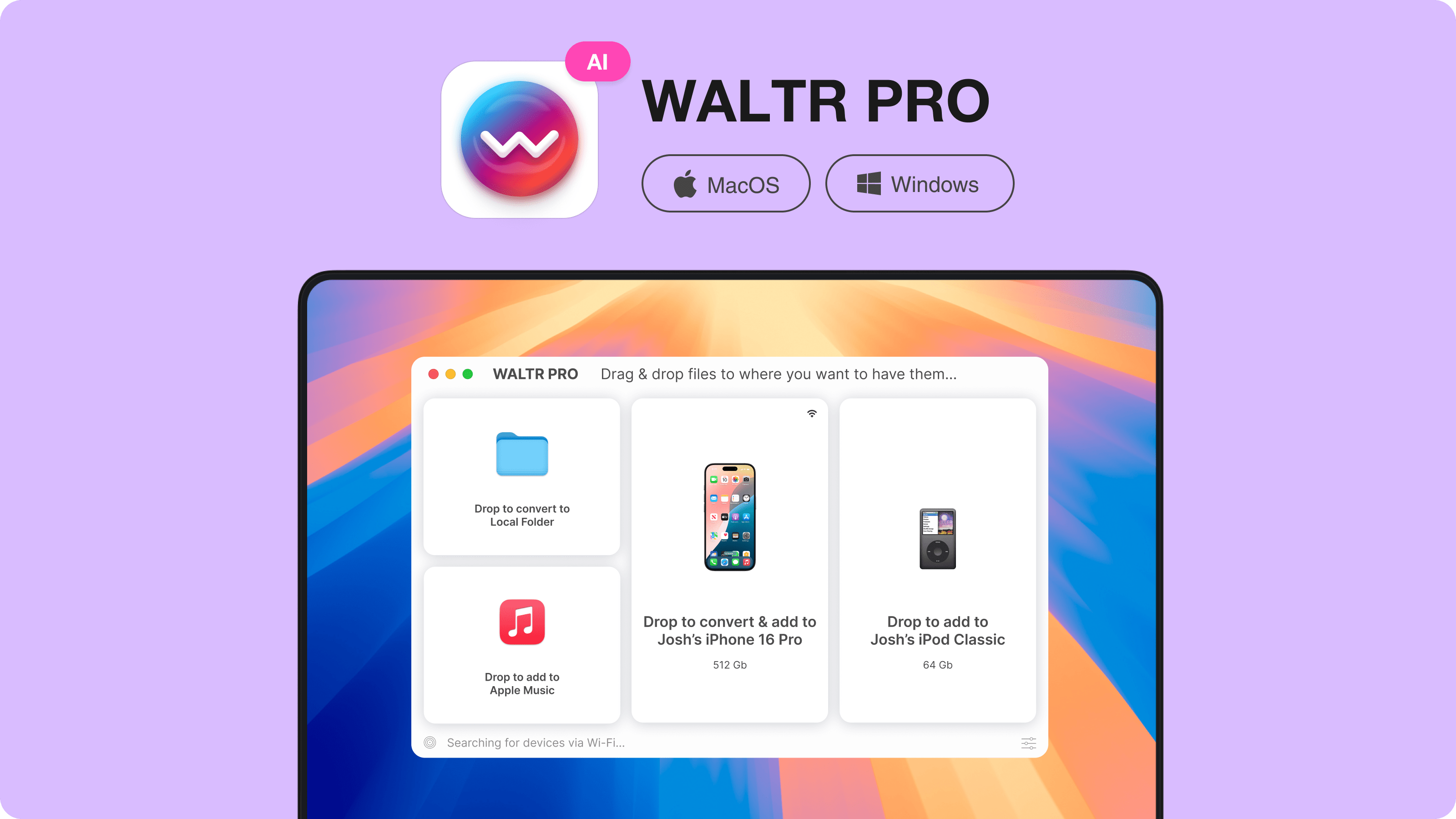
Start the free trial if you want to test the workflow before paying. Use the same app screen to connect your iPhone and confirm the device is ready.
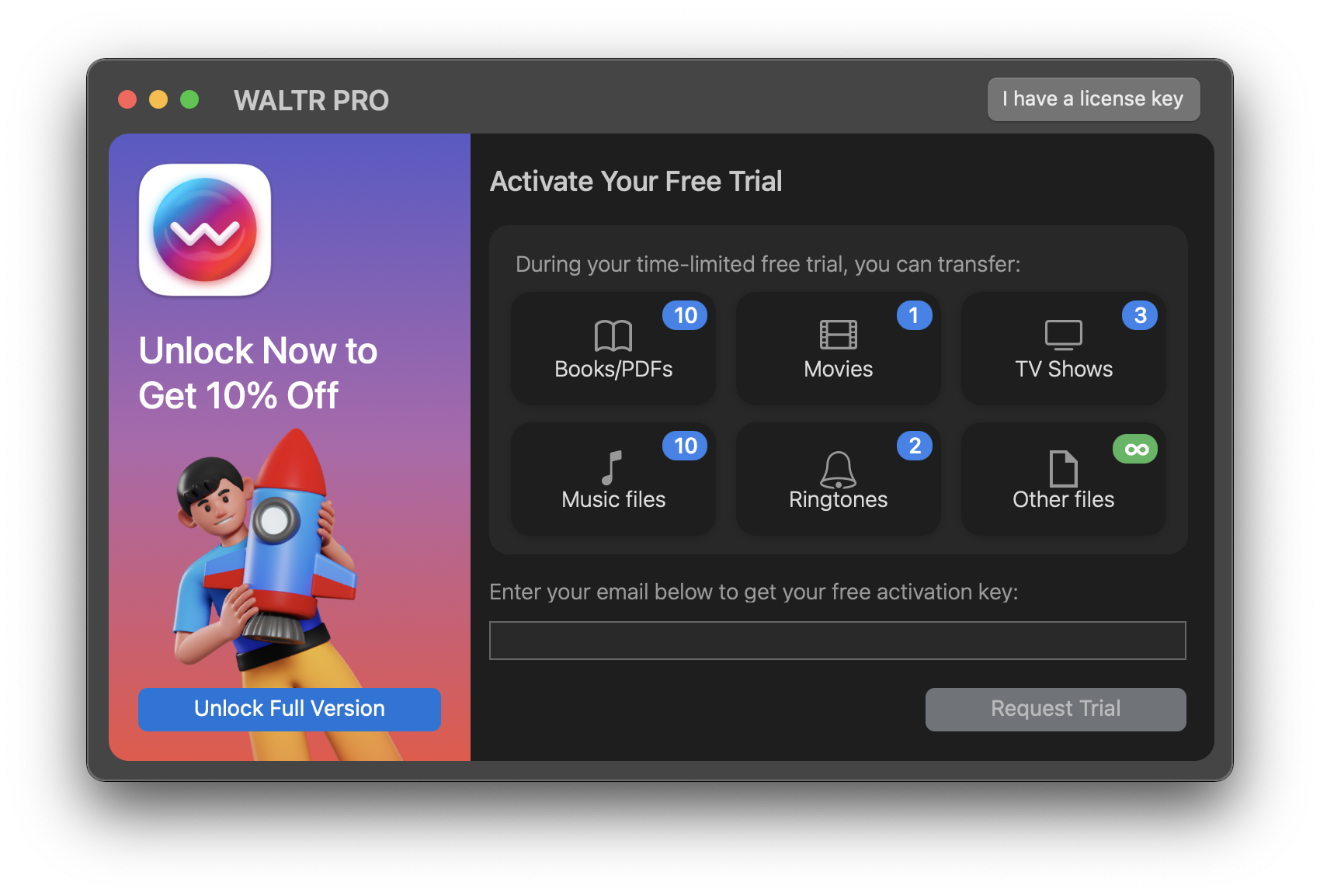
Once WALTR PRO sees your iPhone, you are ready to drop in the video.
Step 2: Drag in your video file
Drag your MKV, AVI, MP4, or other video file into WALTR PRO. The app handles the transfer and prepares the file for iPhone playback during the process.
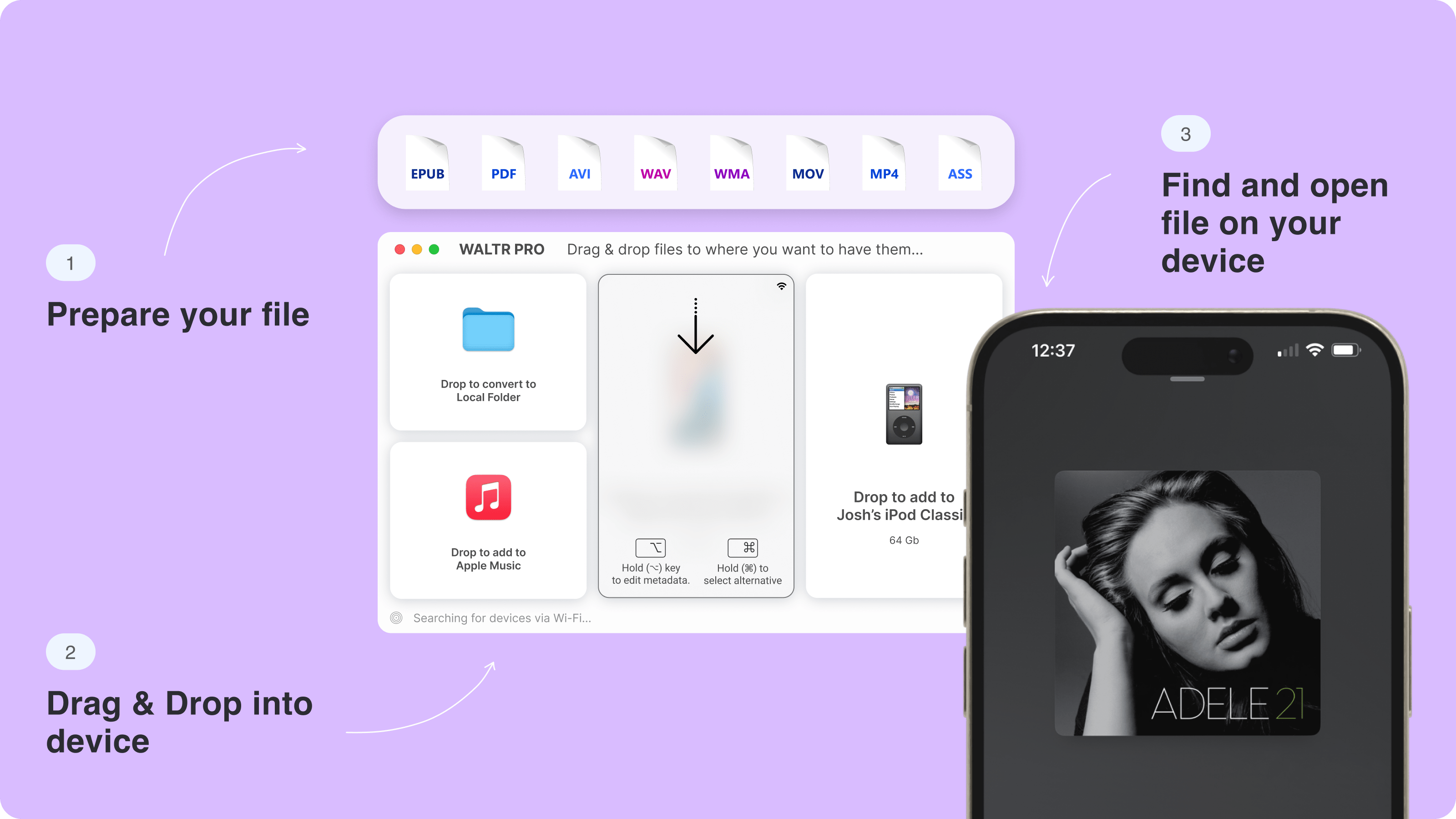
That matters because a normal converter only gives you another file on your desktop. You still have to move that file to your iPhone. WALTR PRO handles the “get it onto the phone” part too.
This is useful when you want to transfer video from PC to iPhone, move old AVI clips, or watch a downloaded MKV file in an Apple-friendly way.
Use HandBrake for manual MP4 conversion
HandBrake is a good free option if you want control and do not mind doing the transfer yourself.
Use these basic settings for iPhone:
- Format: MP4
- Video codec: H.264 for broad compatibility
- Audio codec: AAC
- Resolution: same as source, unless the file is too large
- Preset: a device or fast 1080p preset is usually enough
HandBrake is not an iPhone transfer app. After conversion, you still need AirDrop, Finder, iCloud, Apple TV app sync, or another transfer method.
Use online converters only for small, non-private files
Online converters can work for quick files. They are less ideal for large movies, private videos, client files, family videos, or anything you do not want to upload to a random server.
They also have size limits. OnlineConverter, for example, lists a 200 MB maximum upload size for its iPhone video converter page. That is fine for a short clip, not a full movie.
Use online tools when the file is small and not sensitive. Use local software when the file is large, private, or important.
Use a third-party player when you do not need conversion
If you only want to watch an MKV or WebM file once, a third-party player app can be enough. Apps like VLC-style players can handle more formats than Apple’s default apps.
The tradeoff: the video may stay inside that player’s file area. It may not appear where you expect in Apple’s TV app, Photos workflow, or normal media library.
Why a video still won’t play on iPhone
If your iPhone video format looks correct but the file still fails, check these common causes.
Problem | What it means | Fix |
|---|---|---|
Wrong codec inside MP4 or MOV | The extension looks right, but the video stream is unsupported | Convert to MP4 with H.264 + AAC |
Unsupported audio | The video opens with no sound or fails | Convert audio to AAC |
File is too large or too heavy | Resolution, bitrate, or frame rate is too much for the app/device | Export a lighter MP4 version |
DRM protection | The file is protected by a store or service | Use the official app/account that owns it |
Corrupt file | The file is damaged | Re-export or get a clean source file |
App limitation | The app you use cannot read the file | Try another player or convert the file |
Do not start by changing the filename. Start by checking the codec. If you do not know what codec the file uses, open it in a desktop player or media info tool, then convert it to MP4/H.264/AAC if needed.
iPhone video format settings: what to choose
Here is the practical decision tree.
Use Most Compatible when:
- You send videos to Windows users.
- You edit in older software.
- You upload to tools that reject HEVC.
- You want fewer “file not supported” problems.
Use High Efficiency when:
- You need smaller files.
- You keep videos on iPhone, iPad, Mac, or iCloud.
- Your editing apps support HEVC.
- Storage matters more than universal compatibility.
Use ProRes when:
- You shoot on a supported Pro iPhone model.
- You plan to color grade or edit professionally.
- You have enough storage.
- You know why you need ProRes.
For most people, Most Compatible is the safe setting. High Efficiency is the storage-saving setting. ProRes is the “my storage just disappeared” setting.
Related iPhone video tasks
Once the iPhone video format problem is fixed, the next job is usually playback or cleanup.
You may also need to add subtitles to a video on iPhone, download movies on iPad, or add movies to your Apple TV library.
If the file starts on a Windows PC, the most direct related guide is how to transfer video from PC to iPhone.
Final take
The best iPhone video format is MP4 or MOV with H.264 video and AAC audio. Use HEVC/H.265 when you want smaller files and your devices support it. Use ProRes only for serious editing.
If the video already exists in MKV, AVI, WebM, FLV, or another unsupported format, convert it to iPhone-friendly MP4/H.264/AAC. If you also need to get it onto your iPhone, WALTR PRO is the cleaner path because it handles transfer too. No iTunes library. No sync ritual. Just the file on your phone.
FAQ
What is the best video format for iPhone?
The best video format for iPhone is MP4 or MOV with H.264 video and AAC audio. This gives you the fewest playback problems across iPhone, iPad, Mac, Windows, TVs, editors, and sharing apps.
Is iPhone video MP4 or MOV?
iPhone camera video is usually saved as a MOV file. Depending on your settings, the video inside that MOV file may use H.264, HEVC/H.265, or ProRes on supported Pro models.
Can I convert iPhone video to MP4?
Yes. You can convert iPhone MOV video to MP4 with a desktop converter such as HandBrake or another local video tool. Use H.264 video and AAC audio if you want maximum compatibility.
Can iPhone play MKV files?
iPhone does not play MKV files natively in Apple’s normal media apps. You can use a third-party player for MKV playback, or convert the MKV to an iPhone video format like MP4 with H.264/AAC.
Can iPhone play WebM files?
Some iPhone apps and browsers may handle certain WebM files, but WebM is not the safest format for normal iPhone playback. Convert WebM to MP4/H.264/AAC if you want fewer problems.
Should I use High Efficiency or Most Compatible on iPhone?
Use Most Compatible if you share videos with Windows users, older apps, or non-Apple devices. Use High Efficiency if you want smaller files and mostly stay inside newer Apple devices and modern apps.
What is ProRes on iPhone?
ProRes is Apple’s high-quality recording format for supported Pro iPhone models. It is made for editing workflows and creates very large files. Most people do not need ProRes for normal recording.
How do I convert video to iPhone format?
Convert the file to MP4 with H.264 video and AAC audio. If you also need to move the video onto your iPhone, use WALTR PRO to transfer video files to iPhone without iTunes.

WALTR PRO
Convert & Push Any File into Any Apple Device
