Convert FLAC to ALAC in 2026: Lossless Audio for iPhone, iPad, and Apple Music

If you have a FLAC music library and an iPhone, you hit the usual Apple wall fast. FLAC is lossless. Apple Lossless is lossless. But Apple’s Music app prefers ALAC inside an M4A file, not a loose FLAC file you dragged in from somewhere else.
The short answer: convert FLAC to ALAC if you want your music to work cleanly in Apple Music, iPhone, iPad, and older iTunes workflows. Use WALTR PRO when you want the conversion and the iPhone transfer handled in one drag-and-drop step, without iTunes sync.
If you only need to convert a huge archive on your Mac or PC, tools like XLD, Foobar2000, dBpoweramp, MediaHuman, or ffmpeg can also do the job. The right lossless converter depends on what you want next: a neat Apple Music library, a quick iPhone transfer, or batch conversion for a large archive.
Quick answer: the best lossless conversion path
For most Apple-device users, the best path is:
WALTR PRO is the easiest pick when your final goal is playback on iPhone or iPad. Drop the FLAC files into WALTR PRO, choose the destination, and WALTR PRO converts and transfers them into Apple-friendly format.
Use a dedicated batch converter if your goal is different. XLD is strong for free Mac batch conversion. Foobar2000 works well for Windows users who do not mind setup. dBpoweramp is better for serious library management. ffmpeg is perfect if you are comfortable with command-line tools.
- Keep FLAC as your archive copy if you care about long-term library storage.
- Convert the files to Apple Lossless when you want Apple-friendly playback.
- Transfer the ALAC/M4A files to iPhone, iPad, or Apple Music.
Before we begin
Download WALTR PRO on Mac or Windows to convert FLAC into an Apple-friendly lossless format and transfer it to an iPhone or iPad in one workflow. Test one album first and confirm that the Music app shows the expected metadata before moving a large library.
FLAC to ALAC: what changes and what stays lossless
FLAC and ALAC are both lossless audio codecs. That means they compress audio without throwing away the original audio data.
Apple explains lossless compression this way: it preserves all of the original data. Apple’s own lossless format is ALAC, short for Apple Lossless Audio Codec. Apple Music uses ALAC for lossless audio, with quality tiers from CD quality up to Hi-Res Lossless in supported setups.
Here is the important part. Converting FLAC to ALAC should not reduce audio quality if you convert to Apple Lossless. You are moving from one lossless codec to another lossless codec.
The quality problem starts when you accidentally choose AAC, MP3, or another lossy format. Those formats throw away audio data to make smaller files. They may sound fine, but they are not lossless.
Format | Type | Common extension | Best use |
|---|---|---|---|
FLAC | Lossless codec | .flac | Archive libraries, non-Apple players, audiophile storage |
ALAC | Lossless codec | .m4a | Apple Music, iPhone, iPad, iTunes/Finder workflows |
AAC | Lossy codec | .m4a or .aac | Smaller files, normal listening, Bluetooth playback |
MP3 | Lossy codec | .mp3 | Maximum compatibility, smaller files |
WAV | Uncompressed audio | .wav | Editing, mastering, short-term production work |
AIFF | Uncompressed audio | .aiff | Apple-friendly uncompressed audio |
Why ALAC files usually become M4A files
This trips people up.
ALAC is the codec. M4A is the container. The file you get after conversion will usually end in .m4a, even when the audio inside is Apple Lossless.
That does not mean you converted to AAC. M4A can hold ALAC or AAC. One is lossless. The other is lossy.
When you use any FLAC to M4A converter, check the output codec. Pick Apple Lossless, ALAC, or alac. Do not pick AAC if your goal is lossless audio.
A good converter should make this obvious. A bad converter may only say “M4A” and leave you guessing. That is why this article keeps separating container from codec.
Best converter by use case
There is no single best converter for every person. There is a best converter for your job.
Use case | Best fit | Why |
|---|---|---|
Convert FLAC and transfer to iPhone or iPad | WALTR PRO | Converts and sends music into Apple-friendly destinations without iTunes sync |
Free Mac batch conversion | XLD | Strong free option for Mac users with lossless libraries |
Free Windows workflow | Foobar2000 | Powerful, flexible, but needs setup and encoder configuration |
Paid archive management | dBpoweramp | Better for large libraries, metadata, and power-user batch work |
Simple desktop conversion | MediaHuman | Easy GUI for basic FLAC to ALAC batches |
One-off online conversion | Online converters | Fine for non-private, small files you do not care much about |
Command-line conversion | ffmpeg | Fast and exact if you know the command |
WALTR PRO is not pretending to be a hardcore archive manager. Its edge is more specific: it converts the file and gets it onto your Apple device without the iTunes maze.
That matters when your real goal is simple: play these FLAC files on your iPhone.
How to convert FLAC to ALAC using WALTR PRO
WALTR PRO works on Mac and Windows. It supports FLAC and other music formats, then sends files to iPhone, iPad, iPod, USB drives, local folders, or compatible apps.
It also supports metadata handling. Softorino’s product page describes AI-assisted metadata and cover art, plus manual destination selection with keyboard shortcuts.
Step 1. Install and open WALTR PRO
Download WALTR PRO on your Mac or Windows PC. Open the app.
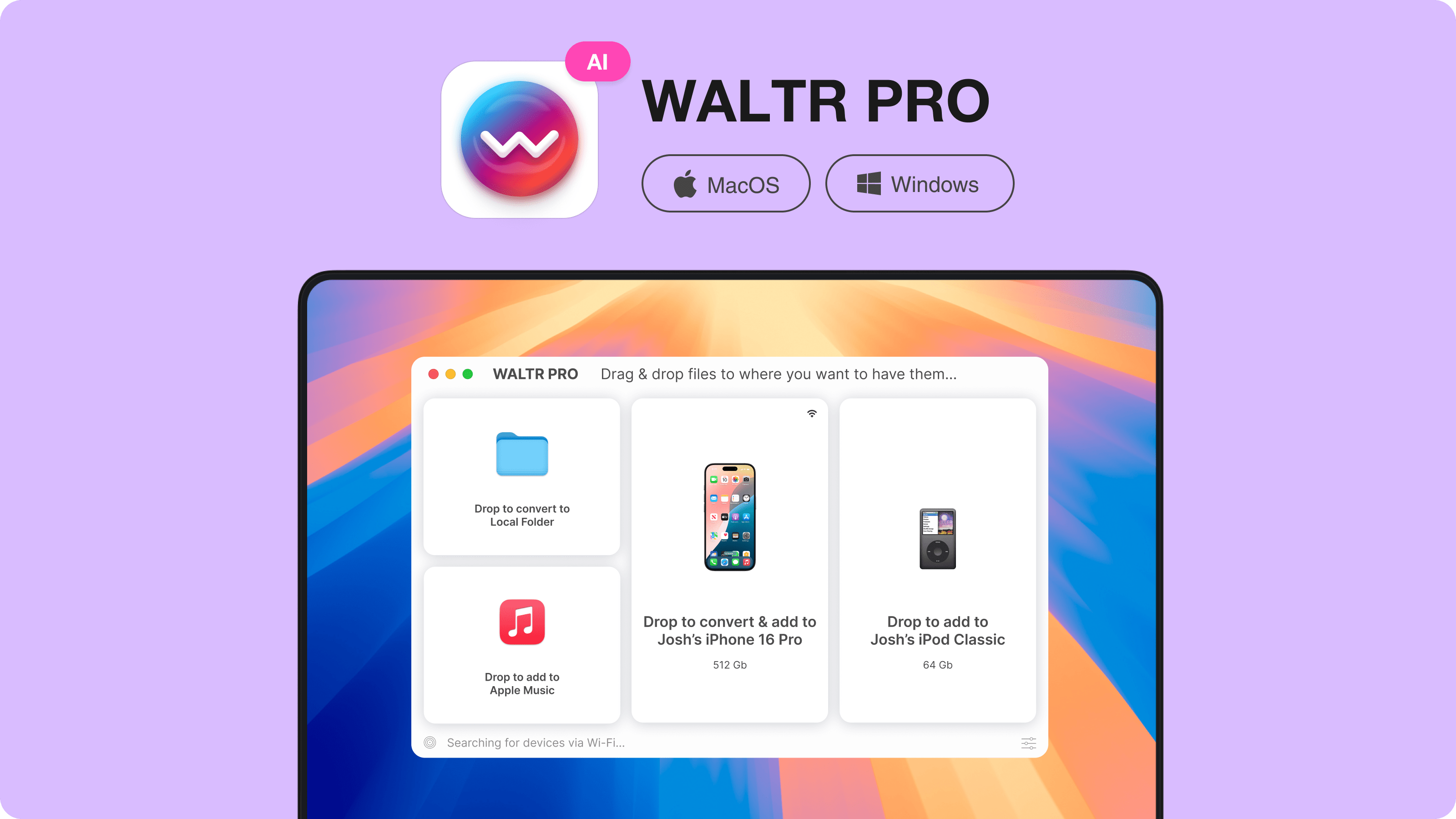
You do not need to open iTunes. You do not need to set up a sync library first. That is the whole point.
Step 2. Connect your iPhone or iPad
Plug in your iPhone with a USB cable. WALTR PRO can also work over Wi-Fi after the device is paired, but USB is the cleanest first run.
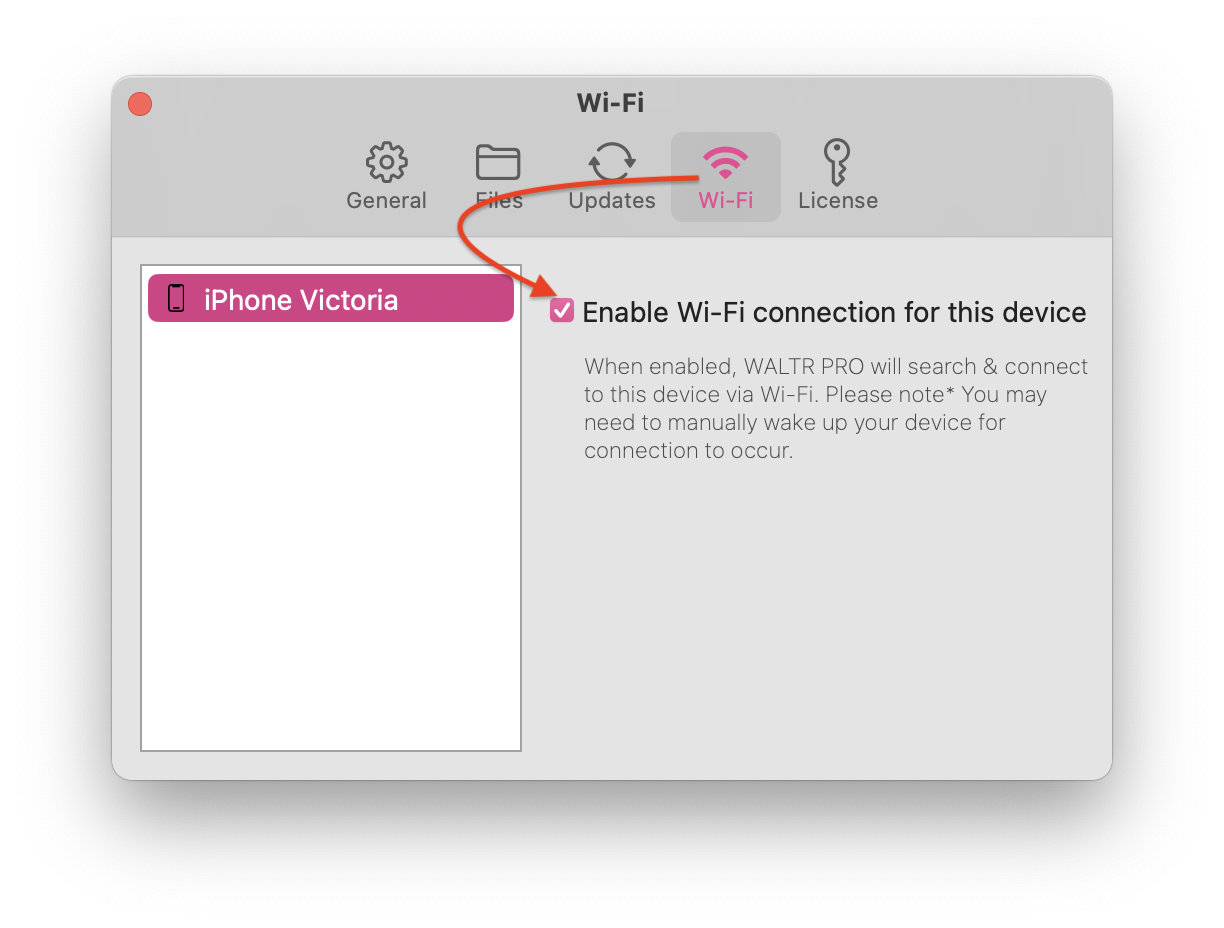
Wait until WALTR PRO sees the device. If the phone asks whether to trust the computer, tap Trust.
Step 3. Drop your FLAC files into WALTR PRO
Drag your FLAC files into WALTR PRO. WALTR PRO converts them into an Apple-friendly lossless format and transfers them to the device.
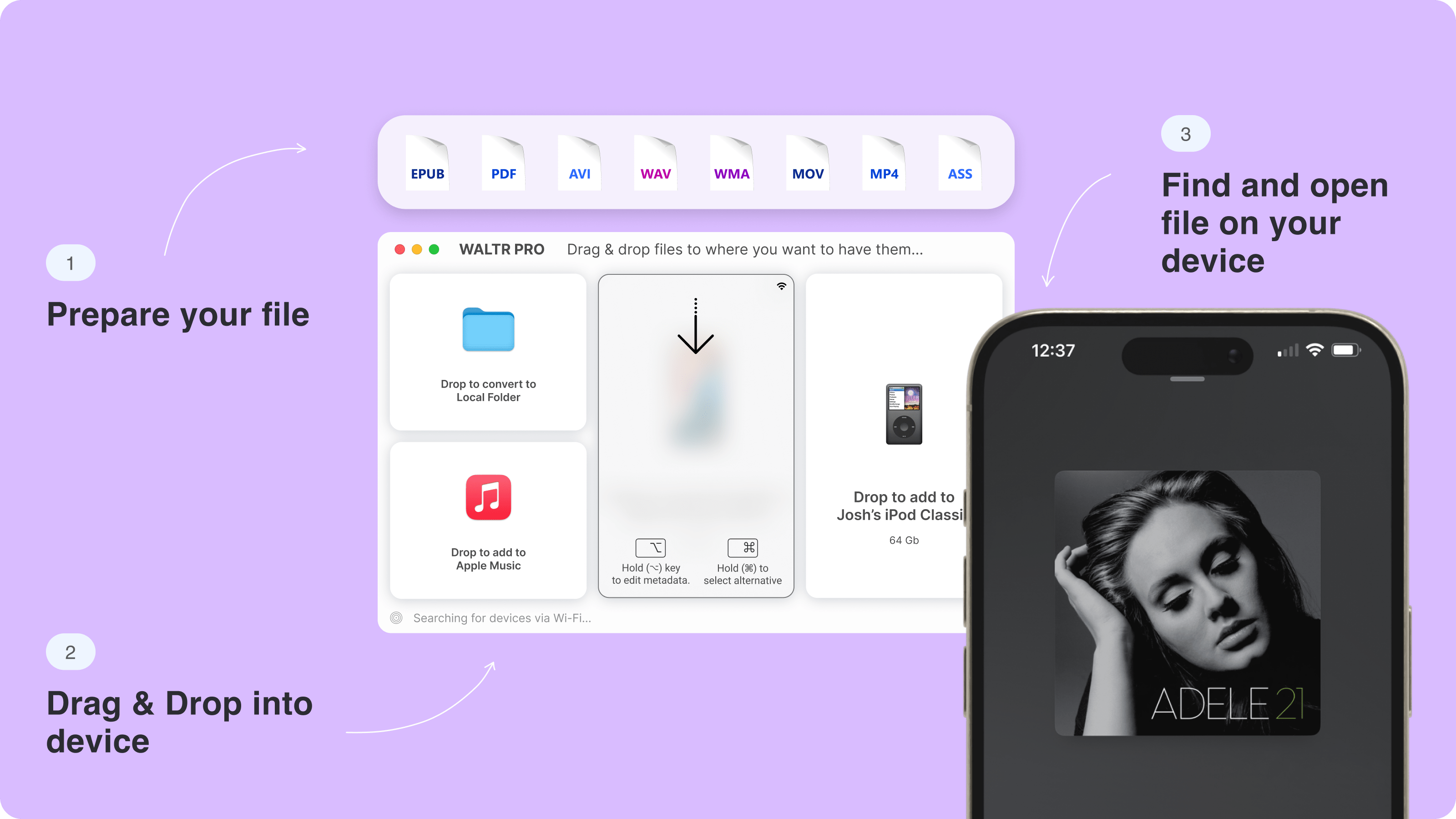
After transfer, check the Music app. Your tracks should appear there with the right format for Apple playback.
Important: ALAC files usually show the .m4a extension. That is normal. M4A is the container. ALAC is the lossless codec inside it.
Step 4. Adjust metadata if needed
Messy metadata turns a music library into a junk drawer. Artist names split into duplicates. Album art disappears. Track numbers go weird.
Before transfer, you can edit details such as title, artist, album, and destination. WALTR PRO also has AI metadata features for artwork and media details.
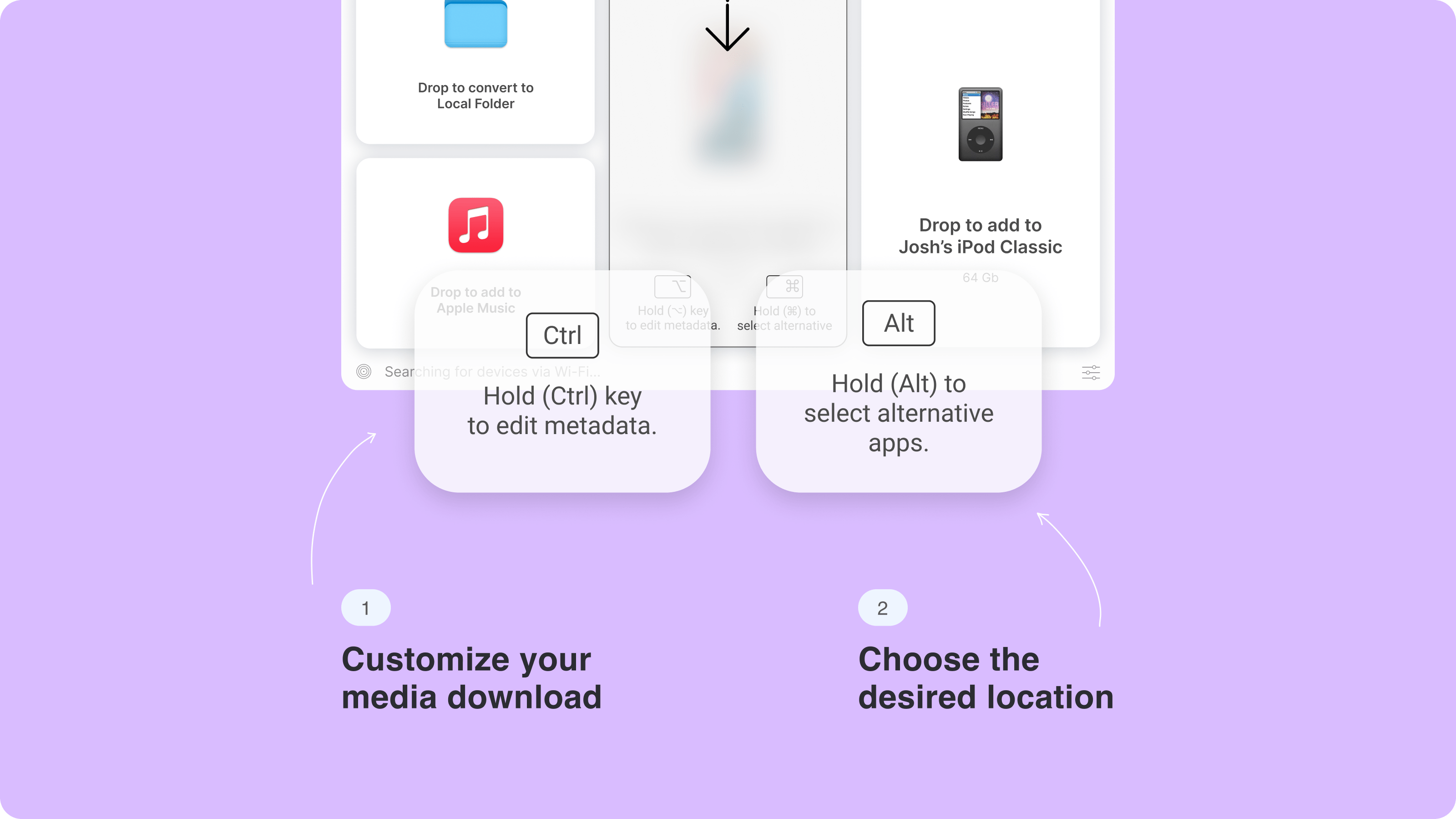
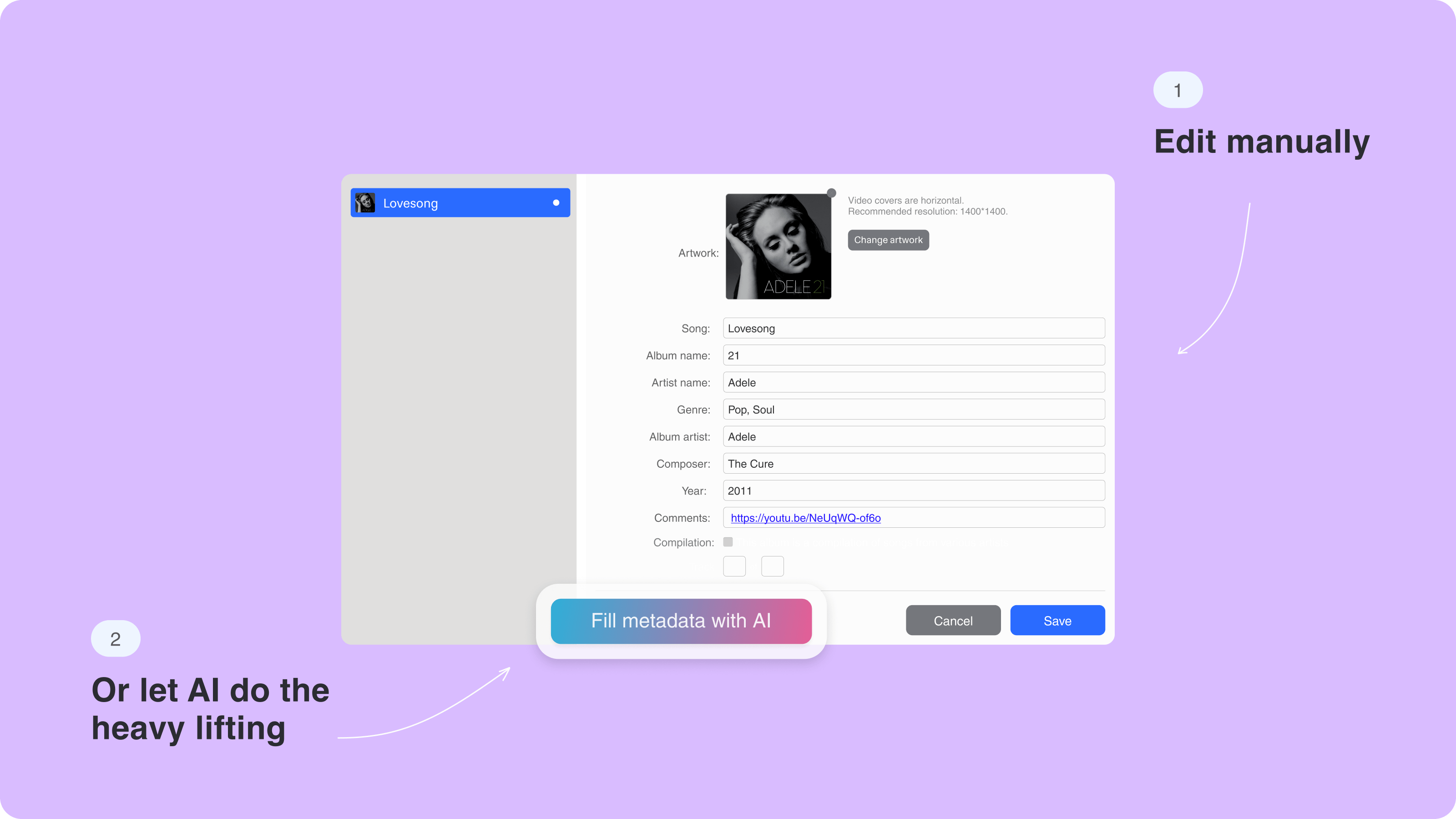
If you care about a clean Music library, check one album first. Then batch the rest.
Step 5. Open Music and play the converted files
Open the Music app on your iPhone or iPad and play the tracks.
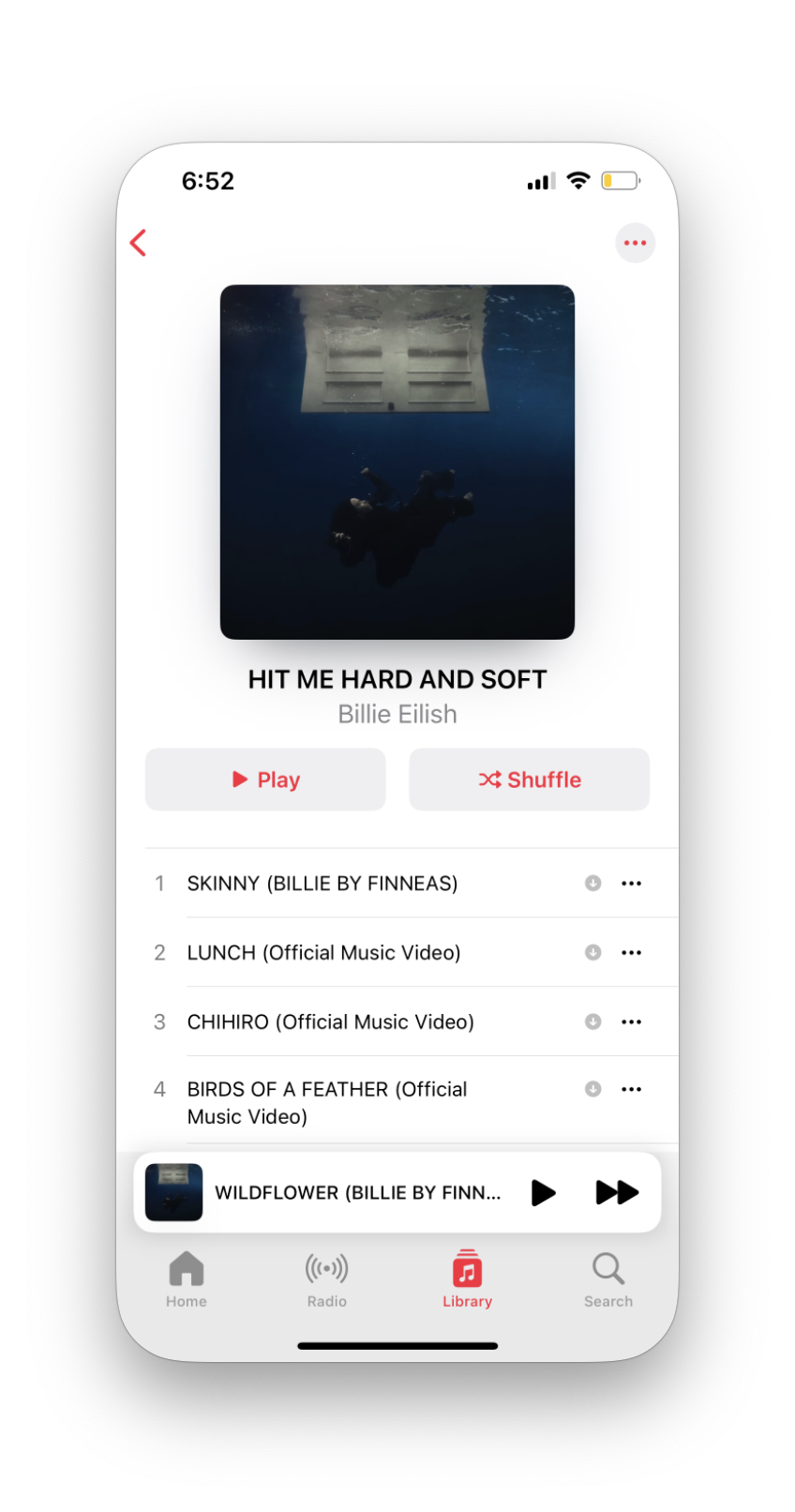
If you use wired headphones, a receiver, or a DAC, you can take better advantage of lossless playback. Apple notes that Bluetooth connections, including AirPods and Beats wireless headphones, do not play true lossless audio over Bluetooth.
FLAC to ALAC on Mac: practical options
Mac users have 3 practical routes.
Option 1: WALTR PRO for iPhone and iPad transfer
Use WALTR PRO when your target is an Apple device. It handles the conversion and transfer in one workflow. This is the least annoying route if you want music in the iPhone Music app and you do not want to wrestle with iTunes or Finder syncing.
Option 2: XLD for free batch conversion
XLD is a common free Mac pick for lossless audio conversion. It is good when you want to convert a folder of FLAC files to ALAC and manage the library yourself after that.
The tradeoff is setup. You need to choose the output format, check metadata, and then import or transfer files separately.
Option 3: ffmpeg for exact command-line control
If you already use Terminal, ffmpeg is clean:
ffmpeg -i input.flac -c:a alac output.m4a
That command converts one FLAC file into an ALAC-encoded M4A file. For folders, you will need a loop or script.
Use ffmpeg if you are comfortable checking codec output. Skip it if you want a normal app and fewer chances to mistype something.
FLAC to ALAC on Windows: practical options
Windows users have more friction because Apple’s own Windows tools are still not pleasant.
Option 1: WALTR PRO for direct iPhone transfer
WALTR PRO works on Windows and Mac. If you want FLAC files on an iPhone without iTunes on Windows, this is the clean route.
Windows iTunes can still do some library work, but nobody wakes up excited to troubleshoot iTunes sync. WALTR PRO avoids that whole routine.
Option 2: Foobar2000 for free conversion
Foobar2000 is powerful and free. It can convert FLAC to ALAC with the right components and encoder setup.
Use it if you like configuring tools. Avoid it if you want a one-window converter.
Option 3: dBpoweramp or MediaHuman for batch libraries
dBpoweramp is better for large libraries and careful metadata work. MediaHuman is simpler and lighter for everyday conversion.
Neither one removes the transfer problem by itself. After conversion, you still need to get the files into Apple Music or onto the iPhone.
Are online lossless converters safe?
Online converters are fine for a quick test file. They are not ideal for a private music library.
An online converter requires you to upload the file to someone else’s server. That creates 3 problems:
Use online converters for one non-sensitive file. Use a desktop converter for albums, rare recordings, client audio, paid downloads, or anything you want to keep private.
- Privacy: your audio file leaves your computer.
- Speed: large FLAC albums can take a long time to upload and download.
- Metadata: online tools can strip or mangle cover art, album names, or track numbers.
Will the conversion reduce quality?
No, not when you convert to Apple Lossless correctly.
FLAC and ALAC both preserve the original audio data. A proper lossless transcode decodes the original audio and encodes it again as ALAC without reducing quality.
But two warnings matter:
Check the output codec after conversion if the file matters.
- If your source file was already lossy, converting it to ALAC will not restore lost detail.
- If your converter outputs AAC inside an M4A file, you did not create a lossless ALAC file.
Can iPhone play FLAC directly?
The practical answer: not in the native Music app the way Apple users expect.
Some third-party iPhone apps can play FLAC. That works if you only want local playback inside that app. It does not give you the same Music app library flow.
If you want the file to behave like normal Apple music, convert FLAC to ALAC/M4A and place it in the Music app. That is where WALTR PRO fits.
Storage, Bluetooth, and Hi-Res Lossless notes
Lossless audio uses more space than AAC or MP3. Apple also notes lossless streaming and downloads use more data and storage than standard audio.
If you are converting a large FLAC library for iPhone, do the math before transferring everything. A 512 GB iPhone gives you room. A 64 GB iPhone gets crowded fast.
Also, lossless does not mean your Bluetooth headphones play lossless. Apple states Bluetooth connections are not lossless. AirPods still sound good, but they use AAC over Bluetooth.
For Hi-Res Lossless above 48 kHz on iPhone, Apple says you need an external DAC. If you do not own one, standard lossless is the more realistic target.
Common FLAC to ALAC problems and fixes
My converted file says M4A
That is normal if the codec is ALAC. M4A is the container. Open file info in your converter or media app and check the audio codec.
My file converted to AAC instead of ALAC
Change the converter output setting to Apple Lossless, ALAC, or alac. AAC is lossy.
My album art disappeared
Try a converter that preserves metadata better, or use WALTR PRO’s metadata tools before transfer. For large libraries, test one album first.
My iPhone storage filled up
Lossless files are bigger. Convert only the albums you actually want on the phone, or use AAC for casual listening.
The file plays on Mac but not on iPhone
Check sample rate, bit depth, channel layout, and codec. Some unusual Hi-Res or multichannel files can behave differently on portable devices. Try a standard ALAC output first.
Additional WALTR PRO features for Apple-device users
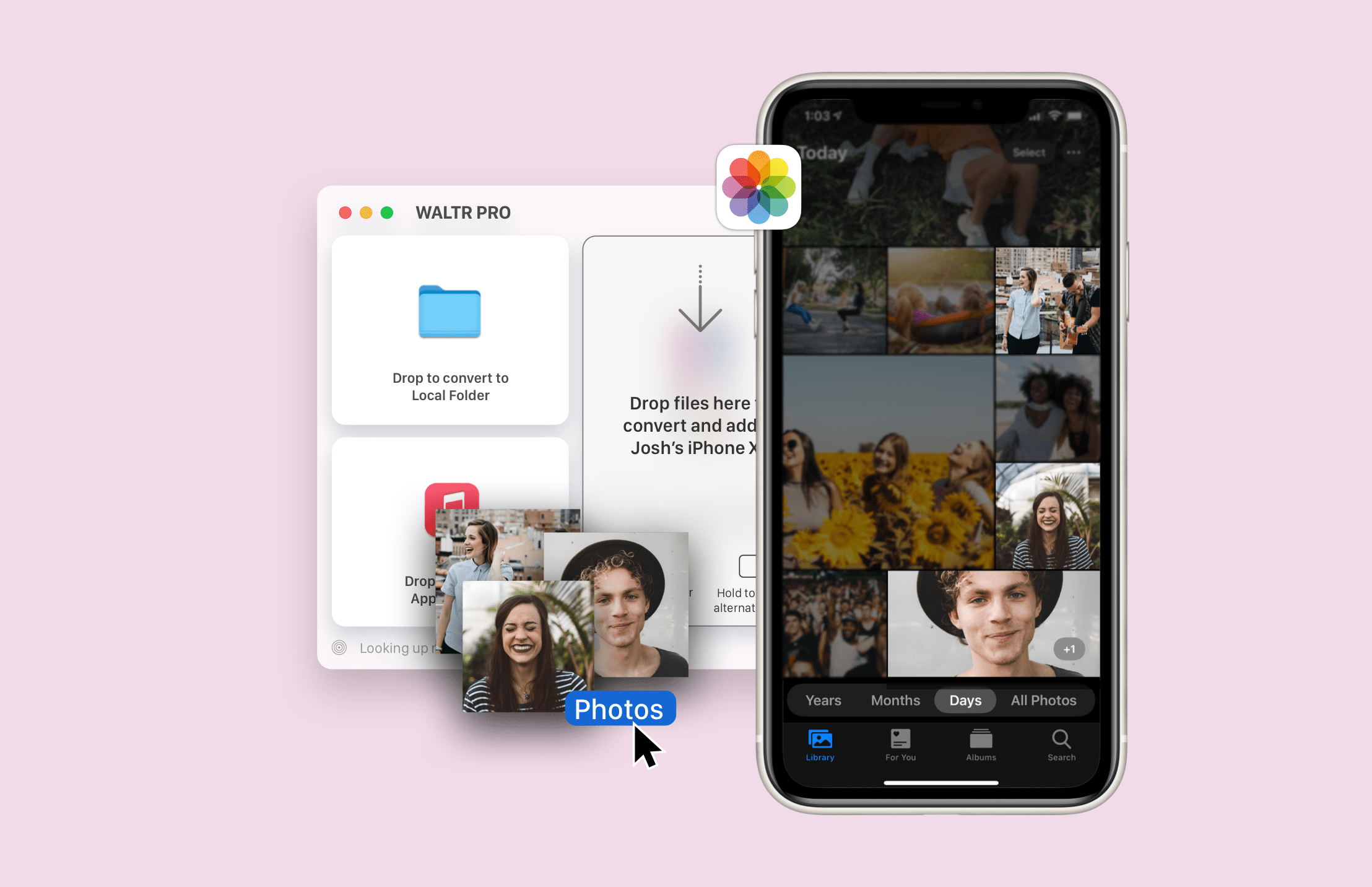
WALTR PRO is useful beyond FLAC to ALAC conversion if you often move files into Apple devices.
This is why WALTR PRO makes sense for mixed media. If your library includes FLAC music, MKV videos, PDFs, and other files Apple makes annoying, one drag-and-drop app beats 5 separate workarounds.
If you use more than one Softorino app, the Universal License can be cheaper than buying tools one by one. Keep the main choice simple, though: use WALTR PRO for this FLAC workflow.
- Transfer music to iPhone without iTunes.
- Move videos such as MKV, AVI, and MP4 into Apple-friendly apps.
- Send PDFs and EPUB files to Apple devices.
- Transfer subtitles with video files.
- Add metadata and cover art before transfer.
- Use cable or Wi-Fi after setup.
Final recommendation
If you want to convert FLAC to ALAC for iPhone, iPad, or Apple Music, use WALTR PRO. It handles the part Apple makes painful: conversion plus transfer without iTunes sync.
If you only need archive conversion, use XLD on Mac, Foobar2000 on Windows, dBpoweramp for serious library work, or ffmpeg if you like the command line.
Either way, remember the rule: FLAC to ALAC is lossless. FLAC to AAC is not. And M4A is only the container, not proof of the codec inside.
Try WALTR PRO if your real goal is simple: get your lossless music onto your iPhone and play it in Music without Apple turning it into a chore. You can also pair it with Softorino’s iPhone file transfer tools when Apple’s default workflow gets in the way.
FAQ
Does Apple Lossless conversion lose quality?
No. FLAC and ALAC are both lossless formats. A proper lossless conversion keeps the original audio data. You lose quality only if you convert to a lossy codec such as AAC or MP3.
Why did my ALAC file save as M4A?
ALAC audio usually lives inside an M4A container. The .m4a extension is normal. Check the codec to confirm the file contains ALAC, not AAC.
Can iPhone play FLAC files directly?
Some third-party iPhone apps can play FLAC. The native Music app works better with ALAC/M4A files. Convert FLAC to ALAC if you want Apple Music-style library playback.
What is the best converter for Mac?
Use WALTR PRO if you want to convert and transfer music to iPhone or iPad. Use XLD if you want a free Mac batch converter and will handle transfer yourself.
What is the best converter for Windows?
Use WALTR PRO if the destination is iPhone or iPad. Use Foobar2000 if you want a free configurable workflow. Use dBpoweramp if you manage a large paid music library.
Are online lossless converters safe?
They are fine for small, non-private files. Use a desktop converter for private audio, large albums, paid downloads, or files where metadata matters.
Should I use ffmpeg?
Use ffmpeg if you are comfortable with Terminal or scripts. The basic command is ffmpeg -i input.flac -c:a alac output.m4a. Use a GUI tool if you want less setup.
Is ALAC the same as Apple Lossless?
Yes. ALAC stands for Apple Lossless Audio Codec. Apple uses ALAC for lossless audio in Apple Music.
Is M4A always lossless?
No. M4A is a container. It can contain ALAC, which is lossless, or AAC, which is lossy. Check the codec before deleting your original FLAC files.

WALTR PRO
Convert & Push Any File into Any Apple Device
