How to Convert YouTube to AAC in 2026: 3 Safe Methods for iPhone


You want a YouTube to AAC file because AAC plays nicely with Apple devices, sounds good at reasonable file sizes, and does not drag iTunes into the room. Fair.
The catch: many “free” converter sites are ad mazes, and not every tool that says AAC gives you the Apple-friendly file you expect. This guide explains AAC, M4A, MP3, and the safest ways to extract audio from YouTube for personal, permitted use.
Quick legal note before the buttons start flying: download only videos you own, have permission to use, or can legally save offline. YouTube Premium is YouTube’s official offline option, and YouTube’s Terms restrict downloads outside features YouTube provides.
Before we begin
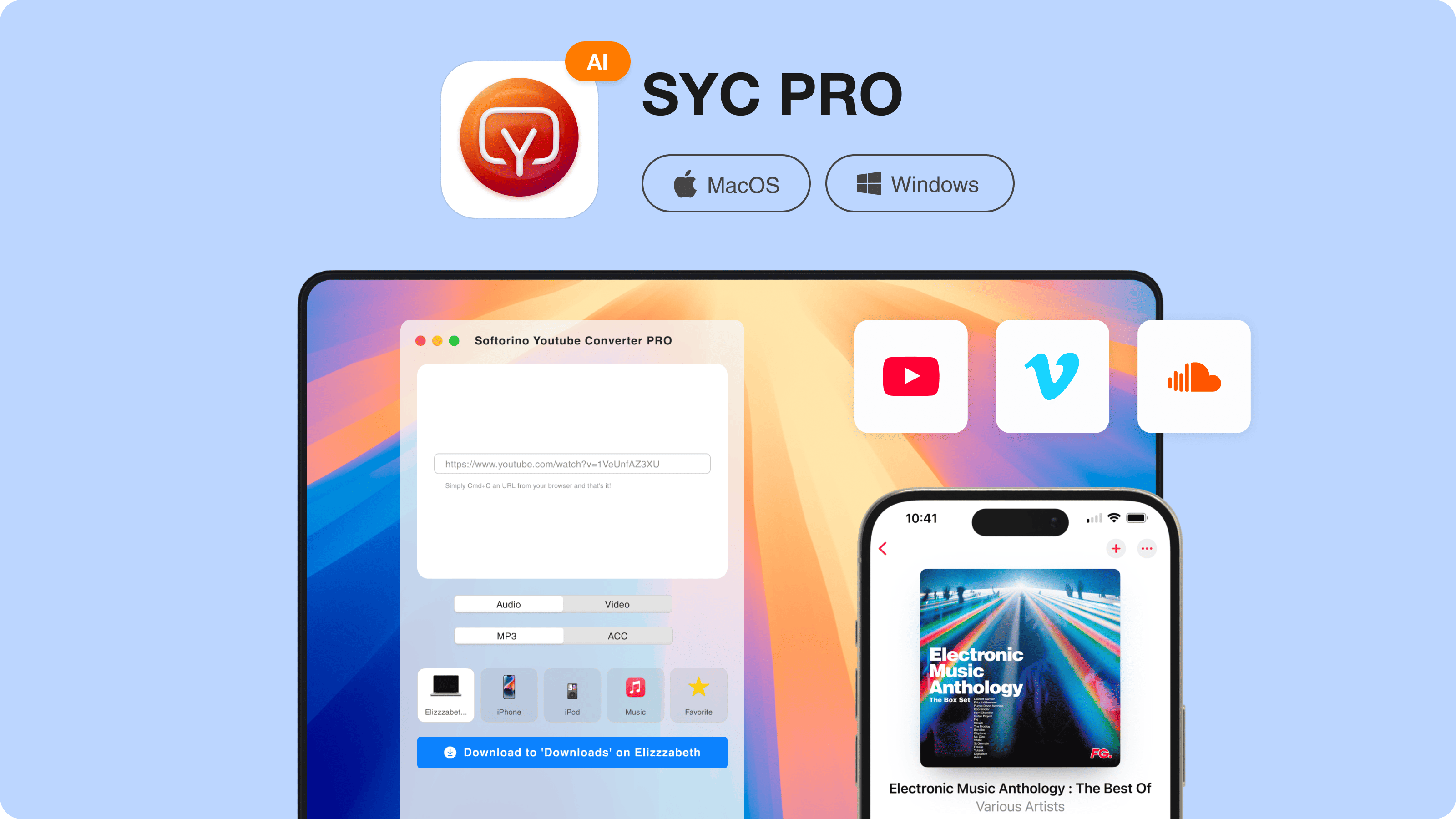
Download SYC PRO on Mac or Windows to save permitted YouTube audio as AAC and send it to an iPhone or Apple Music. Choose AAC before downloading and use only media you own or may legally save.
What AAC means when you convert YouTube to AAC
AAC stands for Advanced Audio Coding. It is an audio codec, which means it defines how the audio gets compressed.
M4A is different. M4A is a container file, and it often stores AAC audio inside it. Many audio converters give you an .m4a file instead of a raw .aac file for this reason. For iPhone, iPad, Mac, and Apple Music workflows, M4A is usually fine. In many cases, M4A is the more practical Apple-friendly file.
MP3 is the fallback. It works almost everywhere, including older players, car stereos, and random devices that have not seen a software update since 2014. AAC usually gives you better sound than MP3 at the same bitrate, but converting YouTube audio cannot create quality that was not in the source. YouTube audio is already compressed.
Use AAC or M4A when you care about Apple device playback and smaller files. Use MP3 when you need the broadest compatibility.

Best ways to convert YouTube to AAC
Start with the method that fits your actual job.
Method | Best for | Pros | Cons |
|---|---|---|---|
SYC PRO | Mac and Windows users who want YouTube audio on iPhone or Apple Music | Downloads YouTube audio, supports AAC and MP3, transfers to Apple devices, edits metadata | Paid after free trial |
Online converters | One-off downloads on a computer | No install, quick for short clips | Ads, file limits, privacy risk, inconsistent output |
Desktop video editors | Users who already have downloaded video files | Useful editing tools | Extra steps, often no direct YouTube download |
yt-dlp / command-line tools | Technical users | Flexible and scriptable | Not beginner-friendly, requires setup, legal responsibility stays with you |
YouTube Premium | Official offline viewing | Compliant YouTube offline feature | Downloads stay inside YouTube apps, not separate AAC files |
For most Softorino readers, SYC PRO is the cleanest route. It is built for YouTube, SoundCloud, and Vimeo downloads, works on macOS and Windows, supports MP3 and AAC audio, and can send media to Apple devices without the old iTunes sync dance.
1. Use SYC PRO for AAC audio
SYC PRO, short for Softorino YouTube Converter PRO, is the best fit when you want more than a random audio file in your Downloads folder. It can convert YouTube video to MP3 or AAC, download playlists, edit metadata, and send audio straight to Apple Music on your iPhone.
That last part matters. Online converters stop after they generate a file. Then you still have to move it to your phone, rename it, fix the artwork, and hope Apple Music does not make the process annoying. SYC PRO handles the download and the Apple-device workflow in one place.
How to use SYC PRO for AAC downloads
SYC PRO works on macOS and Windows. Start with the free trial if you want to test the workflow before buying.
- Download and install SYC PRO from the official Softorino website.
Softorino also offers a Universal License for users who want access to multiple Softorino apps. Use it if you also need iPhone file transfer, ringtone tools, or other Apple utility apps.
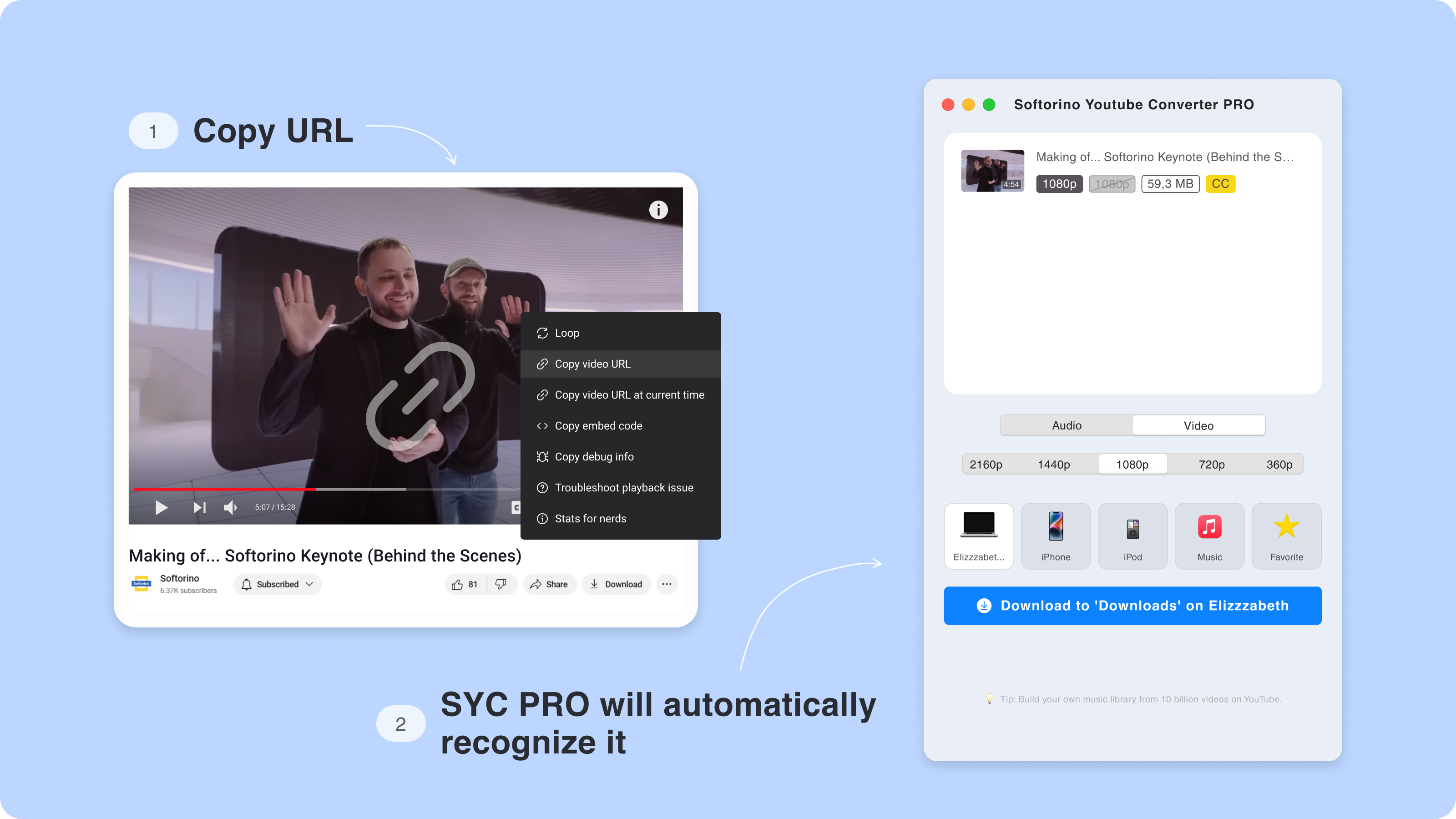
Open YouTube, find the video, and copy the link from your browser. SYC PRO can detect copied media URLs, so you do not need to paste links like it is 2009.
Step 1: Copy the YouTube video URL.
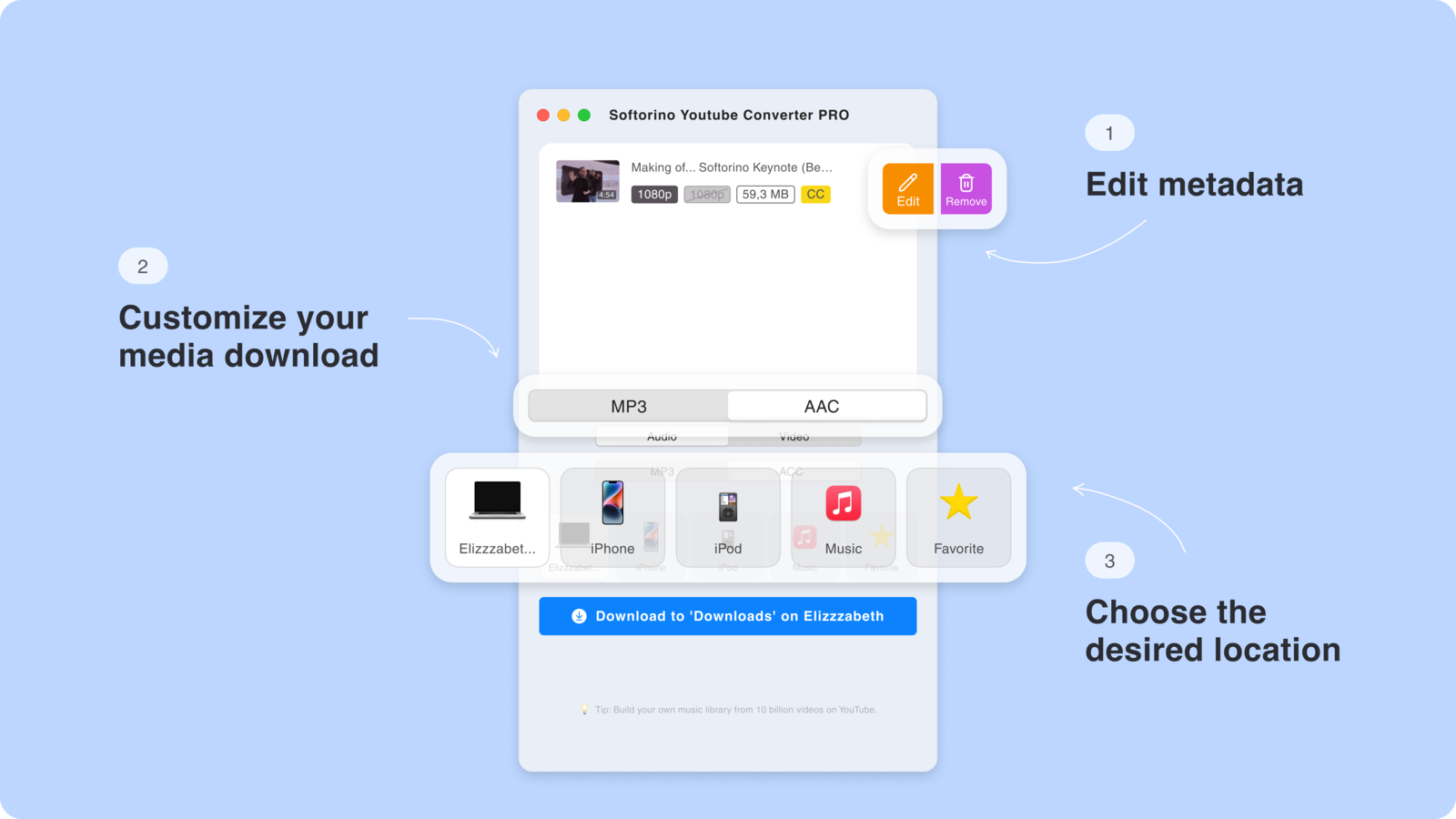
Select AAC if you want an Apple-friendly audio format. Choose your Mac, Windows PC, iPhone, iPad, Apple Music, or another supported destination depending on your setup.
Step 2: Choose AAC as the output format and pick a destination.
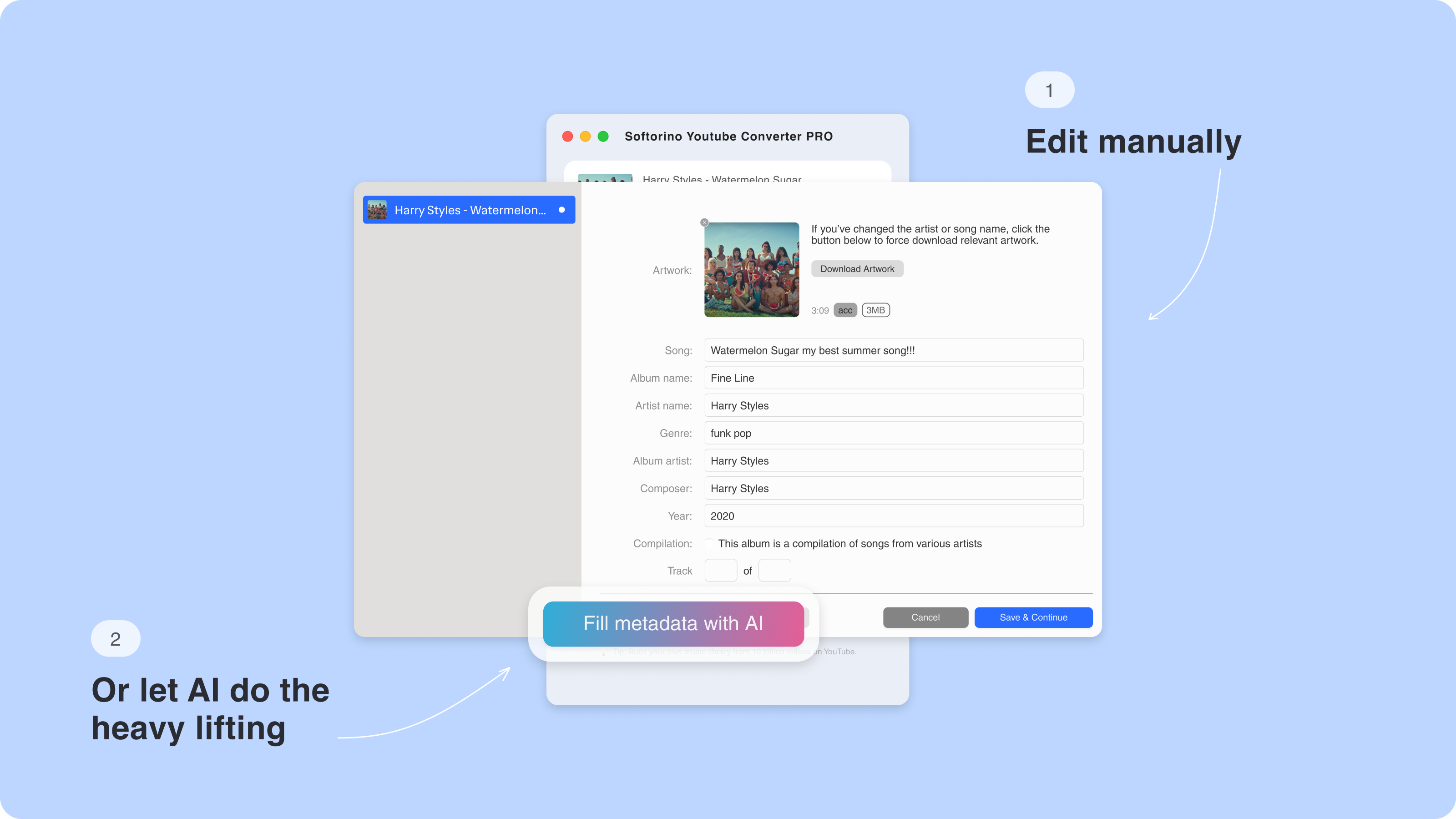
SYC PRO beats disposable converter pages here. You can fix the title, artist, album, genre, and artwork before the file lands in your library. SYC PRO also includes an AI metadata feature, so you can fill missing details faster.
Step 3: Edit the metadata before download.
Click Download. SYC PRO extracts the audio and saves it in the format and destination you selected. If you send it to your iPhone, the file goes into the Apple Music app workflow instead of sitting as a mystery download you have to hunt down later.
Step 4: Download and listen offline.
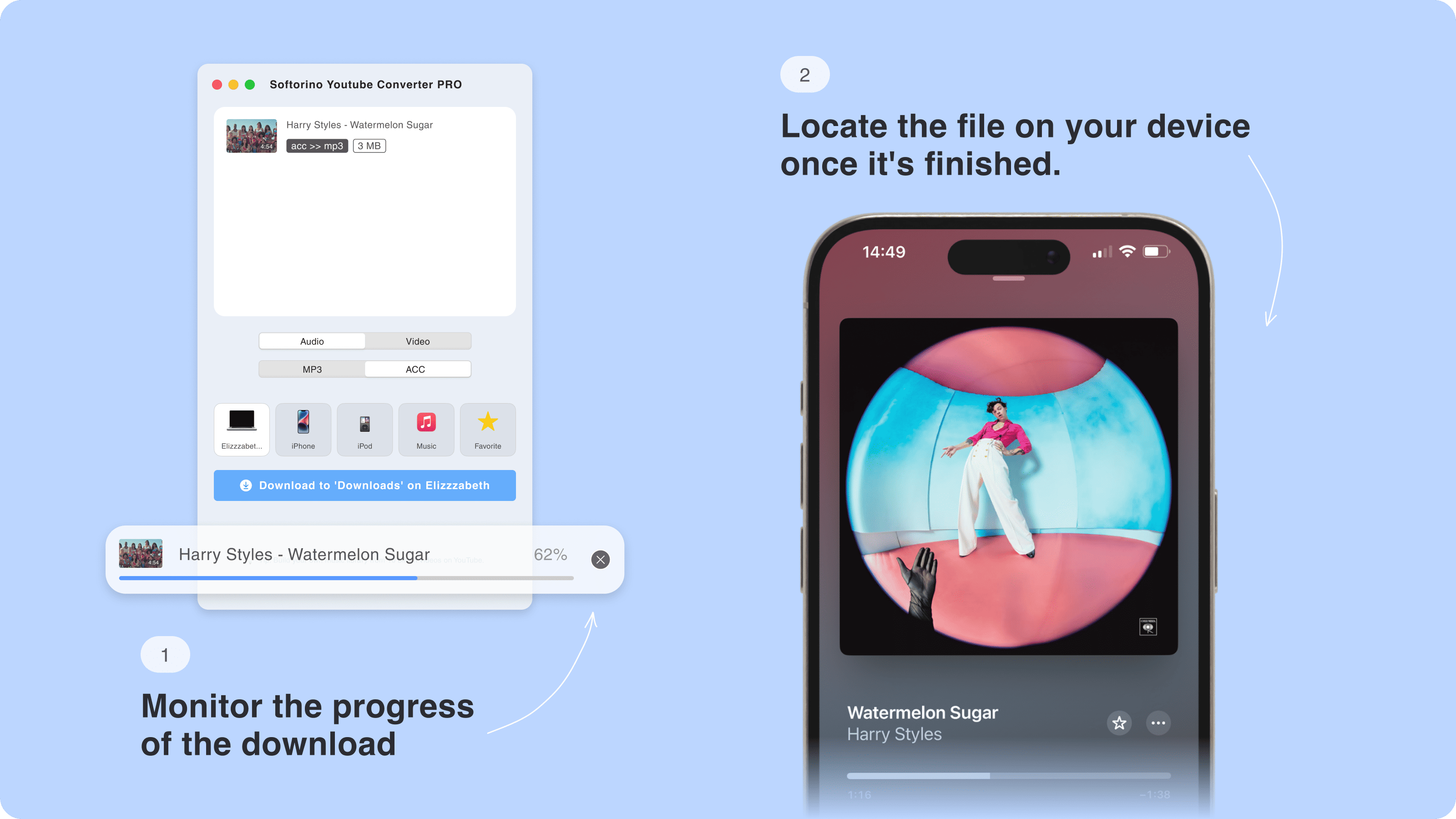
Pros:
Converts YouTube audio to AAC or MP3 in one app
Works on Mac and Windows
Sends audio to iPhone, iPad, Apple Music, or your computer
Supports YouTube, SoundCloud, Vimeo, Shorts, playlists, and subtitles
Lets you edit metadata before the file reaches your library
Cons:
Paid app after the free trial
Not meant for users who only need one quick throwaway conversion
2. Use an online AAC converter
Online audio converters are the fastest option if you only need one file and do not want to install anything. Copy the link, choose AAC, convert, download. Done.
That version sounds nice.
The less nice version: many online converters throw pop-ups at you, hide the real download button, limit file length, rename files badly, or switch output formats without making it obvious. Some also disappear or break when YouTube changes something.
How to use an online AAC converter
- Pick a converter site you trust.
- Paste the YouTube URL.
- Choose AAC or M4A if AAC is not listed.
- Start the conversion.
- Download the finished audio file.
- Scan the file if your browser or system warns you.
Warning: do not download browser extensions, installers, or “helper apps” from converter pages unless you trust the source. A real online converter should not need that for a basic file conversion.
Pros:
No app install
Works for quick one-off clips
Usually simple enough for short audio files
Cons:
Ads and fake buttons are common
File length and quality limits vary
Batch downloads are usually weak or missing
You still have to move the file to iPhone yourself
3. Use a desktop video editor
A desktop editor can convert video files to AAC, but it is usually not the fastest way to handle YouTube audio. Editors are built for trimming, merging, and exporting media you already have. They are not always built to download YouTube URLs directly.
EaseUS Video Editor is one example. It can export audio formats such as AAC, MP3, WAV, and FLAC, but the workflow has extra steps. You need to download the YouTube video first, import it into the editor, then export the audio.

How to use EaseUS Video Editor for AAC export
- Install EaseUS Video Editor on Windows.
- Download the YouTube video through a separate permitted method.
- Import the video file into the editor.
- Add the clip to a new project.
- Export the audio and choose AAC as the format.

Pros:
Useful if you need trimming or editing before export
Supports several output audio formats
Cons:
Windows-only workflow
No direct YouTube download in the editor workflow
Too much work if you only want audio on your iPhone
AAC vs M4A vs MP3 for YouTube audio
Most audio-format articles get sloppy here.
AAC is the codec. M4A is the container. MP3 is a different codec and file format with wider compatibility.
Format | Best use | Apple device support | Notes |
|---|---|---|---|
AAC | Efficient audio compression | Strong | Good for Apple workflows, but source quality still matters |
M4A | Apple-friendly audio file container | Strong | Often contains AAC audio and handles metadata well |
MP3 | Maximum compatibility | Strong | Works almost everywhere, but larger files at similar quality |
WAV | Uncompressed audio workflows | Supported, but large | Bad fit for most YouTube downloads because YouTube source audio is already compressed |
FLAC | Lossless music libraries | Limited native Apple fit | Converting YouTube audio to FLAC does not make it lossless |
If your goal is iPhone listening, AAC or M4A makes sense. If you plan to share the file with older devices, choose MP3. If a converter claims “lossless AAC from YouTube,” leave. AAC is a lossy format, and YouTube audio has already gone through compression.
Apple Music on Mac can import songs from files and CDs, and Apple documents import settings for formats such as AAC. YouTube Premium also offers offline downloads inside YouTube’s own apps. Those are different workflows. One creates files in your music library. The other keeps downloads inside YouTube.
Is AAC better than MP3 for YouTube audio?
AAC is better for Apple-device listening when you want smaller files with good quality at normal bitrates. YouTube to MP3 is better when you need a file that works on almost any device.
Do not choose based on “best quality” claims alone. Choose based on where the file will live.
Use AAC or M4A if:
- You listen on iPhone, iPad, Mac, or Apple Music
- You want compact files
- You care about metadata and library organization
- You do not need playback on old devices
Use MP3 if:
- You use older players or car stereos
- You send files to people on unknown devices
- You need the safest compatibility choice
For most iPhone users, AAC or M4A is the cleaner answer. For everyone else, MP3 is the safe fallback.
Safety and legal notes before you download YouTube audio
YouTube’s Terms of Service restrict downloading content unless YouTube provides a download button or otherwise allows it. YouTube Premium lets you download videos for offline viewing on supported devices, but those downloads stay inside YouTube apps.
Use common sense and stay on the right side of the creator’s rights. Download your own uploaded videos, royalty-free content, public-domain material, or videos where you have permission. Do not use converter tools to rip commercial music you do not own.
Also watch the software source. A clean desktop app from a known company is easier to trust than a converter site with 4 download buttons and a fake “Your Mac is infected” warning.
Best iPhone workflow for YouTube audio
If you want the least annoying iPhone workflow, use SYC PRO.
Format conversion is only half the job. The real job is getting the audio into a place where you can listen to it later. SYC PRO can download YouTube audio, use AAC or MP3, edit metadata, and send the file to Apple Music on your iPhone over cable or Wi-Fi. If you also move local files to iPhone often, WALTR PRO handles music, videos, PDFs, and ringtones without iTunes.
That beats the usual chain:
If you only need one throwaway file, an online tool may be enough. If you save playlists, lectures, podcasts, workout tracks, or music clips often, use a real downloader.
- Find an online converter.
- Dodge the ads.
- Download a weirdly named file.
- Figure out whether it is AAC, M4A, or something else.
- Move it to iPhone.
- Fix metadata later.
- Wonder why you did not start with a desktop app.
Final thoughts: the best way to convert YouTube to AAC
The best YouTube to AAC method depends on what you want after the conversion.
Use an online converter for a quick one-off file. Use a desktop editor if you already have the video file and need trimming. Use YouTube Premium if you want official offline viewing inside YouTube.
Use SYC PRO if you want a cleaner YouTube to AAC workflow: download YouTube audio, choose AAC or MP3, fix metadata, and send it to your iPhone or Apple Music without iTunes.
FAQ
How can I convert YouTube videos to AAC format?
Use a desktop downloader such as SYC PRO, an online audio converter, or a desktop editor after downloading the video through a permitted method. SYC PRO is the better fit if you also want to send the audio to iPhone or Apple Music.
Is AAC the same as M4A?
No. AAC is an audio codec. M4A is a container file that often holds AAC audio. Many Apple-friendly audio files use M4A because it handles AAC audio and metadata well.
Is AAC better than MP3 for iPhone?
AAC is usually better for iPhone listening at similar bitrates because it gives good quality with smaller files. MP3 is still better when you need maximum compatibility across older devices.
Can I convert YouTube to AAC on Mac and Windows?
Yes. SYC PRO works on macOS and Windows and supports YouTube audio conversion. Some online converters also work in any browser, but quality, privacy, and file limits vary by site.
Can I transfer converted AAC files directly to my iPhone?
Yes, if your tool supports device transfer. SYC PRO can send downloaded audio to Apple Music on your iPhone through cable or Wi-Fi. If you use a plain online converter, you still need a separate transfer method.
Is converting YouTube audio legal?
It depends on the content and your rights to use it. YouTube’s Terms restrict downloads outside approved YouTube features. Download your own videos, permitted content, or public-domain material. Use YouTube Premium for official offline viewing inside YouTube apps.
Why do some converters output M4A instead of AAC?
M4A is the common Apple-friendly container for AAC audio. A tool may say “AAC” because the audio codec is AAC, while the downloaded file ends in .m4a because that container works better for Apple music libraries and metadata.
Does converting YouTube to AAC improve audio quality?
No converter can add quality missing from the original YouTube stream. AAC can preserve good quality at efficient file sizes, but the source audio sets the ceiling.

SYC PRO
Download Web Videos Like a PRO
