How to Backup iPhone Without iCloud in 2026

If iCloud keeps asking for more storage, you are not stuck. You can back up iPhone without iCloud by saving a local backup to your computer, exporting important files to a Windows PC, or keeping extra copies on an external drive or trusted cloud folder.
The trick is choosing the right kind of backup. A full computer backup helps you restore an iPhone later. A selective export helps you save photos, messages, contacts, videos, and files you can browse on your computer. They sound similar. They solve different problems.
Before we begin
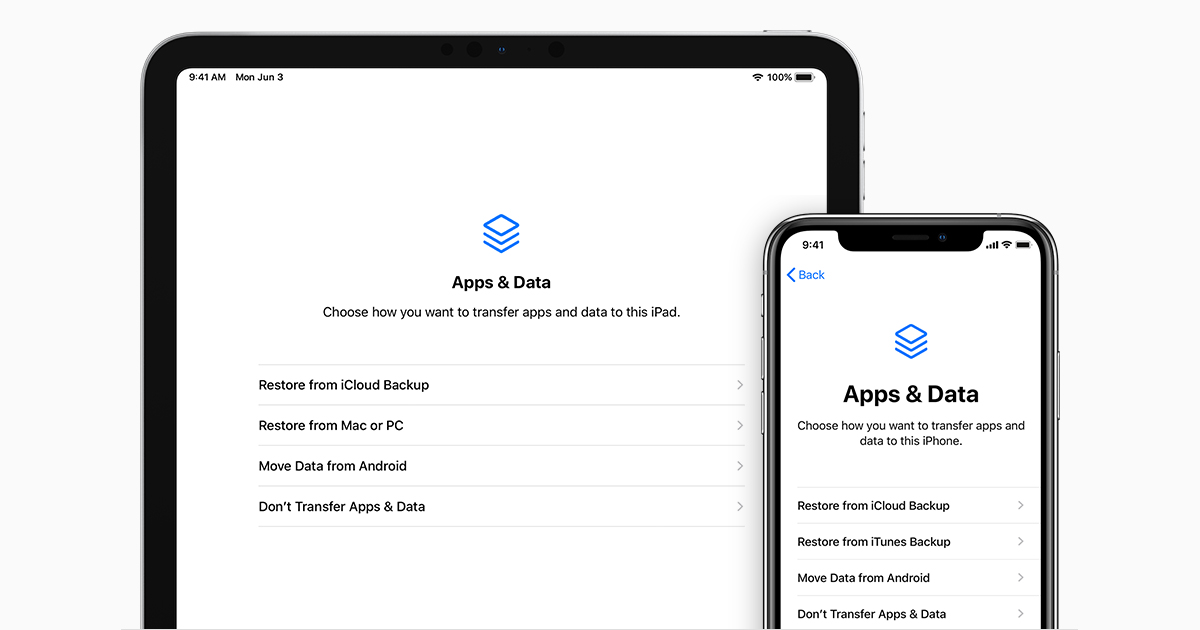
Decide whether you need a restorable device backup or browsable copies of specific files. Finder and Apple Devices create full local backups. AltTunes exports photos, messages, contacts, music, and other data to a Windows PC. Use encryption when Health, Activity, or Keychain data matters.
Quick answer: how to backup iPhone without iCloud
Here is the clean version before we get into steps.
Method | Best for | Full iPhone restore? | Works on |
|---|---|---|---|
AltTunes | Local Windows backup, browsing, and export without iTunes | Use for local backup/export control, not as a blanket Apple-system restore promise | Windows 10/11 |
Finder | Official full computer backup on Mac | Yes, for Apple computer backups | macOS Catalina or later |
Apple Devices app | Official full computer backup on Windows | Yes, for Apple computer backups | Windows |
iTunes | Older official computer backup path | Yes, for Apple computer backups | Windows or macOS Mojave and earlier |
Google One, Google Photos, Dropbox | Extra copies of photos, videos, contacts, calendar items, or files | No | iPhone, Mac, Windows |
External drive copy | Second copy of exported files or backup folders | Not by itself | Mac, Windows |
If you want the safest setup, use 2 layers: make a local computer backup, then copy the backup or exported files to an external drive. One copy is better than none. Two copies are how you sleep.
Quick takeaways before you back up
- Use Finder on Mac or Apple Devices on Windows when you need an official full iPhone backup you can restore later.
- Use AltTunes on Windows when you want local, browsable copies of iPhone photos, videos, messages, contacts, notes, files, music, voice memos, and similar data without iCloud.
- Encrypt Apple computer backups if you need Health, Activity, or Keychain data. Save the password, because Apple cannot recover it for you.
- Treat Google Photos, Dropbox, OneDrive, and external drives as extra copies, not full iPhone backups.
- Create the backup or export first. Then copy the folder to an external drive. Do not edit Apple backup folders by hand.
Full backup vs selective export: know the difference first
Before you back up iPhone without iCloud, decide what you need to recover later.
A full computer backup is the Apple-style backup. It stores most device data on your Mac or PC so you can restore it to the same iPhone or a new one. Apple says computer backups can be encrypted, and encryption is needed for Health, Activity, and Keychain data. Keep the password. Apple cannot recover an encrypted backup password for you.
A selective export is different. It saves the files you care about in a form you can see on your computer. Photos, videos, messages, contacts, music, files, notes, call history, and WhatsApp messages are the kinds of data Windows users often want outside Apple’s cloud. This is where an iPhone file manager for Windows makes more sense than fighting iTunes.
If you only back up photos to Google Photos, you did not create a full iPhone backup. You created a photo copy. Useful, but not the same thing.
What does an iPhone backup include and exclude?
Apple computer backups save most local iPhone data and settings, but they do not save everything. Apple says computer backups do not include content synced from a Mac or PC, data already stored in iCloud, Apple Mail data, Face ID or Touch ID settings, and Apple Pay information.
Health, Activity, and Keychain data need an encrypted computer backup. If you skip encryption, those categories may not come with the backup. If you forget the encrypted backup password, you cannot restore that encrypted backup later. Painful, but Apple is clear about it.
This is why the best answer to how to backup iPhone without iCloud is not one tool for every job. Use an official Apple computer backup for full-device restore. Use AltTunes when you want visible Windows copies of the data categories you choose. Then keep a second copy somewhere safe.
Method 1: How to backup iPhone without iCloud on Windows with AltTunes
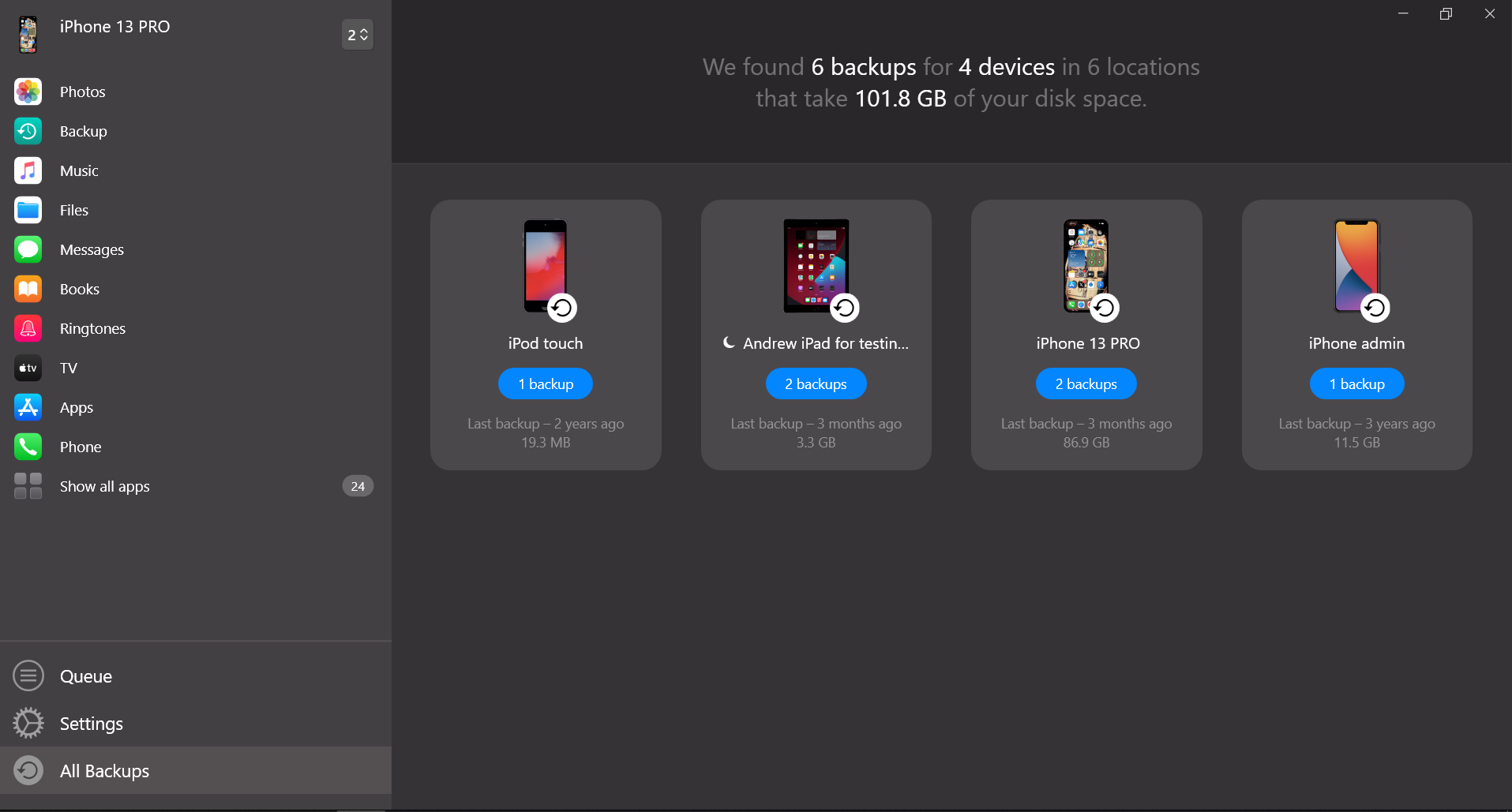
AltTunes is for Windows users who want local control without iCloud, internet syncing, or the iTunes maze. It connects by cable, lets you choose where data goes, and helps you browse, back up, and export iPhone or iPad data on your PC.
Use AltTunes when you want to back up iPhone without iCloud and you also want access to the data afterward. For example, you may want to export photos to a PC, save contacts as CSV or vCard, browse old backups, or move messages and files into a local folder you control.
Step 1: Download and install AltTunes
Download AltTunes on your Windows 10 or Windows 11 PC. Install it like any other Windows app, then open it and activate the free trial if prompted.
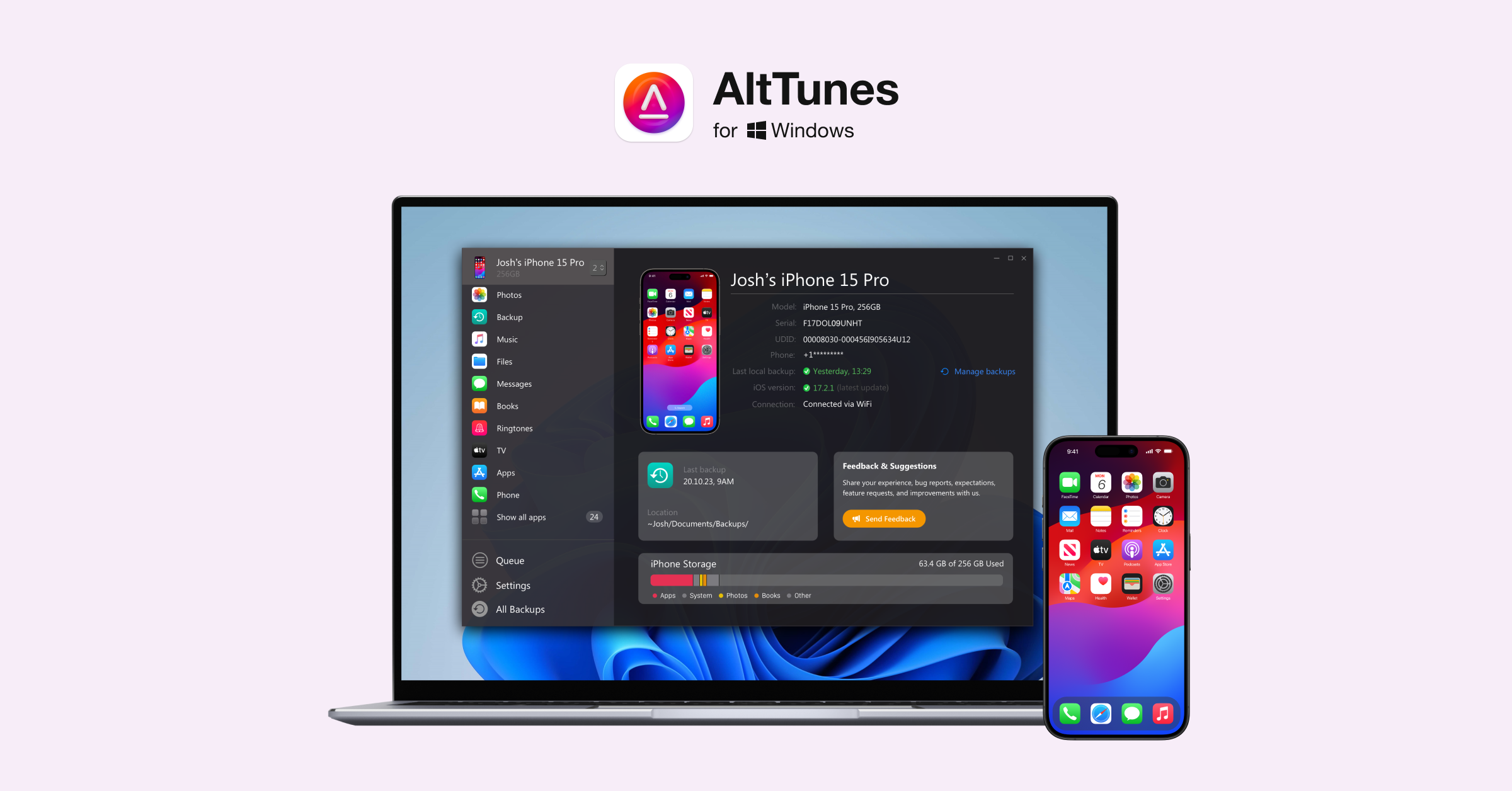
AltTunes fits the same frustration that brings people to articles like why you cannot add songs to iPhone. Windows and iPhone should work together without a small ceremony. AltTunes gives you a local path for iPhone files, backups, photos, messages, contacts, and more.
Step 2: Connect your iPhone with a cable
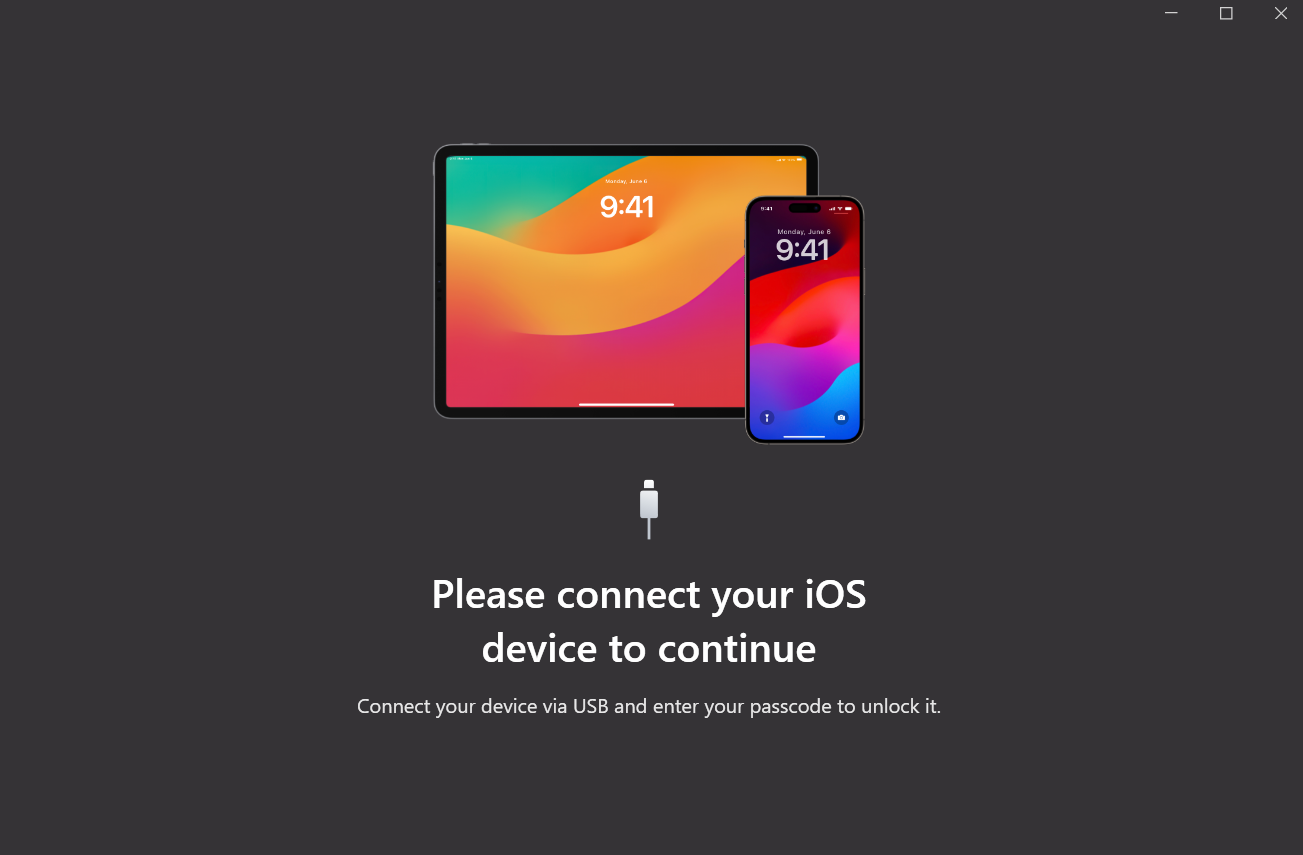
Plug your iPhone into the PC with a USB cable. Unlock the iPhone and tap Trust This Computer if iOS asks.
AltTunes works with iPhone and iPad. If you also need to back up iPad or prepare a transfer from iPhone to iPhone, the same local-control idea applies: connect the device, choose the data, and keep the copy somewhere you can find it.
Step 3: Choose what you want to back up or export
Open the sections inside AltTunes and pick the data category you care about. You can work with photos, music, contacts, files, notes, call history, messages, backups, app data, and WhatsApp messages where available.
This is the part iCloud does poorly for many users. iCloud can sync, but it does not give you a simple Windows folder full of the exact files you chose. AltTunes lets you browse from the PC side, then save local copies where they belong.
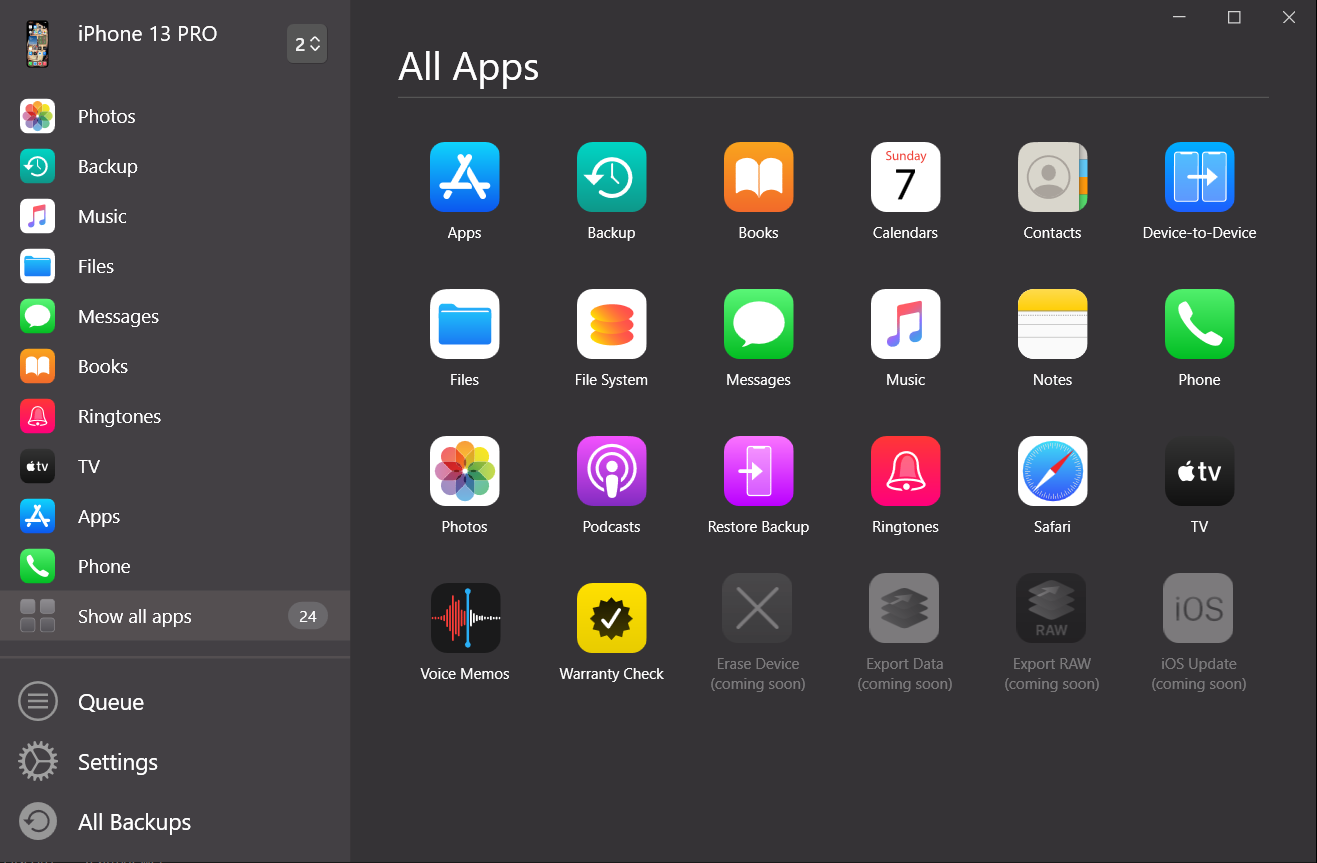
Use this route when you need specific data, not a black-box cloud backup. It is especially useful for photo libraries, contacts, messages, and media files you want to archive, share, or move to an external drive.
Step 4: Start the local backup or export
Choose a destination on your PC or external drive. Then start the backup or export and keep the iPhone connected until AltTunes finishes.
If you are exporting contacts, pick the format you need. CSV works well for spreadsheets. vCard works well for address books. If you are exporting photos, AltTunes can help with HEIC to JPEG conversion so the files open more easily on Windows.
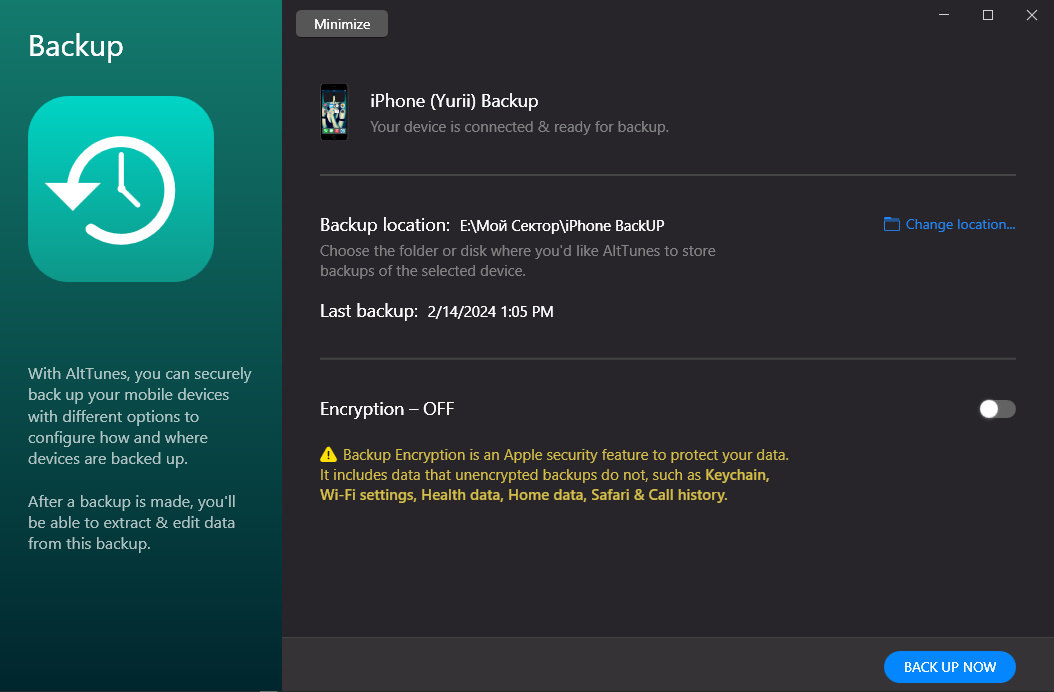
Do not unplug the iPhone halfway through. That is not bravery. That is how you create a mystery folder and a bad afternoon.
Method 2: Back up iPhone without iCloud on Mac with Finder
Finder is Apple’s official computer-backup tool on macOS Catalina and later. Use Finder if you want a full restorable iPhone backup on your Mac.
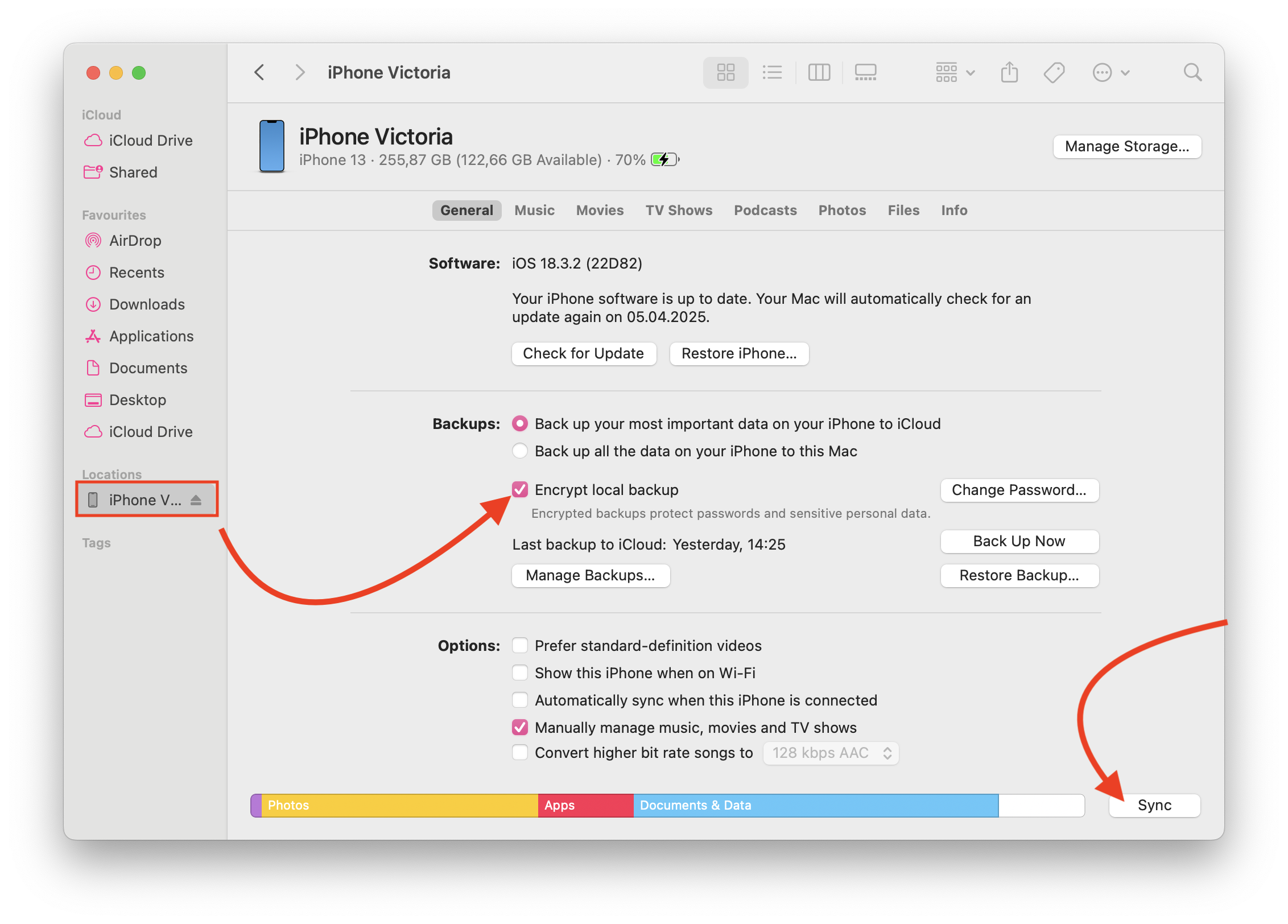
Follow these steps:
Finder is the best option for Mac users who want the official restore path without iCloud. It is not the best option if your main goal is to browse individual messages, export a specific photo batch, or manage iPhone files from Windows.
- Connect your iPhone to your Mac with a cable.
- Open Finder.
- Select your iPhone in the Finder sidebar.
- Click General.
- Choose Back up all of the data on your iPhone to this Mac.
- Turn on Encrypt local backup if you want Health, Activity, and Keychain data included.
- Create and save the backup password somewhere safe.
- Click Back Up Now.
Method 3: How to backup iPhone to PC with Apple Devices or iTunes
Apple now points Windows users to the Apple Devices app when available. If your PC does not have Apple Devices, or you are on an older setup, iTunes remains the fallback.
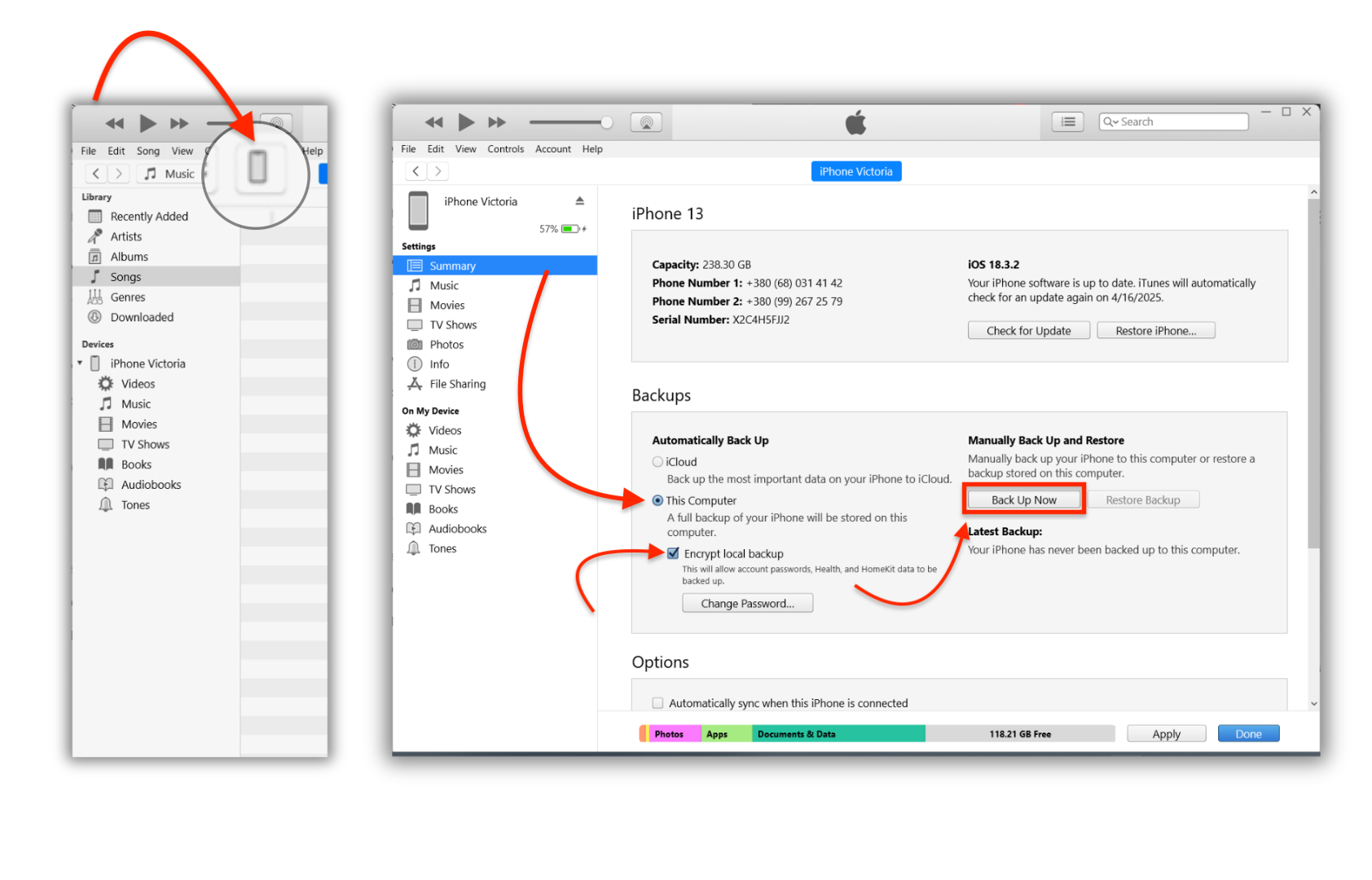
Use Apple Devices on Windows like this:
Use iTunes only when Apple Devices is not available or your setup still depends on it. The steps are similar: connect iPhone, open iTunes, select the device icon, choose Summary, then click Back Up Now.
The official Windows path is good when you want a restorable Apple backup. AltTunes is better when you want a friendlier Windows workflow for local backup, browsing, and export without iTunes friction.
- Install Apple Devices from Microsoft Store if you do not already have it.
- Connect your iPhone to the Windows PC with a cable.
- Unlock the iPhone and trust the computer.
- Open Apple Devices and select your iPhone in the sidebar.
- Go to General.
- Choose the backup option for this computer.
- Select Encrypt local backup if you need Health, Activity, or Keychain data included.
- Click Back Up Now.
Method 4: Back up photos and files to Google One, Google Photos, Dropbox, or another cloud folder
Google One, Google Photos, Dropbox, OneDrive, and similar tools can protect copies of important files. They do not create a full iPhone device backup.
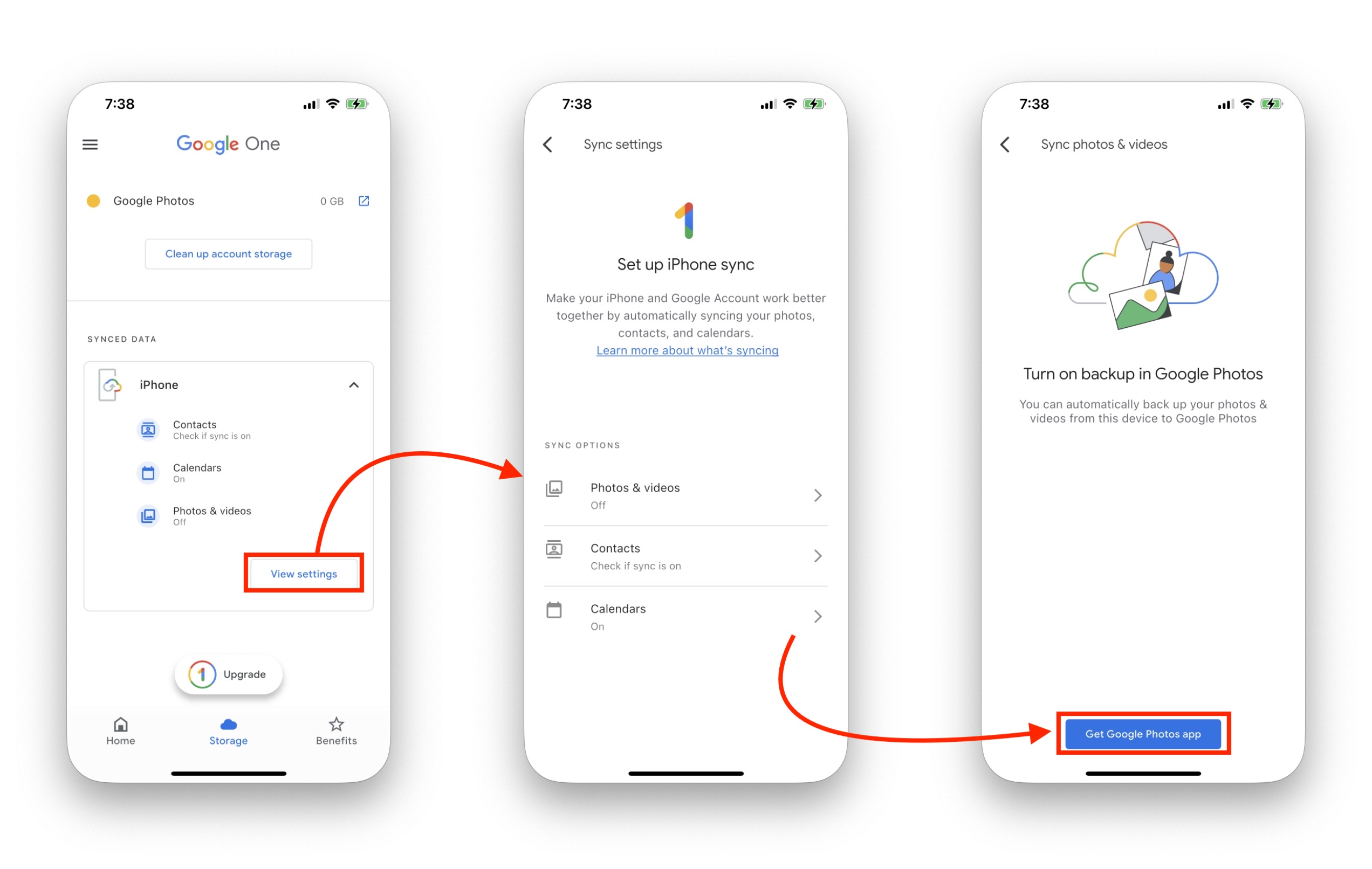
Use this method for data you can treat as normal files:
This works well as a second layer. For example, export photos from iPhone to your PC with AltTunes, then copy that folder to Dropbox or an external drive. Now you have a local copy and another copy somewhere else.
Do not rely on photo sync alone if your goal is to restore a whole iPhone. Sync tools can mirror deletions, miss app data, or store only selected categories. They are useful. They are not magic.
- Photos and videos
- Contacts or calendar exports
- PDFs and documents
- Files saved from apps
- Backup folders copied from your computer
Method 5: Copy your local backup to an external drive
A local backup sitting on one laptop is still one point of failure. If the laptop dies, gets stolen, or runs out of storage at the wrong time, your backup plan gets ugly.
After you back up iPhone without iCloud, copy the backup or exported folders to an external SSD, hard drive, or trusted cloud folder. This gives you a second copy without depending on iCloud storage.
Good candidates for an external copy:
Keep the folder names boring and clear. iPhone Backup May 2026 beats new backup final final 2 every time.
- AltTunes export folders for photos, videos, contacts, messages, and files
- Finder or Apple Devices backup folders, if you know where they live
- Photo archive folders sorted by year or trip
- Contact exports in CSV or vCard format
- Important documents from Files or app exports
How to restore iPhone data from these backups
Restoring depends on the method you used. This is where backup marketing gets sloppy, so keep the categories separate.
Backup type | What restore looks like |
|---|---|
Finder backup | Restore through Finder on Mac |
Apple Devices backup | Restore through Apple Devices on Windows |
iTunes backup | Restore through iTunes on older setups |
AltTunes backup/export | Browse, extract, copy, or move supported data locally |
Google Photos/Dropbox files | Download files back to iPhone or computer |
External drive copy | Copy the saved folders back to your computer first |
If you made an encrypted Apple computer backup, you need the password to restore it. Write it down in a password manager. Do not trust Future You to remember it. Future You is busy and overconfident.
For official backup limits and Windows backup steps, check Apple Support before making a risky restore decision. The useful Apple pages are the iPhone backup methods guide, the computer backup exclusions page, and the Windows Apple Devices backup guide.
Common mistakes when backing up iPhone without iCloud
Avoid these and your backup will be much more useful later.
- Treating sync as backup. Sync mirrors data. Backup preserves a recoverable copy.
- Skipping encryption for computer backups. You may miss Health, Activity, and Keychain data.
- Keeping one copy only. One laptop is not a backup strategy.
- Forgetting the encrypted backup password. No password means no restore.
- Assuming Google One or Dropbox backs up app data. They mainly help with copies of files, photos, videos, contacts, or calendar data.
- Waiting until the iPhone is already failing. Backups made during panic mode are cursed.
Which method should you choose?
Choose Finder if you use a Mac and want the official full iPhone backup without iCloud.
Choose Apple Devices if you use Windows and want Apple’s official full computer backup path.
Choose iTunes only if your Mac or Windows setup still depends on it.
Choose AltTunes if you use Windows and want local control, browsable backups, and exports without iCloud or iTunes friction.
Choose Google Photos, Dropbox, OneDrive, or an external drive as a second layer, not as your only iPhone backup plan.
Ready to back up your iPhone without iCloud?
You can back up iPhone without iCloud in a few sane ways. Finder and Apple Devices handle official full computer backups. AltTunes gives Windows users a practical local path for backup, browsing, and export. External drives and cloud folders add another safety layer.
If you are on Windows and want to stop wrestling with iTunes, try AltTunes for local iPhone backup and export control. Connect your iPhone, choose the data, and save it where you can actually find it.
For Windows exports, AltTunes can export iPhone photos, music, messages, and other data to a PC without relying on iTunes.
FAQ
Can I back up my iPhone without iCloud?
Yes. You can back up iPhone without iCloud by using Finder on Mac, Apple Devices or iTunes on Windows, or AltTunes for local Windows backup and export control. You can also copy photos, videos, files, and exports to an external drive or cloud folder as a second layer.
What is the best way to back up iPhone to a computer?
Use Finder on macOS Catalina or later, Apple Devices on Windows, or iTunes on older setups if you want an official full computer backup. Use AltTunes on Windows if you want to browse and export specific iPhone data locally without iTunes.
Can I back up iPhone without iCloud or iTunes?
Yes. Mac users can use Finder. Windows users can use AltTunes for local backup, browsing, and export without iCloud or iTunes. If you need Apple’s official full Windows backup path, use Apple Devices where available.
Does Google One create a full iPhone backup?
No. Google One, Google Photos, Dropbox, and similar tools can save copies of photos, videos, contacts, calendar items, or files. They do not create a full restorable iPhone system backup.
Should I encrypt my local iPhone backup?
Yes, if you want Health, Activity, and Keychain data included in an Apple computer backup. Save the password in a password manager because you need it to restore the encrypted backup later.
Can I save an iPhone backup to an external drive?
Yes, but the safest workflow is to create the backup or export first, then copy the backup folder or exported files to the external drive. This gives you a second copy if your computer fails.
Does backing up my iPhone save everything?
No. Apple computer backups save most local device data, but Apple lists exclusions. They do not include data already synced to iCloud, Apple Mail data, Apple Pay information, Face ID or Touch ID settings, or Health, Activity, and Keychain data unless the backup is encrypted.

AltTunes
Seamlessly Browse, Manage & Export iOS Data
