APE to MP3: Convert Monkey's Audio or Play It on iPhone in 2026

Need to convert APE because your iPhone, iPad, Apple Music app, car stereo, or speaker refuses to play the file? Start with the real job.
If you need a standalone .mp3 file, use a true audio converter. If you only want to play an APE music file on your iPhone or iPad, WALTR PRO is the cleaner route. It transfers APE and other music files to Apple devices without iTunes and places music in the native Music app.
Monkey's Audio is a lossless format. It is lossless, which is good for quality. The compressed target is lossy, which is good for compatibility. That tradeoff matters before you hit convert.
Before we begin
Download WALTR PRO on Mac or Windows to convert an APE file locally or transfer it to an iPhone, iPad, or iPod without an iTunes sync. Test one track first and keep the lossless source until playback is confirmed.
APE to MP3: Pick the Right Method First
Most converter pages throw an upload button at you. That works for one small, non-private file. It is a poor default for music libraries, old CD rips, APE+CUE albums, or files with metadata you care about.
Use this table first.
Your goal | Best method | Why it fits |
|---|---|---|
You need a quick MP3 from one small, non-private APE file | Online converter | No install, fast, but you upload the file |
You need real .mp3 files on Mac, Windows, or Linux | fre:ac or MediaHuman | Local conversion, batch support, better control |
You have an APE+CUE album image | MediaHuman, foobar2000, or FFmpeg | These tools can split album rips into tracks |
You want command-line control | FFmpeg | Best for repeatable batch workflows |
You want APE music on iPhone or iPad | Transfers APE to Apple devices without iTunes | |
You want Apple Music or iTunes to convert it | Usually not the right tool | Apple conversion works for supported formats, not APE as a safe default |
Quick answer: Use fre:ac or MediaHuman if you need an actual MP3 file. Use WALTR PRO if the real goal is to put APE music on your iPhone or iPad and play it in the Music app without iTunes.
Tip
APE vs MP3 vs ALAC vs FLAC
APE, MP3, ALAC, and FLAC are not interchangeable labels. They solve different problems.
Format | Type | Best for | Apple-device fit |
|---|---|---|---|
APE / Monkey's Audio | Lossless | Archiving music with smaller files than WAV | Poor native Apple support |
MP3 | Lossy | Maximum compatibility across phones, speakers, cars, and apps | Strong support |
ALAC in M4A | Lossless | Apple-friendly lossless music | Strong support |
FLAC | Lossless | Open lossless libraries and audiophile collections | Limited native Apple support compared with ALAC |
- APE / Monkey's Audio: Lossless source format with poor native Apple-device support. Keep it when you want an archive copy.
- MP3: Lossy compatibility copy. Use it when you need a file that plays almost everywhere.
- ALAC / M4A: Lossless Apple-friendly copy. Use it when you want high-quality playback inside Apple workflows.
- FLAC: Open lossless library format with broader non-Apple support than APE.
The source keeps the original audio data. The compressed target throws some data away to make the file smaller. That does not make the format bad. It makes the smaller file practical when you need the file to play everywhere.
If you own the lossless APE source, keep it as your master copy. Make a compressed copy for compatibility. Convert to ALAC or M4A when you want lossless playback inside Apple's apps and devices.
Quality note: MP3 is not lossless. Once you convert APE to MP3, you cannot get the discarded audio data back by converting the MP3 to WAV, AIFF, or another larger format later.
Tip
Can iPhone or Apple Music Play APE Files?
Apple devices do not treat Monkey's Audio as a native everyday format. AAC, ALAC, WAV, and AIFF are safer choices for Apple Music and iPhone playback.
Apple's own conversion workflow in the Music app or iTunes for Windows can convert supported songs between formats and keeps the original file unchanged. Apple also warns that converting to compressed formats can reduce sound quality. That is normal audio math, not an Apple bug.
The catch: Apple Music and iTunes are not the right default path for Monkey's Audio files. If you drag one of these files into an Apple workflow and it fails, do not waste your afternoon fighting menus.
Use one of these paths instead:
- Need a real MP3 file? Convert with fre:ac, MediaHuman, FFmpeg, or another local converter.
- Need music on iPhone or iPad? Use WALTR PRO to transfer the file into the Apple device workflow without iTunes.
- Need to keep lossless quality? Convert APE to ALAC/M4A or keep the original APE master.
Method 1: Put APE Music on iPhone with WALTR PRO
WALTR PRO is not the answer when you need a finished MP3 file sitting in a folder. It is the answer when you searched “APE to MP3” because your real problem is simpler: you have lossless music and you want it on your iPhone.
Softorino's WALTR PRO product page lists APE among supported music formats. It also supports MP3, FLAC, AAC, AIFF, WAV, WMA, OGG, OGA, CUE, and more. WALTR transfers music to iPhone, iPad, or iPod and places it in native Apple apps such as Music.
That means you can skip the old chain of APE to WAV to ALAC through iTunes. You drop the file into WALTR PRO, choose the device, and let WALTR handle Apple-compatible delivery.
Step 1: Download WALTR PRO
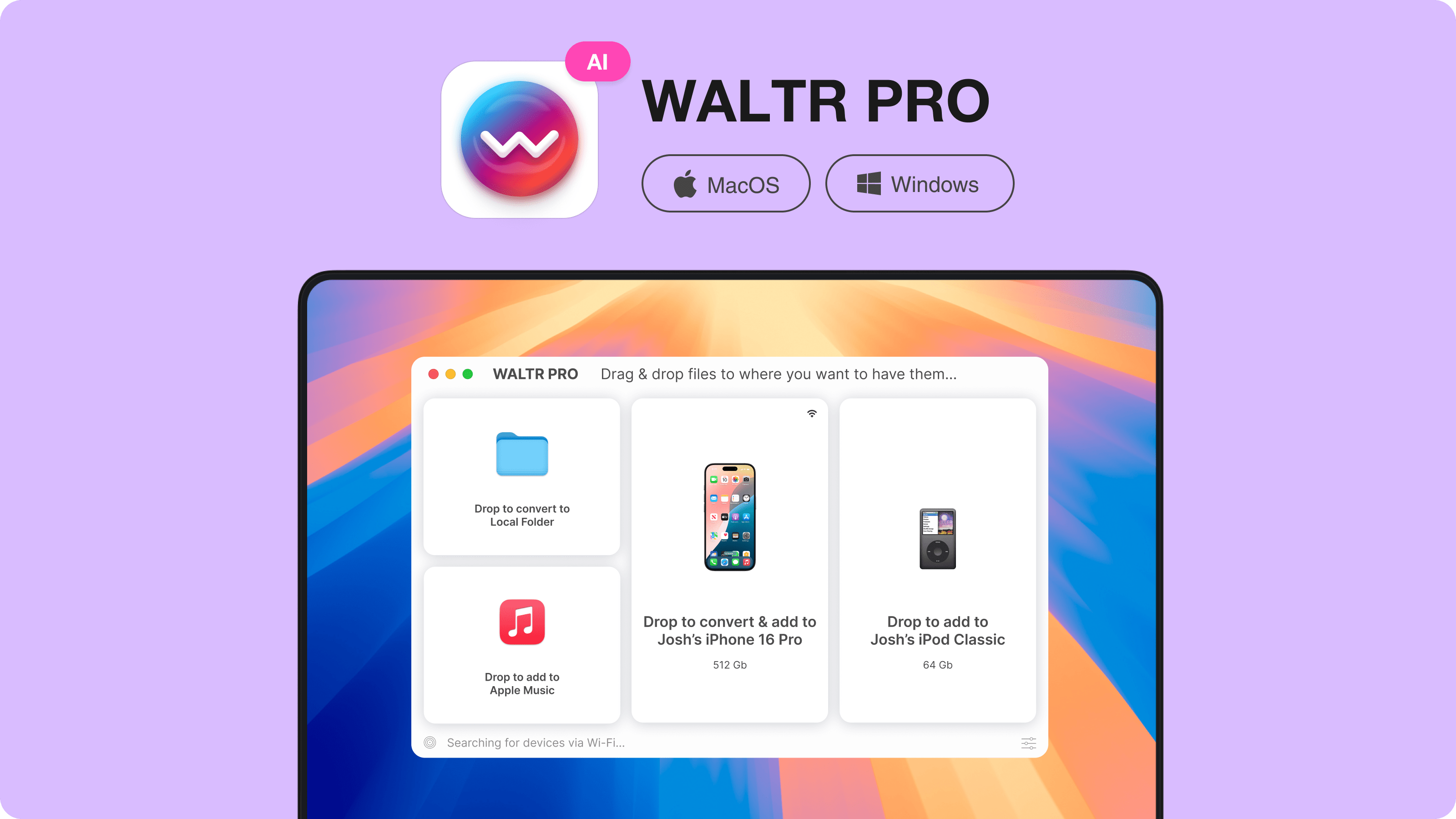
Download WALTR PRO on Mac or Windows. A free trial is available.
Install it, open it, and connect your iPhone or iPad. You can use USB. Wi-Fi transfer works after pairing.
Step 2: Add Your APE Music
Drag your APE file or album folder into WALTR PRO.
WALTR PRO is built for the annoying Apple-device transfer job:
This is the clean Softorino path: no browser upload, no iTunes library wrestling, no manual codec guessing.
- It supports this format and other major audio formats.
- It sends music to the native Music app.
- It works without iTunes sync.
- It can transfer by USB or Wi-Fi.
- It also handles video, books, subtitles, ringtones, and documents.
Step 3: Open the Music App on Your iPhone
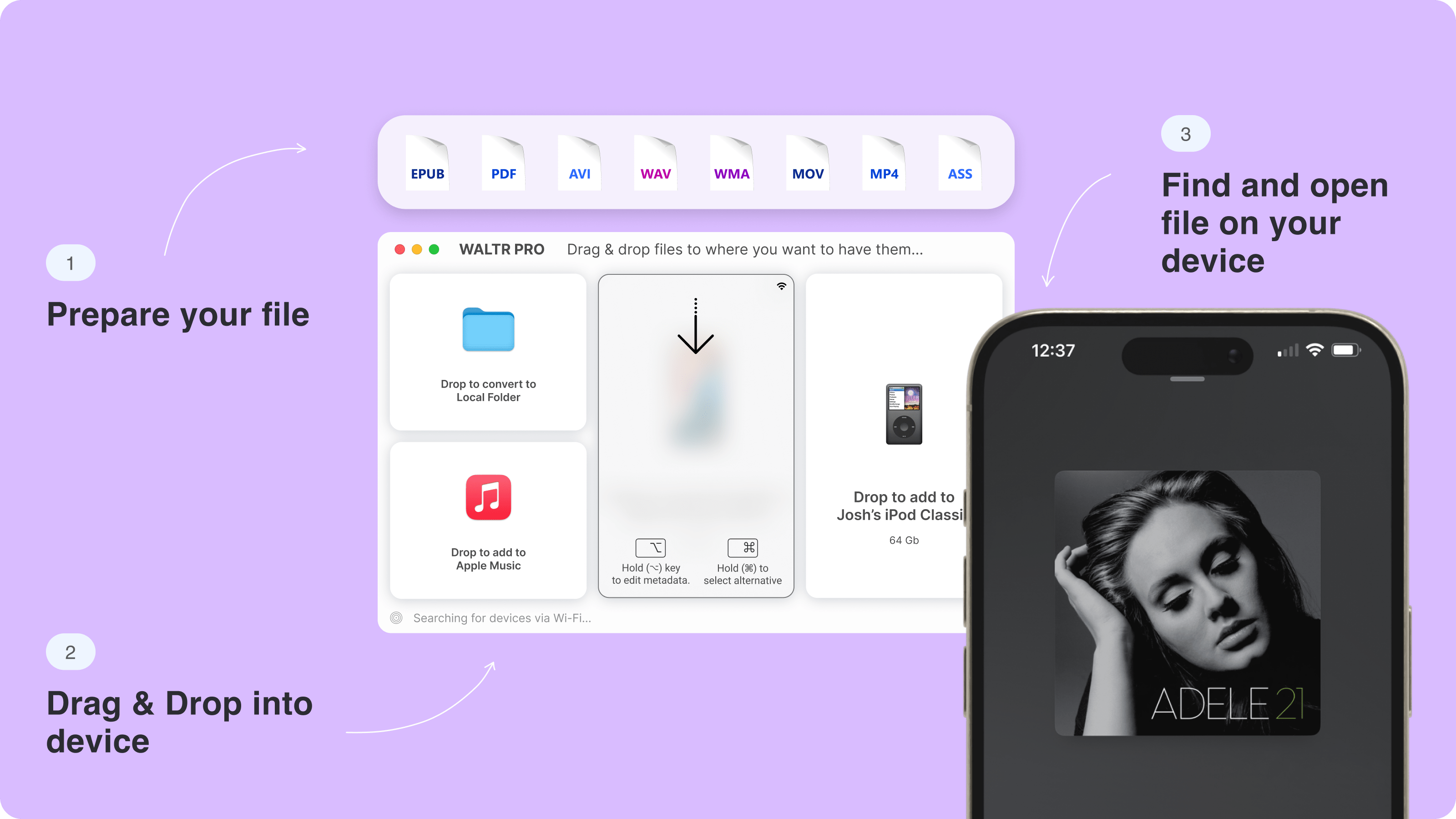
After transfer, open the Music app on your iPhone or iPad. Your music should appear there like music you can play, not like a mystery file hiding in Files.
If you also need help moving other tracks, use Softorino's guide on how to add music to iPhone without iTunes. If you work with lossless libraries, the related FLAC to ALAC guide is a better fit than forcing every file into MP3.
Method 2: Convert APE to MP3 with fre:ac
Use fre:ac when you need real .mp3 output and want the work to stay on your computer. It is free, open source, and available for Windows, macOS, and Linux.
The fre:ac site says it converts between MP3, M4A/AAC, FLAC, WMA, Opus, Ogg Vorbis, Speex, Monkey's Audio (APE), WavPack, WAV, and other formats. It can also convert whole music libraries while keeping folder and filename structure.
fre:ac workflow
fre:ac is the sensible recommendation for private batches. You do not upload your music library to a website, and you get more control than a one-click browser converter.
- Install fre:ac from the official site.
- Add your source files or folder.
- Choose MP3 as the output encoder.
- Pick a bitrate. Use 256 kbps or 320 kbps if you want high compatibility with fewer quality compromises.
- Choose an output folder.
- Start the conversion.
- Test several tracks before deleting or moving anything.
Method 3: Use an Online Converter
Online converters rank well because they match the lazy version of the task: upload, convert, download.
They are fine for one small file you do not care about. They are not ideal for private music collections, rare recordings, paid downloads, or large albums.
Privacy check: If you would not upload the music file to a random shared folder, do not upload it to a browser converter either. Use a local converter instead.
Warning
Before using an online converter, check 4 things:
If the file is private, use a local converter. If the file is small and disposable, an online converter can be the fastest route.
File-size limits. Some free tools cap uploads or queue larger files.
Storage policy. Your file may stay on the service for hours after conversion.
Metadata support. Artwork, album tags, and track names can get messy.
APE+CUE support. Many browser tools convert the large APE file but do not split tracks properly.
Method 4: Split APE+CUE to MP3
Many APE files come from old CD rips. You may have one large .ape file plus a .cue sheet. The large audio file holds the album. The CUE sheet stores the track boundaries and names.
If you convert only the large source file, you may get one huge MP3 instead of separate songs. That is not what most people want.
Use a tool that understands CUE sheets:
Keep the original APE and CUE files until you confirm track names, gaps, artwork, and playback look right.
- MediaHuman can handle APE+CUE workflows for splitting album images.
- foobar2000 is strong on Windows if you are comfortable installing components.
- FFmpeg can work for power users who want scripted conversion.
- fre:ac is better for library conversion, but check your CUE workflow before running a large batch.
Method 5: Use FFmpeg for MP3 Output
FFmpeg is the power-user answer. It is not friendly, but it is reliable once you know the command.
A basic command looks like this:
ffmpeg -i input.ape -codec:a libmp3lame -b:a 320k output.mp3
That command reads the source file, encodes with LAME, and sets the bitrate to 320 kbps.
Use FFmpeg when:
Do not start with FFmpeg if you hate command lines. Use fre:ac or MediaHuman instead.
- You need repeatable batch conversion.
- You are comfortable with Terminal or Command Prompt.
- You want to script folders of files.
- You need logs when a file fails.
What Bitrate Should You Use for MP3 Output?
The source format is lossless, so your source file is better than MP3. The bitrate decides how much quality you trade for smaller files.
Use this simple rule:
Setting | Use it for |
|---|---|
128 kbps | Speech, tiny files, low expectations |
192 kbps | Casual listening where size matters |
256 kbps | Good balance for music |
320 kbps | Best common setting for music compatibility |
V0 VBR | Good quality with variable file size |
If you can spare the space, use 256 kbps or 320 kbps for music. If you care about lossless quality, do not use a lossy file as your archive. Keep APE, FLAC, or ALAC as the master.
Should You Choose MP3, FLAC, or ALAC?
Choose MP3 when compatibility matters most. MP3 plays almost everywhere.
Convert APE to ALAC when you use Apple devices and want lossless music in an Apple-friendly format. ALAC usually lives inside an .m4a file.
Convert APE to FLAC when you want an open lossless format with broader support across non-Apple players and audio tools.
For iPhone and iPad, the decision is even simpler:
- Need a playable Apple-device library without iTunes? Use WALTR PRO.
- Need a file you can send anywhere? Make the compatible copy.
- Need lossless Apple compatibility? Use ALAC/M4A.
- Need an open lossless archive? Use FLAC.
APE Converter FAQ
Can iPhone play APE files?
Not as a normal native format. iPhone supports AAC, ALAC, WAV, and AIFF better than APE. Use WALTR PRO for Apple-device transfer or convert APE to an Apple-friendly format.
Can Apple Music convert APE?
Do not count on Apple Music as a Monkey's Audio converter. Apple's Music app can convert supported songs between formats and keeps the original copy unchanged, but APE is not the safe input format to build the workflow around.
Is Monkey's Audio lossless?
Yes. Monkey's Audio is a lossless compression format. It preserves the original audio data when decoded properly.
Is MP3 lossless?
No. The compressed target is lossy. It removes audio data to reduce file size. Use the compressed format for compatibility, not for lossless archiving.
What is the best free APE converter?
fre:ac is the safest free pick for most people because it is local, open source, cross-platform, and supports Monkey's Audio. MediaHuman is also good for easier APE+CUE workflows.
Is an online converter safe?
It depends on the file and the service. Online converters require an upload, may have size limits, and may store converted files temporarily. Use local software for private music libraries.
How do I split APE+CUE into MP3 tracks?
Use a converter that reads the CUE sheet, not only the APE file. MediaHuman, foobar2000, and FFmpeg are better choices than simple online converters for APE+CUE album images.
Should I use WALTR PRO or an MP3 converter?
Use WALTR PRO when you want this music on your iPhone or iPad without iTunes. Use an MP3 converter when you need actual .mp3 files for sharing, car stereos, speakers, or other non-Apple workflows.
Final Take
This conversion is not one job. It is two jobs wearing the same search query.
If you need real MP3 files, use fre:ac, MediaHuman, FFmpeg, or a careful online converter. Keep the original source files because MP3 conversion is lossy.
If you only want the music on your iPhone, skip the conversion maze. WALTR PRO handles the Apple-device transfer path without iTunes and gets the music into the native Music app.

WALTR PRO
Convert & Push Any File into Any Apple Device
