How to Convert WebM to MP4 for iPhone, Mac, and Windows in 2026

Need to convert a web video because your iPhone, iPad, Mac app, or video editor refuses to play the file? Start with the real goal. If you only need an MP4 file, use HandBrake, VLC, FFmpeg, or a trusted online converter. If you need the video on an iPhone or iPad without iTunes drama, use WALTR PRO and send the Apple-ready file straight to the device.
The format works well on the web. Apple devices are pickier. A source file can use VP8, VP9, or AV1 video with Opus or Vorbis audio, while native Apple playback is safest with MP4, M4V, or MOV using H.264 or HEVC video and AAC audio. The extension matters, but the codec inside the file matters more.
This guide shows the best WebM to MP4 method for each situation: iPhone transfer, free local conversion, quick VLC conversion, online tools, and power-user FFmpeg.
Best WebM to MP4 method: quick answer
For most people, the best method depends on where the file needs to end up.
Method | Best for | Works offline? | Main catch |
|---|---|---|---|
WALTR PRO | Getting WebM or Apple-ready video onto iPhone/iPad without iTunes | Yes | Desktop app, not an online converter |
HandBrake | Free local WebM to MP4 conversion on Mac, Windows, or Linux | Yes | More settings to choose |
VLC | Quick one-off conversion or playback check | Yes | Conversion settings are less friendly |
Online converter | Small, non-private videos you need converted fast | No | Uploads, limits, compression, account prompts |
FFmpeg | Exact codec control and batch workflows | Yes | Terminal required |
Third-party iPhone player | Playing WebM without converting | Yes, after transfer | Does not create an MP4 file |
If you searched for a converter because you want the file inside Photos, TV, iMovie, or another native Apple app, convert to an Apple-friendly MP4 or use WALTR PRO to handle the transfer path. If you only want to watch a WebM file once, a player app may be enough.
Before we begin
Download WALTR PRO on Mac or Windows to transfer the finished MP4 video to an iPhone or iPad without iTunes. Keep the original WebM file until you confirm video and audio playback on the device.
WebM vs MP4: why iPhone playback fails
WebM and MP4 are containers. They hold the video and audio streams, but your device still needs to decode those streams.
WebM usually contains VP8, VP9, or AV1 video with Opus or Vorbis audio. That setup is common for web video, screen recordings, Discord clips, and browser downloads. It can look great in Chrome and fail in Apple’s native apps.
MP4 is the safer container for iPhone, iPad, QuickTime, iMovie, most TVs, and social apps. Softorino’s iPhone video format guide covers the Apple playback angle in more detail. For Apple playback, aim for:
Apple’s own support page says older or specialized media formats may not open if the device, operating system, or app does not support the format. That is the annoying part. A file can be “MP4” and still fail if the video or audio track inside it uses the wrong codec.
- MP4 or M4V container
- H.264 video for safest compatibility
- HEVC/H.265 video when you want smaller files and your device supports it
- AAC audio
- Burned-in subtitles or compatible soft subtitles if subtitles matter
Check the codec, not only the file extension. For iPhone and iPad, H.264 video with AAC audio is the safest MP4 target.
Warning
Convert WebM to MP4 for iPhone with WALTR PRO
Use WALTR PRO when the goal is not only conversion. Use it when you want to move the video to an iPhone or iPad and avoid iTunes, Finder syncing, AirDrop failures, and the “where did my file go?” problem.
WALTR PRO is a Mac and Windows desktop app from Softorino. It supports WEBM, MP4, MKV, AVI, MOV, FLV, WMV, and other video formats. You can drag a file into the app, choose a destination like iPhone, iPad, Apple TV, a USB drive, or a local folder, and let WALTR PRO prepare the file for Apple playback.
Step 1: Install WALTR PRO
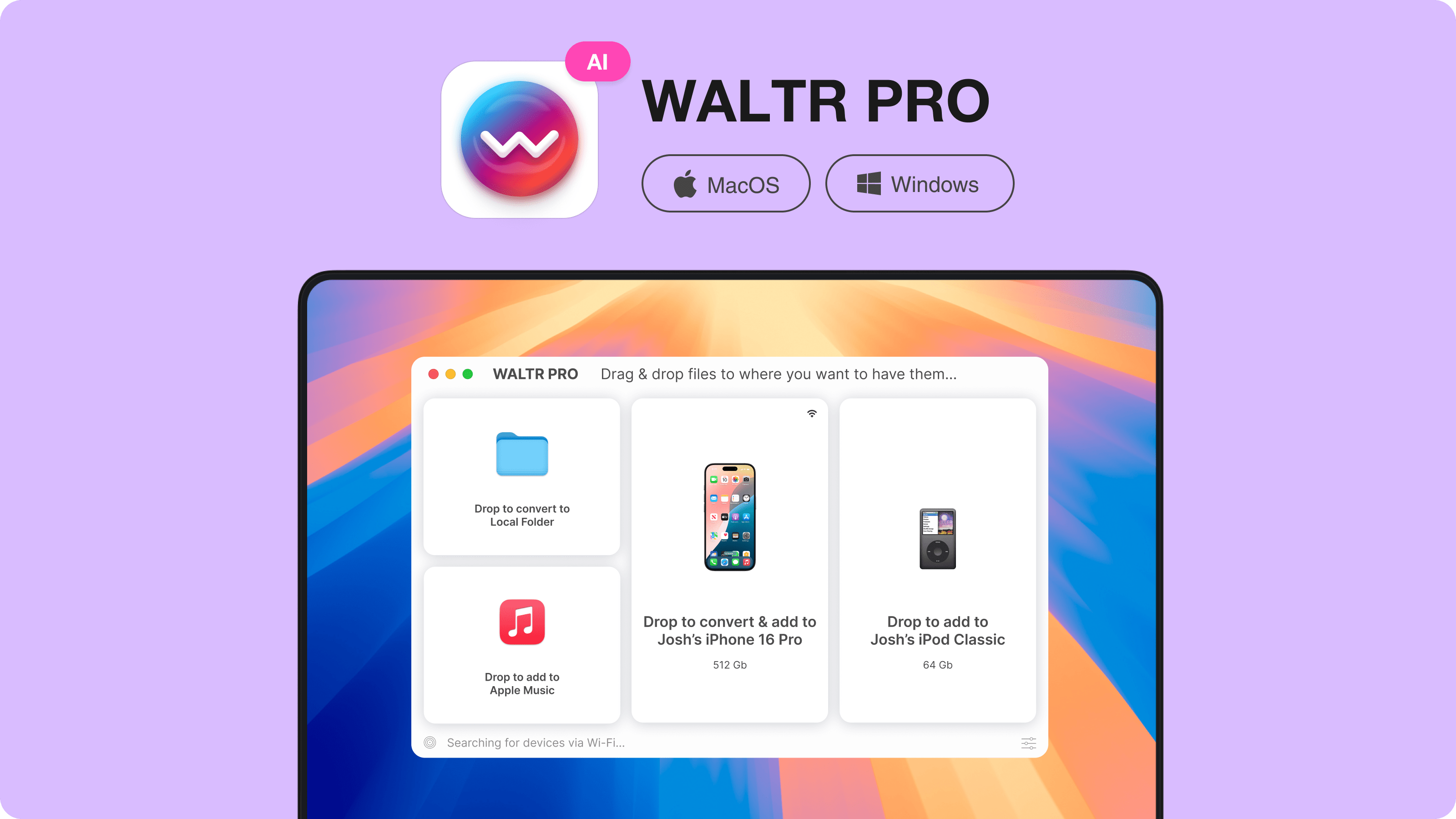
Download WALTR PRO on your Mac or Windows PC. The app has a free trial, so you can test the workflow before paying for anything.
Connect your iPhone or iPad with a cable, or use Wi-Fi transfer if your device is already paired. Cable is the better choice for large WebM files. Nobody enjoys watching a 3 GB movie crawl across Wi-Fi.
Step 2: Choose the right destination
Open WALTR PRO and pick where the video should go.
If you want the file on your iPhone or iPad, choose the device. WALTR PRO sends videos to Apple-friendly destinations like the Apple TV app when the file fits that use case.
If you only need a local Apple-ready file, use the Local Folder destination. The same no-iTunes logic also applies when you transfer music from computer to iPhone with Softorino tools. That lets WALTR PRO convert the file without sending it to a device.
Step 3: Drag the WebM file into WALTR PRO
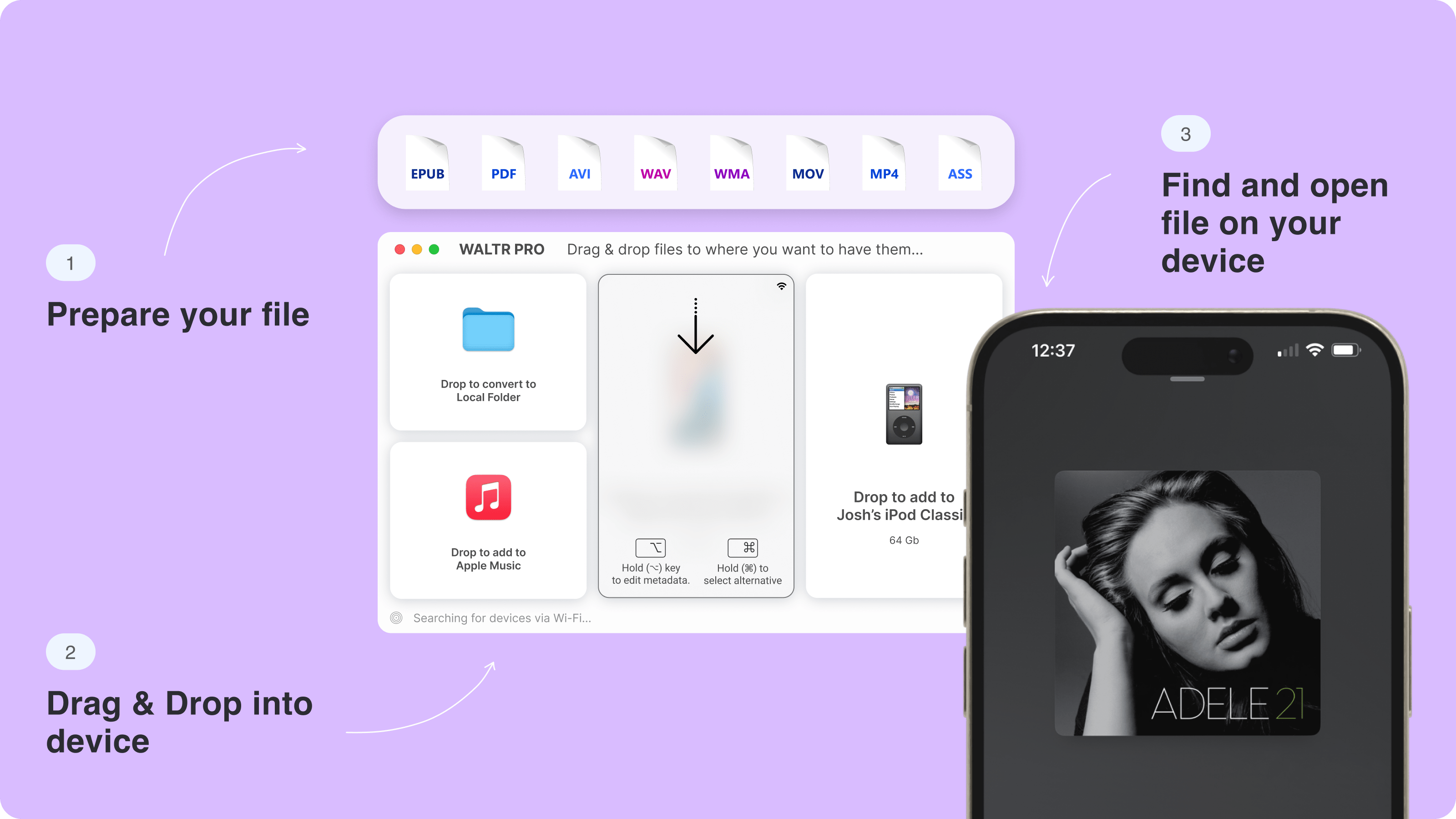
Drag your WebM file into WALTR PRO. The app reads the file and handles the Apple-device workflow for you. For video files, it can prepare unsupported formats for Apple playback and transfer them without iTunes.
Do not treat this as a magic guarantee for every odd file ever created. If a WebM file has broken audio, damaged frames, DRM, or strange subtitle tracks, any converter can struggle. For normal WebM videos, WALTR PRO removes the manual conversion-and-sync mess.
Step 4: Check the video on your iPhone or iPad
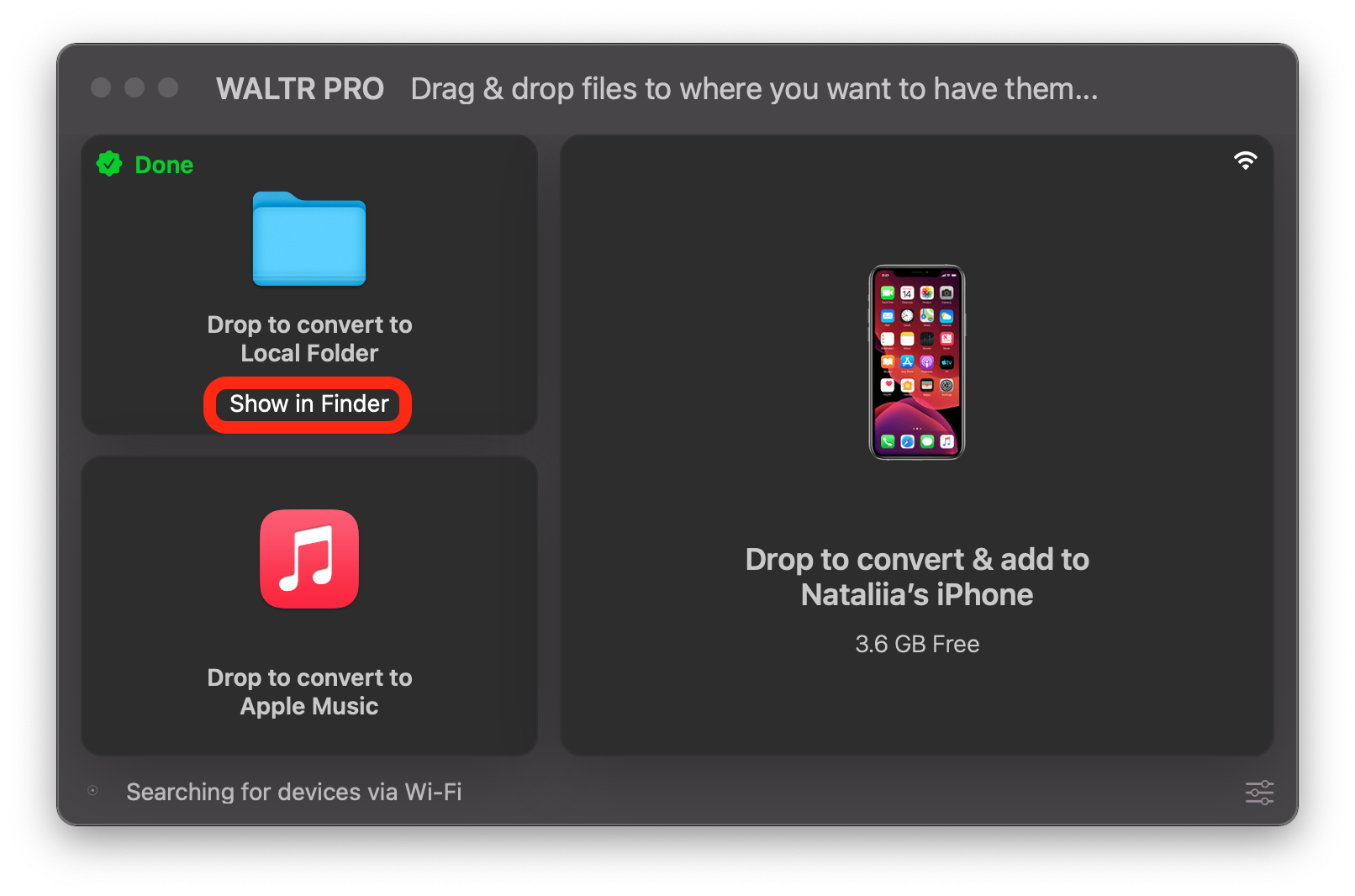
After the transfer finishes, open the destination app on your iPhone or iPad and play the video. Check sound and subtitles before deleting the original file from your computer.
This is the part WALTR PRO handles better than generic WebM to MP4 tools. Online converters give you a download. WALTR PRO solves the Apple-device delivery problem.
Convert WebM to MP4 free with HandBrake
HandBrake is the best free local converter for most people. It is open-source, runs on Mac, Windows, and Linux, and converts supported video sources to MP4, MKV, or WebM. HandBrake’s own docs also make one thing clear: it always converts video, and it does not bypass copy protection or DRM.
Use HandBrake when you want privacy, batch conversion, or more control over quality than browser tools give you.
HandBrake steps for MP4 output
HandBrake is great for large files and private files because the video stays on your computer. It also gives you better control over file size. The tradeoff is the settings screen. If you only convert one short clip every few months, HandBrake may feel like too much app for the job.
- Download HandBrake from the official HandBrake site.
- Open HandBrake and choose your WebM file as the source.
- Set Format to MP4.
- Choose a preset close to your target device. For iPhone/iPad playback, pick a general H.264 preset if you want maximum compatibility.
- In the Video tab, use H.264 for the safest iPhone playback. Use H.265/HEVC only if you know the target device supports it.
- In the Audio tab, use AAC when possible.
- Check subtitles. If you need subtitles to appear everywhere, consider burning them in. Soft subtitles can behave differently across apps.
- Start the encode.
- Test the finished MP4 before deleting the original WebM.
Convert WebM to MP4 with VLC
VLC is better known as a player, but it can also convert video files. VideoLAN describes VLC as a free, open-source, cross-platform multimedia player that plays most multimedia files, including WebM and H.264 content.
Use VLC when you already have it installed and need a quick WebM to MP4 conversion. Use HandBrake when quality, batch work, or subtitles matter more.
VLC steps for MP4 output
VLC is useful, but its conversion workflow is not as polished as its player. If the output has no audio or your iPhone still refuses it, rerun the conversion with H.264 video and AAC audio, or switch to HandBrake.
- Open VLC on Mac or Windows.
- Use the Convert/Save option.
- Add your WebM file.
- Choose an MP4 profile. Pick one with H.264 video when you need iPhone compatibility.
- Choose a save location and filename ending in .mp4.
- Start the conversion.
- Play the finished file and check audio, video, and subtitles.
Use an online converter only for small, non-private files
Online converters win the SERP because they give people an upload box immediately. That is convenient. It is not always smart.
Use online converters when this checklist passes
The file is small.
The video is not private.
You do not need batch control.
You can tolerate compression.
You only need a quick download.
Avoid online converters when this checklist matches
Many online tools work fine for throwaway clips. For anything valuable, local conversion is safer. A converter should not make you upload a private file if a free desktop app can do the same job offline.
The file contains client footage, family video, medical content, financial info, or anything private.
The file is large enough to hit free limits or slow uploads.
You need exact bitrate, subtitles, audio tracks, or batch settings.
You cannot risk watermarks, account gates, or export limits.
FFmpeg WebM to MP4 for power users
FFmpeg is the cleanest option if you are comfortable with Terminal. It is also the least friendly option for normal users.
Use FFmpeg when you need exact output settings or repeatable batch conversion. Use HandBrake when you want the same control without memorizing flags.
Tip
A common iPhone-safe command pattern is: ffmpeg -i input.webm -c:v libx264 -crf 23 -c:a aac -b:a 128k output.mp4.
That command converts the video to H.264, converts the audio to AAC, and saves an MP4 file. You can adjust quality, bitrate, scaling, frame rate, subtitles, and batch scripts. That control is the point.
Use FFmpeg if you already know what CRF, bitrate, and codec flags mean. If those words make your eyes glaze over, use HandBrake or WALTR PRO.
WebM to MP4 quality settings that matter
WebM to MP4 conversion can preserve visible quality, but “no quality loss” is not a safe promise. Most conversions re-encode the video. Re-encoding can change quality, file size, bitrate, audio tracks, subtitle behavior, and playback compatibility.
Keep the original WebM until the finished MP4 plays with sound and subtitles on the target device.
Warning
Use these rules:
If your converted MP4 is huge, lower the quality setting or use a smaller resolution. If it looks blurry, raise the quality setting or avoid aggressive compression. If the video plays but has no sound, convert the audio track to AAC.
- Choose H.264 for widest iPhone, iPad, Mac, TV, and social-app support.
- Choose HEVC/H.265 for smaller files when the target device supports it.
- Use AAC audio for Apple playback.
- Keep the original resolution unless you need a smaller file.
- Test subtitles before sending the file to someone else.
- Keep the original WebM until you confirm the converted MP4 works.
Troubleshooting: why the converted MP4 still will not play
An MP4 extension does not prove Apple compatibility. If your converted MP4 still fails on iPhone or iPad, check these problems.
The video codec is not Apple-friendly
The MP4 may still contain a video stream your target app cannot decode. Reconvert with H.264 first. Use HEVC only when you know the device supports it.
The audio codec is wrong
Some converters copy the original audio track instead of changing it. If the WebM used Opus or Vorbis audio, convert the audio to AAC.
Subtitles did not survive the conversion
Subtitles can disappear or fail to display after conversion. For maximum compatibility, burn in subtitles when you need them visible everywhere. If you need selectable subtitles, test the target app before sharing the file.
The file is damaged
If the original WebM is damaged, conversion may fail or create a broken MP4. Try playing the original in VLC. If VLC cannot play it, the source file may be the problem.
The file is DRM-protected
HandBrake does not bypass DRM or copy protection. Do not waste time trying to convert protected commercial content with normal converter tools.
Should you convert WebM or use a WebM player on iPhone?
If you only want to watch the file once, a third-party iPhone player that supports WebM may be enough. Apple’s support guidance says unsupported formats may need different software or another app. That route avoids conversion.
But a player app does not create an MP4. It also does not make the file work in Photos, iMovie, Apple TV, Messages previews, or other apps that expect Apple-friendly video.
Convert the file when you need broader compatibility. Use a WebM player when you only need playback inside that player.
FAQ
Can iPhone play WebM files?
Native iPhone apps are not the safest place for WebM files. The format often uses VP8, VP9, AV1, Opus, or Vorbis, and Apple apps may not support that combination. Convert to an MP4 with H.264 video and AAC audio, transfer it with WALTR PRO, or use a third-party player that supports WebM.
Is WebM or MP4 better?
WebM is good for web video and browser playback. The MP4 container is better for broad device compatibility, especially on iPhone, iPad, QuickTime, iMovie, TVs, and social apps. If you need the file to play almost anywhere, MP4 is the safer choice.
Can HandBrake convert WebM to MP4?
Yes. HandBrake can convert supported video sources to MP4, MKV, or WebM on Mac, Windows, and Linux. Use H.264 video and AAC audio when you want safer iPhone playback.
Can VLC convert WebM to MP4?
Yes. VLC can convert WebM files through its Convert/Save workflow. It is best for quick one-off jobs. If the converted file has no audio or will not play on iPhone, use H.264 video and AAC audio, or use HandBrake for more control.
Is a free online WebM to MP4 converter safe?
It depends on the file. Online converters are fine for small, non-private clips. Avoid them for private, client, family, legal, medical, or sensitive videos because you have to upload the file to someone else’s server.
Will converting WebM to MP4 reduce quality?
It can. Most conversion tools re-encode video, and re-encoding can change quality, bitrate, file size, audio, or subtitles. Use local tools and moderate quality settings when the video matters.
Why did my MP4 lose audio after conversion?
The converter may have copied an audio format the target app cannot play. Reconvert the file and set the audio to AAC. For iPhone and iPad, AAC inside MP4 is the safer choice.
Do I need to convert WebM before sending it to iPhone?
Not always. WALTR PRO supports WEBM and can handle the Apple-device transfer workflow without iTunes. If you need an actual converted file for another app, export it first with HandBrake, VLC, FFmpeg, or a local-folder workflow.
Final recommendation
If you need a plain MP4 file, use HandBrake for the best free local workflow. Use VLC for a quick one-off conversion. Use online converters only for small, non-private files.
If the real problem is “I have a WebM file and I want it on my iPhone,” use WALTR PRO. Drag the file in, choose the destination, and skip iTunes entirely. Start with the free trial and test it with your own video before you commit. If you use more than one Softorino app, the Universal License can cover the broader toolkit.

WALTR PRO
Convert & Push Any File into Any Apple Device
